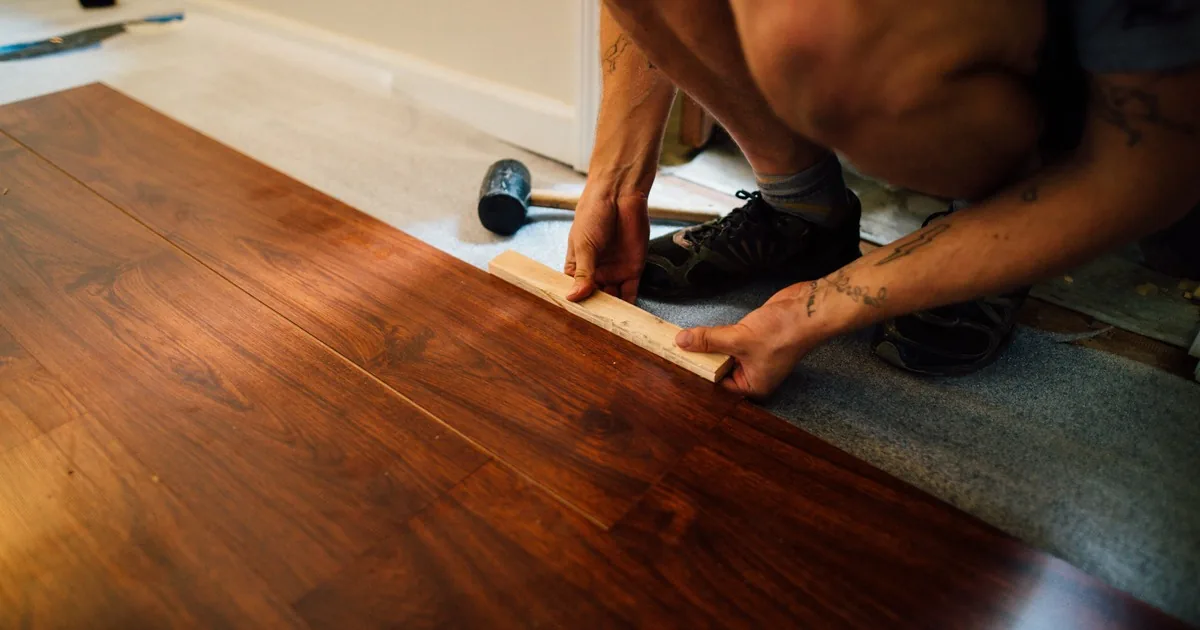
A homeowner calls after finding water around the refrigerator. They dried the visible puddle, but the planks now feel raised near the kitchen doorway. The office has a flooring request, yet it may still have an active water event, a contaminated-water concern, or moisture that reached the room below.
Good intake separates those paths before anyone offers a repair appointment. Ask whether the source has stopped, what kind of floor is visible, where the wet area ends, when it was discovered, and what has already been removed or dried. Record what the caller sees. Leave moisture readings, contamination decisions, and repairability to the people who inspect the property.
Route the water event before the flooring estimate
Begin with the source. Ask, “Where did the water appear to come from, and is it still flowing?” A supply line, appliance overflow, roof leak, backed-up drain, exterior flood, and unknown source create different routing needs. Preserve uncertainty. If the caller says, “We think it came from the dishwasher,” write exactly that unless a plumber or restoration professional has confirmed it.
Find out who stopped the water and when. Note whether a plumber, appliance technician, roofer, utility, fire department, or restoration company has already visited. If the source remains active, route that problem under company policy before treating the call as a normal floor estimate.
Safety details belong near the top of the record. Ask whether there is standing water near outlets, cords, appliances, an electrical panel, or powered equipment. Ask whether anyone has reported sewage, drain backup, outdoor floodwater, fuel, chemicals, or an unsafe floor surface. The CDC's disaster cleanup guidance warns about electrical equipment near water and says floodwater may contain sewage and other waste. A flooring receptionist should not tell someone to cross water to reach a breaker or inspect a soft area.
If sewage or contaminated water may be involved, use the company's emergency or restoration route. The EPA's residential mold and moisture guide recommends experienced professional help when water or mold damage was caused by sewage or other contaminated water. A later flooring repair may still be needed, but it should not outrun source control and safe cleanup.
Name the visible floor without guessing the assembly
Ask what the caller sees underfoot: solid hardwood, engineered wood, laminate, luxury vinyl plank, sheet vinyl, tile, carpet, or something unknown. Accept “wood-look planks” as a valid answer. A photo can clarify the surface appearance, but it cannot prove the full assembly beneath it.
Then ask how the material is installed if the caller knows. Is it nailed, glued, floating, or uncertain? Was it installed over plywood, oriented strand board, concrete, an older floor, or an unknown base? Do not force an answer. “Unknown subfloor” is useful because it tells the estimator what must be confirmed.
Material transitions matter. Record every doorway, threshold, cabinet toe kick, island, wall, stair, closet, and built-in near the reported wet area. Water seen on kitchen planks may have crossed under a refrigerator, reached a tile transition, entered the cabinet base, or shown up as a ceiling stain downstairs. Those are observations for the inspection map, not proof of the final boundary.
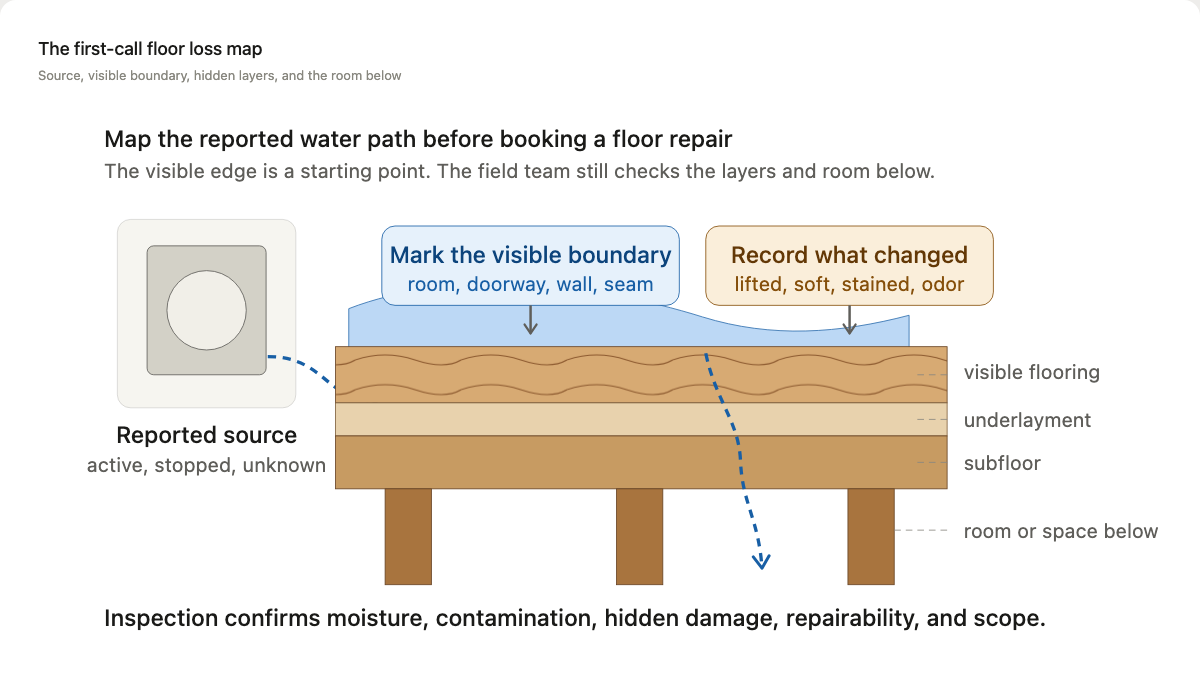
The diagram gives the office a simple sequence. Start at the reported source. Trace every visible boundary. Name the finish floor and nearby material changes. Then ask what is directly below the area. Inspection must settle the hidden conditions.
Map the affected area room by room
“About six feet” is weak unless the note says six feet from what. Anchor the description to fixed features. A useful note might say, “Water was first seen in front of the refrigerator, continued along the cabinet toe kick, and crossed the kitchen doorway about two plank widths into the hall.”
Ask the caller to describe each affected room separately. For every room, capture the visible surface, the first wet point, the farthest observed point, and any change in appearance or feel. Useful descriptions include darkened seams, raised board edges, bubbling, loose corners, staining, softness, a musty odor, damp carpet, wet baseboard, and water at a floor register.
The National Wood Flooring Association describes cupping as board edges that rise above the center after wood gains moisture. That makes “raised edges across several boards” worth recording. It does not let the receptionist declare that the floor is cupped, identify the moisture source, or promise that drying or refinishing will correct it.
Ask what lies below. An unfinished basement may expose framing and the underside of a subfloor. A finished room may show a ceiling stain or active drip. A slab-on-grade home has no lower room, but moisture and finish conditions still need field evaluation. If the caller does not know the construction, mark it unknown.
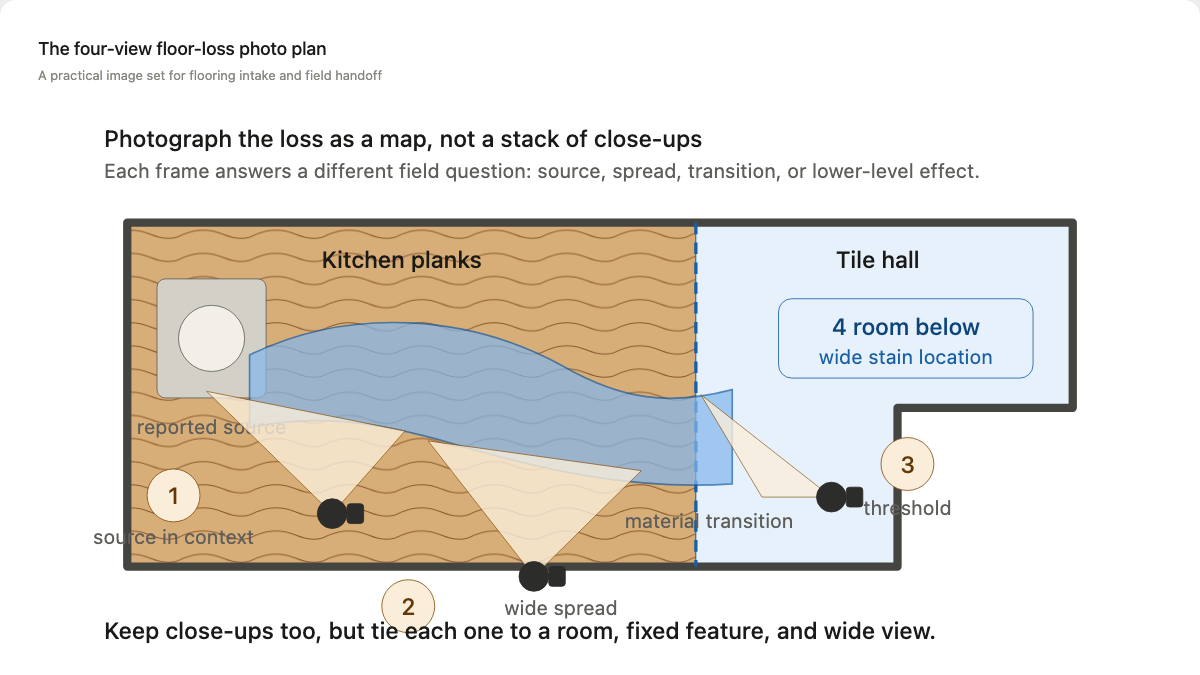
Photos should show context before detail. Request one wide image of the reported source and surrounding room, one image of each transition where the affected material changes, and close views of lifted edges, staining, gaps, or damaged trim. If there is a lower-level stain, request a wide view that shows its position in the room. Never ask the caller to lift flooring, remove trim, open a ceiling, or recreate the leak for a picture.
Build a time-stamped drying and removal history
Ask when the water was first noticed, when the source stopped, and whether anyone knows when the event began. “Discovered Tuesday at 6 a.m.; duration unknown” is better than converting a guess into a start time.
Next, record what happened after discovery. Did the customer mop or use towels? Was standing water extracted? Were fans or dehumidifiers placed? Were carpet, pad, planks, baseboard, cabinets, drywall, or insulation removed? Who did the work, and do they have drying logs, moisture readings, invoices, or photos?
EPA and CDC guidance says water-damaged areas and items should be dried within 24 to 48 hours when possible to limit mold growth. That interval is a reason to route quickly, not a guarantee that material dried inside it is safe or repairable. The office should never announce, “You caught it in time,” based on a phone timestamp.
Porous layers deserve careful notes. EPA says carpet and other absorbent materials may need to be discarded if they become moldy, and it identifies the underside of carpet and pad as a possible hidden-mold location after water damage. A flooring contractor still needs to inspect the actual material, exposure, and prior mitigation before setting scope.
If a restoration company is involved, ask whether it has released the area for reconstruction or flooring evaluation. Request the contact name and any available documentation. Do not translate “the fans are gone” into “the subfloor is dry.” Equipment removal and a flooring-ready substrate are separate facts.
Separate inspection questions from coverage questions
Callers often ask whether the floor can be saved, whether matching material is available, and whether insurance will pay. The office can explain what the estimator needs to inspect. It should not answer those questions before the evidence exists.
For repairability, record the floor product, approximate installation date, leftover cartons, manufacturer or collection name, lot information, continuous area, prior refinishing, and visible changes. Ask whether replacement material is stored on site. A matching plank in a closet may help identify the product, but color and condition can still differ from installed flooring.
For insurance, document the claim number, adjuster or property manager contact, requested estimate format, and any deadline. Keep the language neutral: “We can document our inspection and proposed flooring scope. Your carrier decides coverage under your policy.” Avoid calling work approved, covered, or reimbursable unless the authorized party has confirmed it in writing.
Damage that extends beyond flooring may require coordination. Wet cabinets, drywall, insulation, trim, electrical components, or structural movement can involve other trades. The flooring office can capture those observations and route the file. It should not bury them inside a standard plank-replacement appointment.
Give the estimator a record worth driving to
A complete intake note should include:
- reported source, whether it is active or stopped, and who addressed it;
- possible sewage, floodwater, electrical exposure, unsafe walking surface, or other urgent concern;
- visible floor material, installation details if known, subfloor or slab information, and nearby transitions;
- affected rooms with fixed reference points, visible changes, and the room or space below;
- discovery time, source-stop time, prior extraction or drying, removed materials, and available records;
- photos, access instructions, occupants, pets, parking, claim contacts, and estimate deadlines.
Read the core facts back to the caller. “You reported a refrigerator supply-line leak that a plumber stopped yesterday. Water was visible across the kitchen and two plank widths into the hall. The engineered-wood description is customer-reported, the basement ceiling below has a stain, and a restoration company removed the kitchen baseboard.” That gives the customer a chance to correct the record.
A trained receptionist or an AI receptionist can collect the same source, material, boundary, timing, and access fields after hours. The flooring professional still decides what to measure, open, dry, repair, or replace.
The strongest appointment promise is simple: the estimator will arrive knowing where the water was reported, which surfaces and rooms may be involved, what work has already happened, and which decisions still belong on site.