A homeowner calls and says, “The floor squeaks by the bed.” That sounds simple until the scheduler asks which bedroom, what covers the floor, whether the noise follows one board or a whole walking path, and what sits beneath it. The answer could be an unfinished basement. It could also be a finished living-room ceiling with recessed lights and no practical access from below.
The office does not need to identify the cause. It needs to give the estimator or repair technician a repeatable location, a useful picture of the floor assembly, and any warning signs that change who should review the job. Five focused minutes on the phone can turn “squeaky upstairs floor” into a site note a crew can use.
Start with the exact room and the movement that makes the sound
Ask for the service address and then pin the complaint to a named room. “Upstairs hallway outside the primary bedroom” is better than “second floor.” If the caller says the noise is in a bedroom, ask where it is in relation to a fixed feature: the doorway, closet, exterior wall, stair landing, or heating register.
Next, have the caller describe what reproduces it. Does one step trigger one sharp chirp? Does the sound follow a path across several feet? Does it happen when weight shifts near a wall, when someone crosses a threshold, or when a door closes? Record the caller’s words. “Three steps from the bedroom door, beside the dresser” gives the technician a place to begin. “Floor squeaks everywhere” does not.
Do not ask the caller to jump hard, move a heavy bed, lift carpet, remove a register, or crawl into a tight space. A normal walk across the affected area is enough for intake. If the sound does not repeat during the call, note when the customer usually hears it, such as early morning, during humid weather, or when two people cross the room.
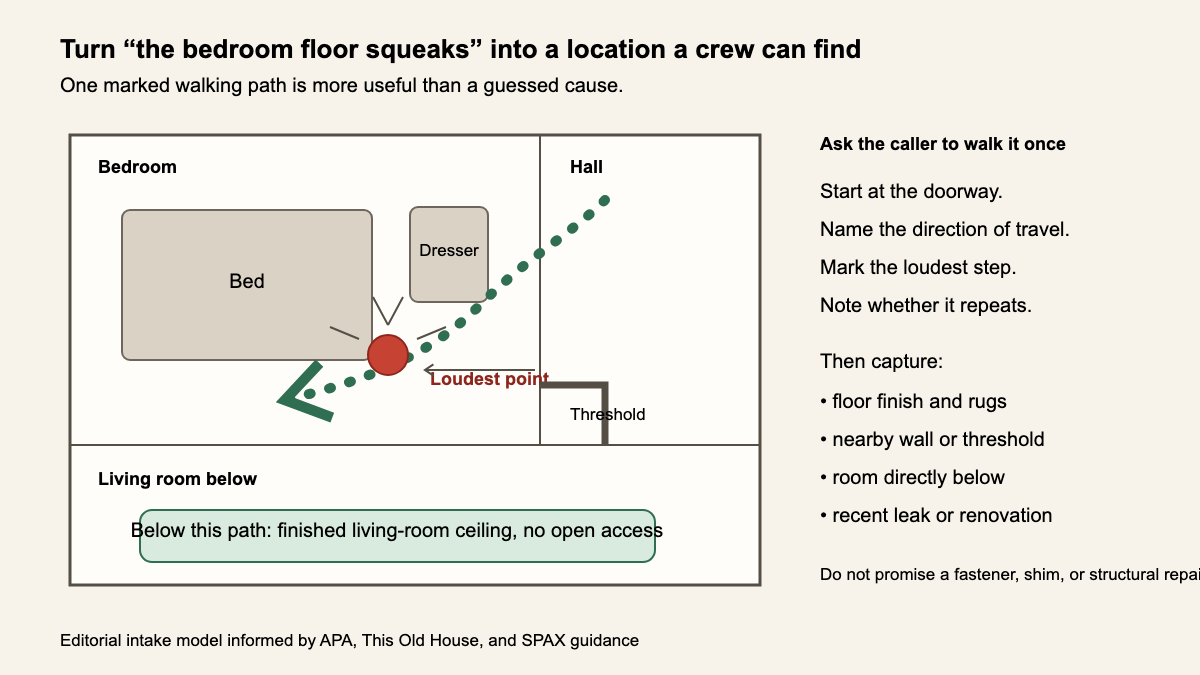
A useful location note can read like this:
“Primary bedroom on the second floor. The sound starts at the doorway and is loudest on the third step toward the bed, about two feet from the dresser. It repeats during a normal walk. The living room is directly below, and its ceiling is finished.”
That note gives the field technician a starting line, a direction of travel, a likely inspection area, and an access constraint.
Name the visible floor before discussing a repair
Ask what the customer can see underfoot. Common answers include solid hardwood, engineered wood, laminate, luxury vinyl plank, sheet vinyl, tile, and wall-to-wall carpet. If the caller does not know, accept a plain description and request a photo. A receptionist should not turn “wood-look planks” into a material diagnosis.
The distinction matters because the finished surface affects what a technician can observe and how carefully the visit must be planned. A noise beneath carpet presents a different access question than a noise at a visible hardwood seam. Tile raises concerns about brittle finishes. A floating floor may produce sounds at joints or transitions that a caller hears as a subfloor squeak. Those are inspection possibilities, not conclusions for the phone script.
The APA technical note on floor squeaks lists many possible noise locations: between subfloor and underlayment, subfloor and joists, joists and bridging, nails and panels, tongue-and-groove joints, partitions, hangers, and even ductwork. APA’s practical point is the one the office should adopt: each squeak requires careful inspection to identify its cause and suitable correction.
Ask whether the floor is original or recently installed. Capture the approximate installation date if the customer knows it, plus any recent refinishing, room remodel, wall change, plumbing leak, or HVAC work near the noisy area. A squeak that appeared after a project deserves that history in the work order.
Ask what lies directly below the noise
Access below can change the inspection plan before anyone drives to the property. Ask, “What room or space is directly under the noisy spot?” Follow with a specific choice if needed: unfinished basement, crawl space, garage, finished room, or unknown.
If it is a basement, ask whether the ceiling structure is open or covered with drywall, plaster, a suspended ceiling, or insulation. If it is a crawl space, record whether the customer already knows about standing water, very low clearance, stored materials, pests, or a locked access hatch. The office should never tell a caller to enter the space for a better answer.
This Old House’s squeaky-floor guide describes one common inspection method when the framing is open: one person walks above while another listens and watches from below. Its guide also separates methods for hardwood, carpet, stairs, and below-floor access. SPAX’s manufacturer guidance likewise distinguishes work approached from above and below. Neither source means that one repair fits every floor. They show why access belongs in the first call record.
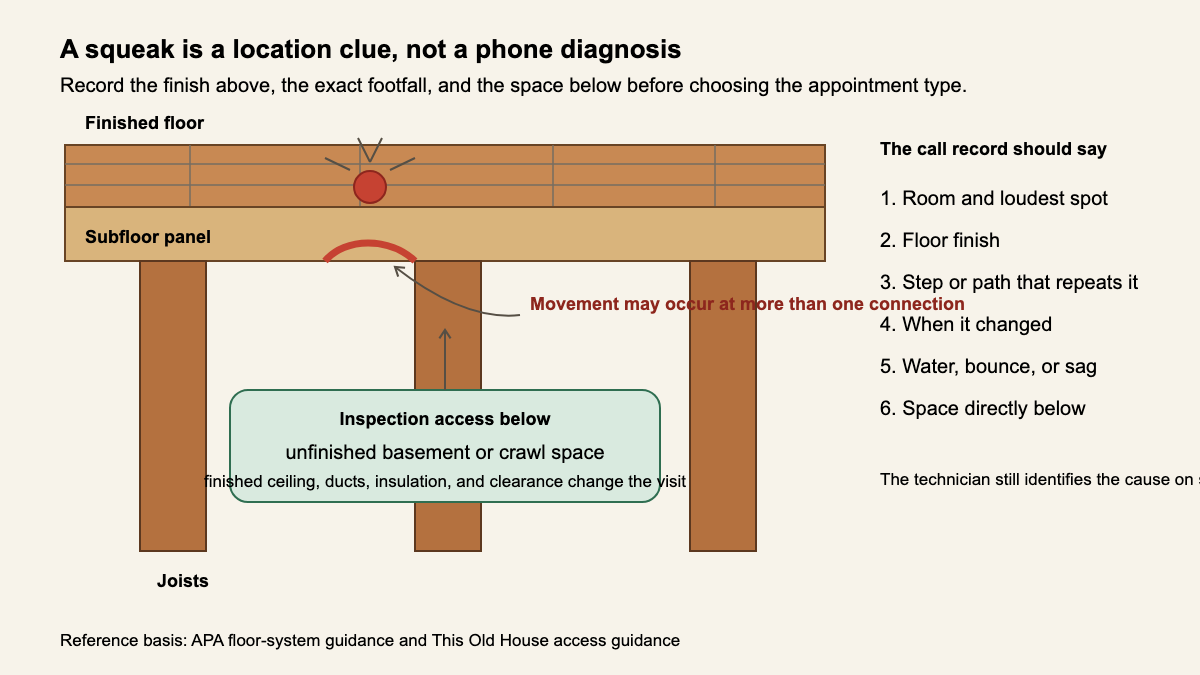
When the ceiling below is finished, say so plainly in the appointment note. Do not promise that the repair can be completed from above without visible marks, or that the ceiling will remain untouched. The estimator needs to see the finish, locate the sound, understand the assembly, and discuss options with the customer.
Separate an isolated noise from movement, moisture, and damage
A repeatable squeak in one stable area may fit a standard flooring inspection under company policy. Other descriptions need a different lane. Ask whether the customer also notices softness, bounce, sagging, a new slope, cracked tile, gaps that recently opened, staining, a musty odor, or visible water damage.
Those details do not prove a structural or moisture problem. They tell the office that the request may extend beyond noise. This Old House recommends professional review when a squeak appears with sagging or bouncy flooring, visible water damage, pest evidence, specialty materials, or a failed DIY repair. A customer who reports an uneven or moving floor may also need the questions in the uneven-floor inspection intake guide.
Use a separate urgent-review path if the caller reports an active leak, a sudden floor change after impact or construction, a section that feels unsafe to walk on, or signs of fire or electrical damage. The office can advise the caller to avoid an area that feels unsafe and route the call according to company emergency policy. It should not declare a joist failure or tell the homeowner how to brace the floor.
Previous repair attempts belong in the record too. Ask whether anyone has already driven screws, added shims, applied powder, lifted flooring, opened the ceiling, or replaced part of the subfloor. Request photos of visible work. A technician needs to know where hidden fasteners may be and which surfaces have already been altered.
Build a dispatch note that a flooring technician can use
A complete squeaky-floor intake should capture:
- the exact room, fixed reference point, and repeatable walking path
- the visible floor finish, approximate age, and any recent installation or remodeling
- whether the sound is one point, one seam, a threshold, a stair, or a broader area
- what room or space lies below and whether its ceiling or framing is open
- any bounce, sag, softness, staining, odor, pest evidence, leak history, or sudden change
- previous repair attempts, photos available, pets, parking, and access instructions
End by setting the right expectation: “We’ve recorded where the sound occurs, the floor surface, what is below it, and the other conditions you mentioned. The technician will inspect the area before recommending a repair.”
Do not quote a permanent fix from this call unless the company has a tightly defined service with written scope and exclusions. Even then, separate the inspection or diagnostic charge from any repair authorization. A squeak can involve more than one interface, and opening the appointment with a promised fastener or shim puts the field technician in a bad position.
Consistent intake also matters when the installer is driving, working in a customer’s home, or unable to answer. A trained receptionist or an AI receptionist can collect the same room, surface, sound, access, and warning-sign fields after hours, then pass the record to the flooring team. The useful output is a dispatch note that tells the technician exactly where to take the first normal step.