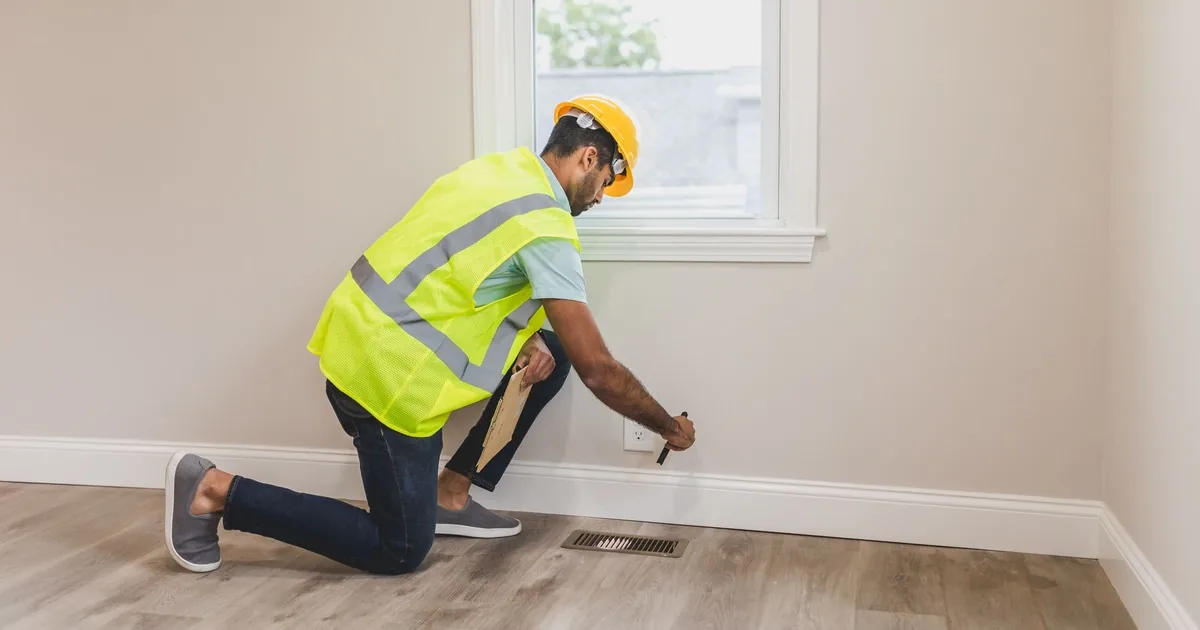
A homeowner calls from the hallway and says, “The floor drops toward the bedroom. I think the foundation is sinking.” The office cannot see the floor, and the caller has already supplied a diagnosis. What the technician needs is a clean observation record.
A useful uneven-floor call captures the affected rooms, the way the floor feels, the direction and extent of the change, when it was first noticed, nearby doors or cracks, moisture, prior work, and access below. Those details help route and prepare an inspection. They do not identify the failed component or select a repair.
Start with the floor. Leave the cause for the site visit.
Locate the uneven area room by room
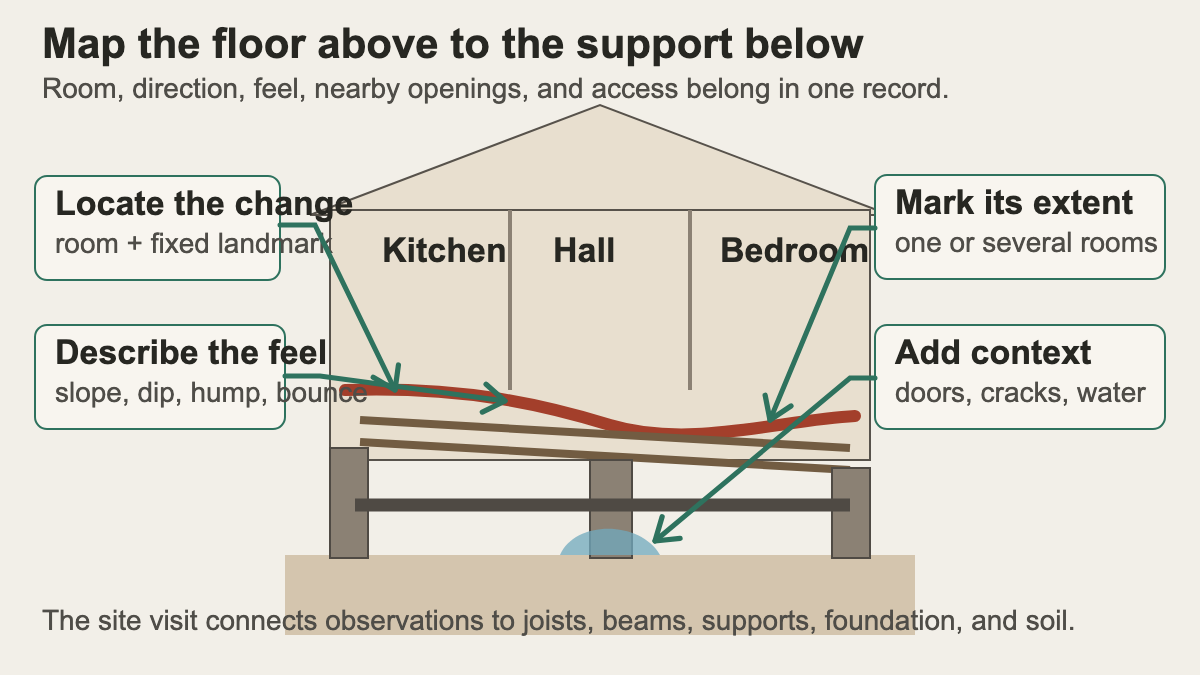
“The whole house feels crooked” is a real concern but a poor dispatch note. Ask the caller to name the first place they noticed the condition and tie it to fixed features: the kitchen doorway, the hall outside the bathroom, the left side of the bedroom, or the path between the stairs and the front door.
Then map the extent. Does the change stay within one room? Does it continue through a doorway? Is there a distinct low spot near a wall, a ridge across the middle of the room, or a steady slope across several rooms? Record the caller's words. Do not change “it dips beside the refrigerator” into “settlement at the kitchen foundation wall.”
The distinction between level and flat helps here. InterNACHI's structural framing guidance treats a floor that slopes as different from one with a local hump or depression. A floor can also feel bouncy while remaining generally level. Each observation points the inspector toward a different part of the site record, but none is a diagnosis by itself.
Floor covering matters because the caller may be describing a surface problem. Ask whether the area is hardwood, tile, laminate, carpet, vinyl, or exposed concrete. Buckled boards after a leak, a loose tile, a raised transition strip, and a long slope across several rooms should not be collapsed into the same note.
If the customer can send photos safely, ask for a wide image showing the room and doorway. A close photo of one board rarely shows direction or extent. The office should never ask someone to pull up flooring, crawl below the house, move a heavy appliance, or step onto an area that feels unstable.
Describe what the floor does underfoot
Use ordinary language. Ask the caller which description comes closest: a steady slope, a sag or dip, a hump, a soft or bouncy area, a sharp height change, or movement that can be seen when someone walks past. More than one may apply.
The exact walking path is useful. “From the kitchen sink toward the back door” gives the inspector a line to check. So does “a soft rectangle between two floor vents.” Record whether the condition is along an exterior wall, around a stair opening, beside a fireplace, near a bathroom, or over a basement beam the caller already knows about.
Ask what first drew attention to it. A chair may rock. A door may swing open. A rolling object may drift toward one wall. Tile may crack along a line. Those are observations, not measuring methods. Do not promise that a ball, phone level, or homeowner measurement can establish structural movement.
A building carries loads through floor surfaces and framing toward beams, posts, foundation, and soil. InterNACHI describes this as the load path. Groundworks' uneven-floor overview also separates possible floor-surface damage from joist, crawl-space support, and foundation conditions. The range of possibilities is why a phone description should preserve evidence instead of narrowing the repair too early.
Add timing and companion changes
Ask when the caller first noticed the condition and what happened around that time. Useful answers include “after the bathroom leak in June,” “during the dry part of last summer,” “after the kitchen remodel,” or “it has looked this way since we bought the house.” Preserve the timing without turning it into cause.
Recent change matters. Has the low area spread into another room? Does the floor feel softer than it did a month ago? Did a door begin rubbing, a cabinet pull away from the wall, or a crack appear near an opening? The HUD NSPIRE foundation standard lists unlevel floors or windows and nonfunctioning doors among indicators considered during foundation inspection. HUD's criteria belong to its housing inspection program, so the office should not convert them into a universal private-home severity rule.
Water deserves its own set of questions. Ask about an active plumbing leak, staining, damp crawl-space odors, standing water, recent flooding, or roof drainage collecting near the exterior. InspectAPedia's foundation inspection framework includes drainage, site conditions, construction type, material, building history, and signs of movement in the inspection record. A report of water belongs in the notes even when the caller is certain the floor problem is unrelated.
Prior work can change access and interpretation. Ask whether anyone has installed posts or jacks, reinforced joists, leveled flooring, repaired the foundation, remodeled the room, or opened the crawl space. Request existing reports, dated photos, invoices, and warranties if the company reviews them. Do not tell the customer to adjust a post or remove a temporary support.
Age needs careful wording. An old floor may have a longstanding slope, and a new-looking room can hide older framing. InterNACHI advises inspectors to evaluate construction in the context of its period and to distinguish built-in geometry from later movement where possible. “The house is 90 years old” does not prove that a slope is harmless. “The floor changed this winter” does not prove which component moved.
Use a fixed intake sequence
A short sequence keeps the call focused when the customer walks through five rooms and remembers details out of order. The office can ask:
- Which room or walkway feels uneven, and what fixed feature is closest?
- Is it a steady slope, local dip, hump, sharp step, soft spot, or bounce?
- Does the condition cross a doorway or continue into another room?
- What floor covering is installed, and is it cracked, buckled, loose, or wet?
- When was the condition first noticed, and what has changed since then?
- Are doors or windows sticking, trim separating, tiles cracking, or wall cracks appearing nearby?
- Has there been a leak, flood, drainage problem, excavation, renovation, or heavy equipment near the house?
- Is the area above a basement, crawl space, slab, garage, or finished lower level?
- Has a contractor installed supports, repaired framing, or leveled the floor before?
- Are the room, basement, crawl-space opening, and corresponding exterior wall accessible for the visit?
- Is there an immediate condition such as collapse, falling material, damaged utilities, or a floor that feels unsafe to cross?
The last question belongs in every version of the intake. The receptionist should follow the company's written safety procedure when the caller reports an active failure or immediate hazard. Phone staff should not improvise shoring advice or tell someone to enter a damaged crawl space for a better photo.
Route the call without choosing a cause
A standard inspection lane fits a stable report with ordinary access and no immediate hazard described. The office can book the appropriate visit, preserve the room map, and request existing records.
Prompt company review fits a recent or spreading change, new bounce or softness, active water, several sticking openings, a new crack pattern, or a prior repair that appears to have moved. A manager or designated field professional can decide timing under company policy. “Prompt review” does not mean the receptionist has confirmed structural failure.
Safety escalation is for reported collapse, falling debris, obvious active movement, damaged utilities, or another condition the company's procedure treats as dangerous. Keep the caller out of any area they already describe as unsafe. Use the company's emergency instructions and escalation contacts.
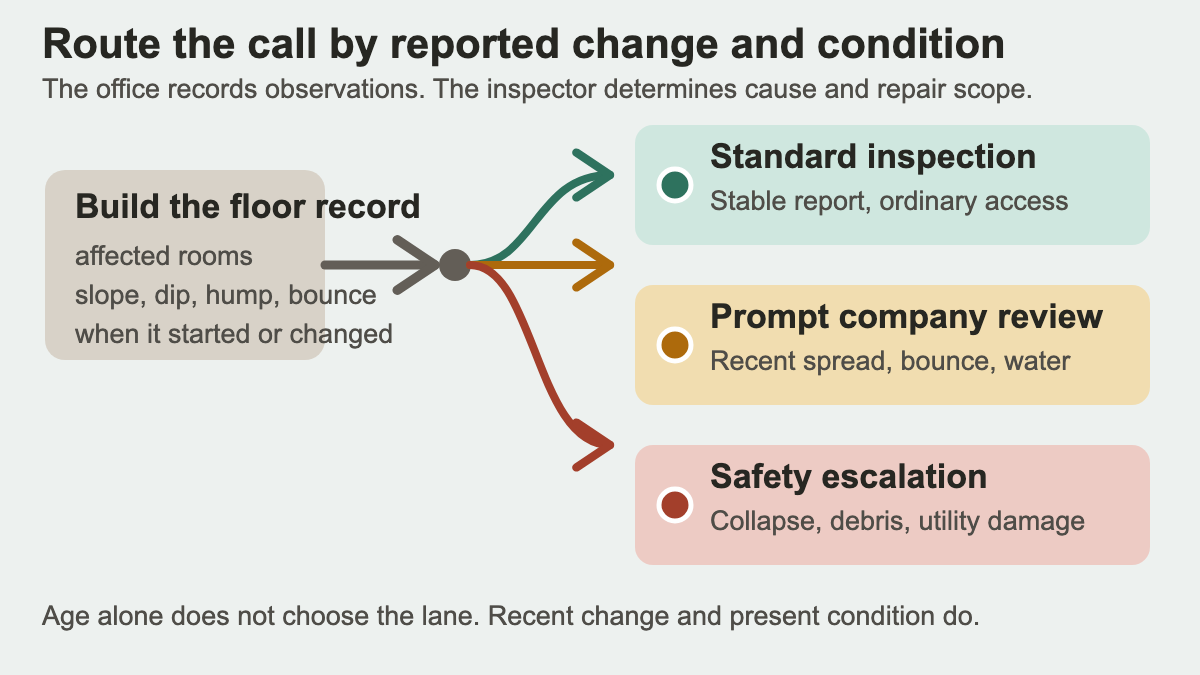
These lanes are operational. The site professional still determines whether the condition involves the finish floor, subfloor, joists, a beam, posts, crawl-space supports, a slab, foundation movement, soil, moisture, previous construction, or some combination.
Prepare access for the inspection
Confirm what sits below the affected rooms. A basement may have a finished ceiling that hides framing. A crawl-space hatch may be inside a closet. A slab may leave no underside access at all. InterNACHI notes that concealed structural areas limit what can be inspected. “No access visible” is a useful note, not a reason to ask the customer to create an opening.
Record locked gates, tenant permissions, pets, stored items, low-clearance areas, standing water, electrical hazards, and who will meet the inspector. If the company requires a clear path, state the normal preparation without asking the customer to move structural supports or enter a hazardous area.
Link the floor record to photos and documents. Name files by room and date when possible. “Hall-facing-bedroom-2026-09-11” is easier to use than five unlabeled images in a text thread. A prior engineering report should remain attached to the job even if the customer summarizes it on the phone.
An AI receptionist can collect the same fields after hours and preserve the customer's wording. The foundation company still owns the routing rules, safety response, inspection scope, and any statement about repair.
A strong handoff reads like this: “Slope begins at the kitchen doorway and continues six steps toward the back bedroom; soft area beside the hall vent; first noticed three weeks ago; bedroom door began rubbing this week; no active leak reported; crawl-space hatch in bedroom closet; prior joist repair invoice attached; homeowner available for access.” The inspector knows where to start.