A homeowner calls and says, “There is a long crack across my driveway. Can you seal it?” The office can book a generic estimate and leave the contractor to rediscover the site. Or it can spend a few minutes mapping the surface so the estimator arrives knowing where the crack sits, whether the slab has moved, where rainwater goes, and what drives over it.
Start there. Record the crack’s location and pattern, whether its two sides are level, when the caller first noticed a change, where water collects, what vehicles use the driveway, and what limits access. Leave the repair method open until a qualified person has inspected the concrete and the support below it.
Give the estimator a map, not a diagnosis
A close photo of a crack proves that concrete is cracked. It may hide almost everything the estimator needs. The frame usually leaves out the garage threshold, adjacent panels, control joints, downspouts, low spots, driveway apron, retaining walls, and the route a truck would use to reach the work.
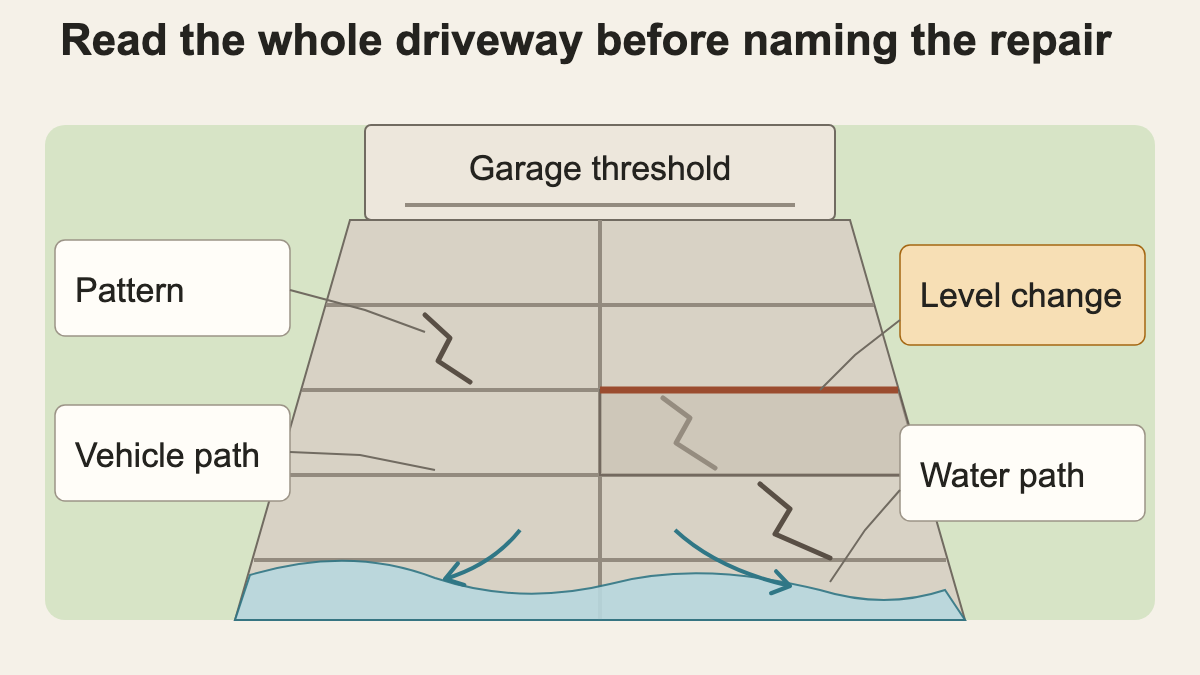
Ask the caller to describe the driveway as a site. Is the crack near the garage, at the street apron, beside a downspout, or through the middle of a parking panel? Does it follow an existing joint or cross one? Is there one line, a branching pattern, a broken corner, or damage repeated across multiple panels?
The American Concrete Institute’s note on cracks in repairs explains that the significance of cracking can depend on its extent, depth, and width, as well as the repair’s intended function. That is a field assessment, not a phone diagnosis. Reception should preserve what the caller sees and where it sits.
A useful first note sounds like this: “Diagonal crack crosses the second panel from the garage, starts near the left edge, and ends at the center joint. Caller reports a second shorter crack in the next panel.” That gives the estimator a place to begin.
Separate crack pattern from slab movement
The first follow-up should be simple: “When you run a shoe across the crack, do the two sides feel level?” Do not ask the caller to kneel in traffic, handle loose concrete, or use a tool near a hazard. A safe visual observation is enough for intake.
Record any visible height difference in plain language. “Garage side appears higher” is useful. “The base has failed” is a conclusion nobody should make from the front desk. Also ask whether the difference seems new, has changed since the last winter or rainy season, or has stayed the same for years. If the caller has dated photos, attach them.
Movement changes the conversation because some repair procedures are meant for cracks that have stabilized. ACI’s field guide to gravity-feed resin repair, for example, describes that procedure for nonmoving cracks and says the cause of the damage and objective of the repair should be understood first. The guide is not a driveway prescription. It is a good reason to avoid promising “we can fill that” before the site visit.
If the caller also reports sticking doors, foundation-wall cracks, interior floor movement, or a gap where the driveway meets the house, route the building concerns separately. The guide to concrete slab settlement versus foundation repair inquiries helps keep flatwork and building-structure questions in the right lanes. A driveway estimator should not become the office’s accidental structural engineer.
Put drainage and traffic on the same sketch
Ask what happens during rain. Does water run toward the garage, collect along one panel edge, leave soil washed out beside the slab, or disappear into a crack? Where do nearby downspouts discharge? Does an irrigation head spray the driveway edge? A dry-day photograph may show staining or debris at the low point, but let the estimator interpret it.
The Guide to Cement-Based Integrated Pavement Solutions says existing pavement conditions should be assessed before repair or restoration is selected. It also calls out drainage problems and loss of subgrade support as conditions that need attention. Residential driveways are not highways, yet the intake lesson transfers cleanly: visible surface damage and water management belong in the same site record.
Then ask what the driveway carries. Two passenger cars present a different access and use picture than a delivery van, work trailer, recreational vehicle, dumpster, or regularly parked equipment. Capture where the heavier vehicle travels or sits. Do not calculate load capacity over the phone. The estimator needs the use pattern so the proposed scope matches the site.
Joints deserve their own note. The American Cement Association’s concrete placement and finishing guidance explains that contraction joints are used to manage random cracking. Ask whether the line follows a straight formed or saw-cut joint, breaks away from it, or crosses the panel at an angle. The answer helps the estimator read the layout. It does not tell reception whether the condition is acceptable.
Ask for photos that preserve context
Request a short photo set after the call. The first image should show the whole driveway from safe ground. The next should show the affected panel with the garage, curb, joint, or another fixed landmark in frame. Then capture a close view of the crack, a side view if one slab edge appears higher, and the area where water collects or leaves the property.
A ruler can provide scale if the caller can place it safely without entering traffic or touching unstable concrete. A coin is a weaker reference because perspective can make it misleading. Never ask someone to insert a screwdriver, pour water into a crack, lift a loose piece, crawl under an adjacent structure, or stand in the street for a better angle.
The work order should collect:
- property address, caller contact, owner or authorized decision-maker, and any deadline tied to a sale, tenant, or other scheduled work;
- driveway material, approximate age if known, panel layout, affected location, crack pattern, and whether either side appears higher;
- date first noticed, reported change over time, prior sealing, patching, lifting, resurfacing, drainage work, or panel replacement;
- garage and street access, gates, slopes, nearby walls, utilities, landscaping, parked vehicles, and any area that must stay open;
- rain behavior, standing water, downspout and irrigation locations, edge washout, and the caller’s safe observations after a storm;
- daily vehicle use, trailers or heavy equipment, planned deliveries, and any timing constraint on moving vehicles;
- wide, panel-level, close, side-angle, drainage, and access photos, plus previous proposals or repair records.
Ask what outcome the caller wants. Some people want to stop water entry. Others want a safer walking surface, a cleaner appearance before selling, or an opinion on whether repairing isolated areas still makes sense. Those are different estimate conversations even when the same crack appears in the photo.
Keep the estimate open until the site is seen
Avoid naming a method during intake. Crack sealing, routing and filling, surface repair, grinding, slab lifting, partial panel replacement, drainage correction, resurfacing, and full replacement solve different problems and have different limits. A contractor may rule options in or out after inspecting movement, concrete condition, support, access, and the caller’s objective.
Price promises create the same problem. A lineal-foot figure says little if the eventual work requires cleaning, saw cutting, removing a panel, preparing the base, matching joints, controlling runoff, moving equipment, or restoring adjacent soil. Record whether the caller needs a written option comparison. Let the field visit define the quantities and exclusions.
If the caller describes a sharp height difference in a walking route, loose chunks, a blocked garage, contact with a public sidewalk, or active damage near a utility, flag it under company policy. Reception can advise the caller to keep people away from an obvious hazard while the request is reviewed. It should not declare the driveway safe.
Read back the site in one minute
Close by reading the record as the estimator will receive it:
“You are scheduled for a cracked-driveway assessment on Tuesday. The main crack crosses the second panel from the garage and branches near the center joint. The caller reports that the street side looks slightly lower, with a change noticed after the recent rainy period. Water collects along the right edge near a downspout, and a work trailer is parked on that side twice a week.
“The driveway is concrete with a two-car garage. Prior crack filler is visible in the first panel, but no lifting or panel replacement was reported. Wide, panel, close, side-angle, and drainage photos are attached. The left side is open for access after the vehicles are moved. The estimator will inspect the pattern, movement, drainage, support, and prior work before recommending a scope.”
An AI receptionist can capture the same approved fields after hours, but the concrete company should set the safety rules and make the repair decision. The best handoff leaves the estimator with a driveway map, a useful photo packet, and room to inspect what the caller could not see.