
“The slab by the house dropped” can describe a low corner of a patio, a garage floor that separated from the stem wall, or movement in the slab supporting the house. Those are different inspection scopes. The office should find out which piece of concrete the caller means before discussing repairs or appointment times.
Start with a fixed location: driveway, front walk, patio, pool deck, detached pad, garage floor, basement floor, or interior floor in a slab-on-grade home. Ask what the concrete touches and what it supports. Then capture where it is lower, when the change was noticed, whether water collects there, and whether doors, walls, floors, or utilities changed nearby. The field professional can determine cause and repair after seeing the site.
Name the concrete before naming the repair
Callers use “foundation,” “slab,” and “concrete” loosely. A sunken sidewalk panel may sit several feet from the house. A garage floor can be inside foundation walls without carrying the same loads as the wall and footing. In another building, a thickened slab edge may participate in the support system. The address and the word “slab” do not settle the question.
Ask the caller to stand somewhere safe and describe the affected area relative to fixed features. Useful phrases include “the driveway panel nearest the garage,” “the patio edge below the kitchen door,” and “the crack crosses the bedroom floor from the exterior wall.” Record the caller's wording. If photos are accepted, request one wide view that shows the building and one closer view that shows the movement against a ruler or another fixed reference.
The Concrete Network foundation repair overview separates sunken concrete such as driveways and sidewalks from larger structural foundation problems when it discusses repair categories. That distinction is useful for intake, but it does not choose the repair. A detached walk can still have buried utilities, drainage problems, or unsafe voids. A crack inside a house can come from more than foundation movement.
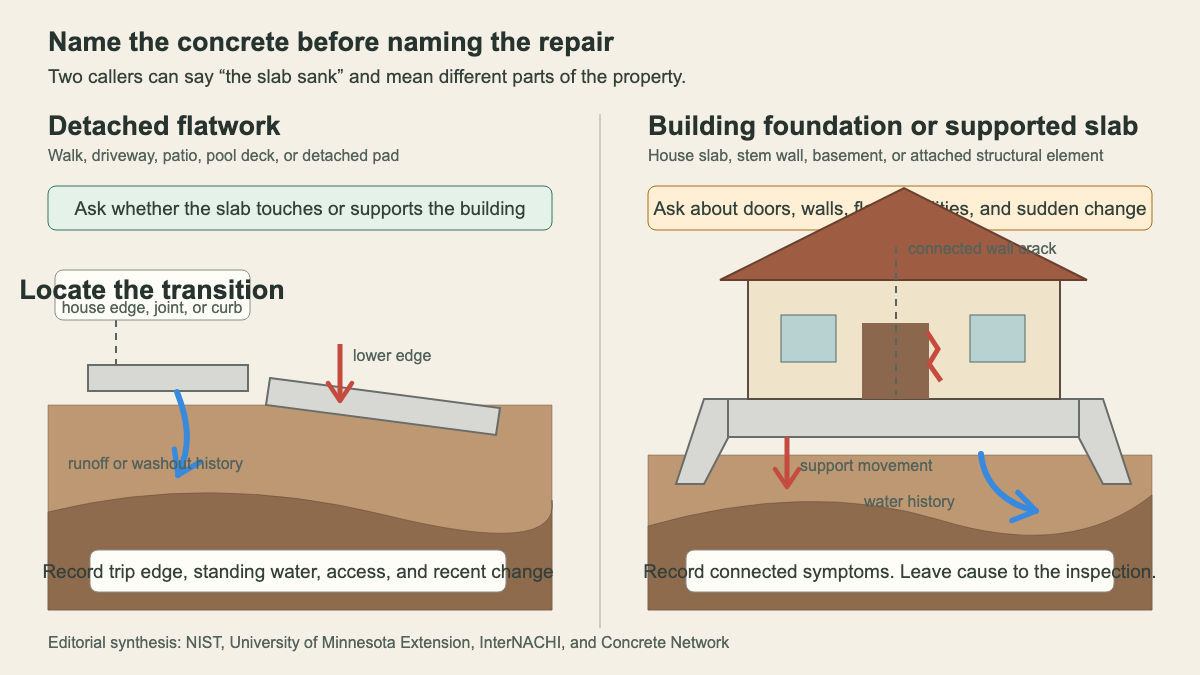
If the business provides concrete lifting and foundation repair, create separate appointment types. One might be “flatwork settlement evaluation” for a driveway, walk, or patio. Another might be “foundation evaluation” when the reported movement involves the building support or appears with changes elsewhere in the house. Companies that serve only one category should use a clear referral policy.
Map movement against fixed landmarks
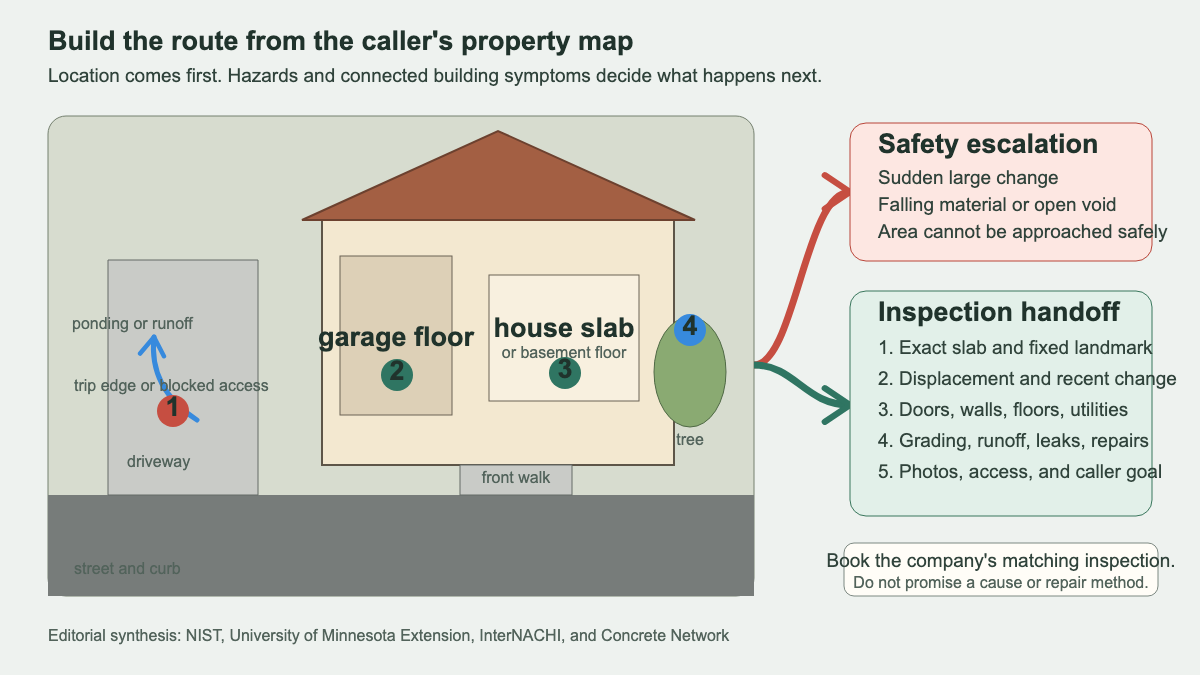
“It's uneven” leaves the field technician almost nothing to work with. Ask where the high side and low side are. Locate each against a wall, control joint, door threshold, column, stair, drain, curb, or neighboring slab panel. Note whether two surfaces that once met now sit at different heights. Ask whether the gap, crack, or pitch looks different from an older photo.
Connected symptoms matter because they can widen the inspection scope. Ask whether a nearby door started rubbing, a window became harder to operate, drywall opened at a corner, flooring separated, a column appears to have moved, or a utility line is under tension. Record observations without translating them into a diagnosis. “The back door rubs at the top latch corner” is useful. “The foundation shifted” is a conclusion the office cannot verify by phone.
The InterNACHI visual inspection guide for concrete explains that a visual review does not always reveal whether the condition has stabilized or will continue. It also describes several sources of cracking, including material properties, placement and curing, shrinkage, environmental exposure, and subgrade movement. That is why a crack shape alone should not drive routing.
An existing Answara guide covers how to describe foundation cracks by location, width, and recent change. If the main complaint is a sloping interior floor across multiple rooms, use the uneven-floor foundation call guide. This article handles the step before either one: identifying the concrete assembly and the right inspection lane.
Ask what water has been doing at the site
Water history belongs in every settlement inquiry, even when the surface is dry during the call. Ask what happens during rain, where downspouts discharge, whether soil has pulled away or washed out, and whether water ponds on the low side. Capture changes in grading, irrigation, drainage work, plumbing leaks, utility trenching, tree removal, or recent excavation.
The University of Minnesota Extension basement moisture guide treats grading, roof runoff, groundwater, subsurface drainage, condensation, and structural cracks as different paths or conditions. That is a useful warning against the office shortcut of labeling every damp crack a drainage failure. The field visit needs the history and the present observation.
Ask for dates where the caller has them. “The downspout was moved last spring, and ponding started after the first heavy rain in August” gives the inspector a sequence. “Water caused the slab to sink” skips the inspection.
Past work should also be attached to the record. Request available invoices, warranties, engineering reports, drainage plans, plumbing repair notes, or photos taken before a prior patch. Keep the source and date with each file. A filled crack can hide the original surface condition without proving that movement stopped.
Route hazards before routine scheduling
A settlement call can include a present hazard. Ask whether anyone can approach the area safely. A sharp trip edge across a public walk, an open void, falling masonry, a visibly displaced support, a damaged utility, or a sudden change described as active should follow the company's written escalation procedure.
Office staff should not tell a caller that the building is safe. They should not ask someone to crawl beneath a slab, enter a damaged area, lift flooring, touch a utility, or test a loose structural part. If the caller reports an immediate threat to people, direct the caller according to company emergency policy, which may include leaving the area and contacting emergency services or the responsible utility.
Keep the safety lane separate from the service lane. A caller may need to secure an unsafe area now and schedule a foundation professional later. The intake record should show who received the escalation, when it was sent, and what the caller was told.
Leave the cause and repair method to the inspection
Concrete can crack while the supporting soil remains stable. Soil can move while part of the concrete stays intact. Material chemistry can also damage concrete. The National Institute of Standards and Technology documents chemical reactions involving aggregate and moisture that can produce cracking over time. A photograph on a phone screen cannot separate that kind of material distress from shrinkage, subgrade movement, installation problems, or a combination.
Avoid promising slab lifting, underpinning, crack injection, drainage correction, replacement, or any other repair before the inspection. The company may later find that one method fits. It may also need elevations, soil information, leak testing, destructive access, an engineer, or a different trade.
The appointment confirmation should state what the visit includes. Tell the caller which areas need access, which records to send beforehand, who should attend, whether measurements are taken, and when written findings or a proposal are normally delivered. The foundation repair estimate intake guide can help define that scope after the correct service category has been chosen.
Read back a field-ready work order
Close the call with a plain summary:
“Maria reports that the patio panel nearest the kitchen door sits lower at the house edge and now holds water after rain. She first noticed the change in July. The kitchen door still operates normally, and she reports no interior wall or floor changes. There is a raised edge at the patio joint, so children have been kept away from that corner. She will send a wide property photo, a close view of the joint, and last year's drainage invoice. We booked a flatwork settlement evaluation. We did not identify the cause or promise a repair method.”
That handoff gives the field professional a slab, location, direction of movement, timeline, water history, connected-symptom screen, hazard note, documents, and requested outcome. It also preserves what remains unknown.
An AI receptionist can collect the same fields after hours and route them under the company's rules. The routing logic should match the services the company actually provides, with a separate path for present hazards and a human review when the caller cannot identify the affected concrete.
A good settlement work order begins with a map of the property. By the time the truck rolls, the technician should know which concrete to inspect and what changed around it, while the cause is still an open question.