A property manager calls about “one bad sidewalk square” outside a six-unit building. The lip catches shoes, a tenant uses a walker, and the city letter gives an inspection date. Before anyone discusses foam, grinding, or replacement, the office needs a clean record of the walking line and the joint that changed.
For a sinking sidewalk or raised trip-edge call, capture who controls the walkway, the exact location, the affected panels, which side is high, cracks or rocking, nearby roots and drainage, any notice or deadline, current access needs, photos, and estimator access. Leave the cause and repair method for the site visit.
Establish whose walkway it is and where the problem sits
Start with the service address, caller’s relationship to the property, and the location in plain language. “Front walk” can mean the private path from the driveway to the door, the public sidewalk along the street, or a shared route through an apartment property. Those are different jobs.
Ask the caller to describe the route with fixed landmarks:
- Is the affected joint by the driveway apron, front steps, curb ramp, mailbox, parking area, or building entrance?
- Is this a private walk, an HOA common area, a commercial entrance, or a sidewalk beside the street?
- How many panels appear affected, and is there a clear route around them?
- Has a city, insurer, property manager, or accessibility reviewer issued a notice? If so, what does it say and what date appears on it?
Do not tell the caller who is legally responsible for a public sidewalk unless your company has verified the local rule. Responsibility varies by jurisdiction and property arrangement. Ask for a copy of the notice and let the estimator confirm the scope.
The office should also ask how the walk is used. A joint on a side path to a hose bib is different from the only route to a clinic entrance. Note wheelchair, walker, stroller, delivery-cart, or high-foot-traffic use without declaring the route compliant or noncompliant.
Describe the joint without diagnosing the soil
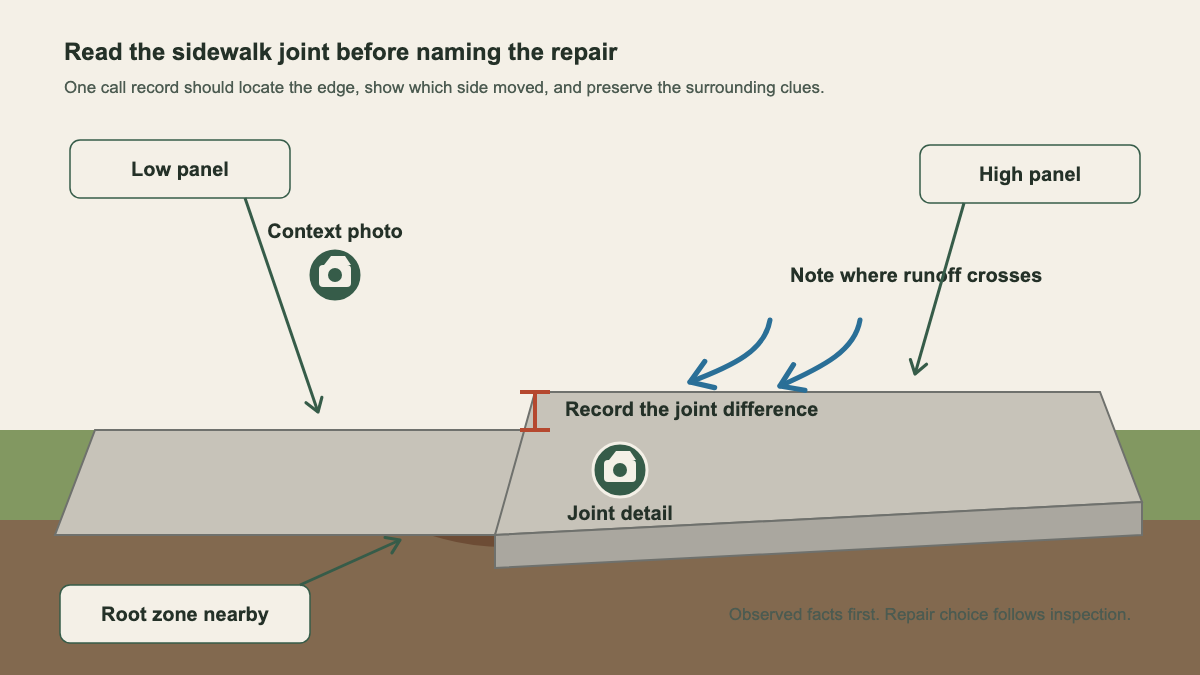
“Raised sidewalk” tells the estimator almost nothing about which slab moved. One panel may have settled. A neighboring panel may have lifted. Roots, washed soil, poor support, or several conditions may be involved, but the caller does not need to choose among them.
Ask the caller to stand where both panels are visible and report observable facts:
- Which side of the joint is higher when facing the building or street?
- Does the low panel slope, or does it look level except at the joint?
- Is either panel cracked through, broken at a corner, flaking, or previously patched?
- Does the panel rock or sound hollow under ordinary foot traffic? The caller should not jump, pry, or test it with a vehicle.
- Has the difference changed recently, or has it looked the same for years?
If the caller can place a ruler vertically against the edge without stepping into traffic or an unstable area, record the reading as an observation. Never turn that number into a remote diagnosis.
The U.S. Access Board’s guide to floor and ground surfaces explains that, on an accessible route, a change in level up to one-quarter inch may be vertical. A change from one-quarter to one-half inch must be beveled no steeper than 1:2. A larger change requires a ramp or another compliant treatment. Those thresholds provide context. Whether the federal standards cover a particular route, and whether a repair will comply, requires site-specific review.
Put roots, runoff, and recent changes in the call record
The joint is only part of the scene. Ask what sits beside and uphill from it.
A mature tree near the high side matters. So does a downspout that empties beside the low panel, irrigation overspray, a leaking service line, a washout after a storm, or soil that has opened along the slab edge. Record what the caller sees. Avoid statements such as “the tree caused it” or “water washed out the base.” Those conclusions need inspection.
Weather timing helps the estimator plan the visit. Ask whether the change appeared after heavy rain, freeze and thaw, utility work, landscaping, tree removal, or excavation. A recent utility patch deserves its own photo because the affected area may cross different materials or backfill.
Ask about previous work too. Injection holes, saw cuts, patched joints, surface grinding, or a replaced panel can change the estimate. If the caller has an invoice or before-and-after photos, attach them to the job record.
This is also where the office can prevent a wasted visit. Confirm gate width, parking, locked courtyards, pets, tenant notice requirements, business hours, and whether the estimator can inspect the walk without the caller present. For a public-facing route, ask when foot traffic is light enough to measure safely.
Ask for a photo set that shows the walking line
A close photo of a concrete lip often hides the very facts the estimator needs. Request a short, structured photo set:
First, take a wide image looking along the route so the estimator can see the entrance, curb, steps, slope, and affected joint together. Next, take one image perpendicular to the joint with both panels visible. Add a close detail of the vertical difference, cracks, patching, or edge deterioration. Finish with the surroundings: tree trunk and root zone, downspout outlet, pooling area, utility cut, or eroded soil.
Include a ruler only when the caller can place it safely. Do not ask someone to kneel in a street, enter a barricaded area, step onto a rocking slab, or approach exposed wiring or an active water leak.
Name the files by location, such as front-walk-context, front-walk-joint-2, and oak-tree-side. That small step prevents confusion when a commercial property has twelve joints and three entrances.
A similar discipline helps with calls about concrete slab settlement versus foundation repair. The office records where movement appears and routes the right field review. It does not assign the cause from a photo.
Route immediate use and accessibility concerns cleanly
Some callers need an estimate. Others need help managing a route that people must use today.
If someone has fallen or is injured, tell the caller to follow the property’s emergency procedure and contact emergency services when appropriate. Do not investigate fault over the booking line. Record the time, exact location, caller’s contact details, and who on the property team was notified.
When the edge is actively changing, a panel rocks, the route is the only accessible entrance, or a notice carries a near deadline, flag the call for prompt human review. The office can state when a manager or estimator will respond. It should not promise that a temporary cone, paint mark, mat, bevel, or patch satisfies any code or removes liability.
For covered routes, the Department of Justice ADA Standards hub is the authoritative federal starting point. Local building, public works, and property-maintenance rules may add separate requirements. Keep the notice and jurisdiction in the file so the field team knows what must be checked.
Do not choose lift, grind, or replacement on the phone
Callers often ask for a specific method because they saw a video or received another quote. Record the request, then set the boundary: the estimator will inspect the slab condition, direction of movement, support, drainage, roots, access, and route requirements before recommending work.
That boundary protects the job. Lifting a sound low panel, reducing a high edge, rebuilding a broken panel, addressing a tree conflict, and correcting drainage involve different conditions. A cracked or badly deteriorated panel may not behave like an intact slab. A city specification may also limit acceptable methods.
Grinding and cutting deserve special care. Concrete work can create respirable crystalline silica. OSHA’s construction guidance covers tasks such as cutting, sawing, grinding, and drilling concrete, along with applicable exposure controls. Reception should never promise a “quick grind” before a qualified person reviews the work and control plan.
Close by reading back the record: “I have the street-side walk at the second joint from the driveway, the panel nearer the curb appears lower, there is one diagonal crack, runoff crosses after rain, and you have a city letter dated October 28. We have four photos and the estimator can access the area from the front gate.”
Then confirm the appointment window, who will meet the estimator, notice deadlines, and where the documents are attached. An AI receptionist can capture the same fields after hours and route urgent flags to a person, but the script should keep diagnosis and method selection out of the booking call.
A useful sidewalk record is modest. It tells the field team where to stand, what changed, who uses the route, and which evidence is already waiting.