
“The inspection period ends Friday, and we need someone to look at the foundation” sounds clear until the office starts asking questions. Friday may be a contract date, an agent's target, a lender request, or the day the caller hopes to receive a repair proposal. The caller may be the buyer, while the seller controls access and someone else ordered the report that raised the concern.
A foundation repair call during a home sale needs four things before scheduling: the exact property, the caller's role, the date and who supplied it, and the document the caller expects after the visit. Capture those first. Then identify the reported condition, existing reports, access arrangements, and the person authorized to hire the company. The office can move quickly without interpreting the contract or promising a structural answer by phone.
Put the transaction clock on the work order
Ask, “What date are you working toward, and where does that date come from?” Write down the answer in the caller's own words. Do not relabel “my agent said Thursday” as a contractual deadline.
The North Carolina Real Estate Commission's due diligence guidance explains that the period in the state contract it discusses is negotiated, begins with the contract's effective date, and ends on the agreed date written into the form. Other contracts and states use different terms. A foundation company should never supply a generic inspection period or tell a caller what a clause allows.
Record every date separately:
- the contract or due diligence date reported by the caller;
- the requested specialist visit date;
- the date a written opinion, proposal, or estimate is requested;
- any repair-response date supplied by the agent or client;
- the scheduled closing date;
- any lender, insurer, engineer, or municipal deadline the caller identifies.
A six-day gap between the phone call and closing does not mean the foundation office has six days to work. Access may take a day to arrange. The field specialist may need records before the visit. A contractor proposal may follow the inspection, while an engineering opinion may require a different professional and appointment.
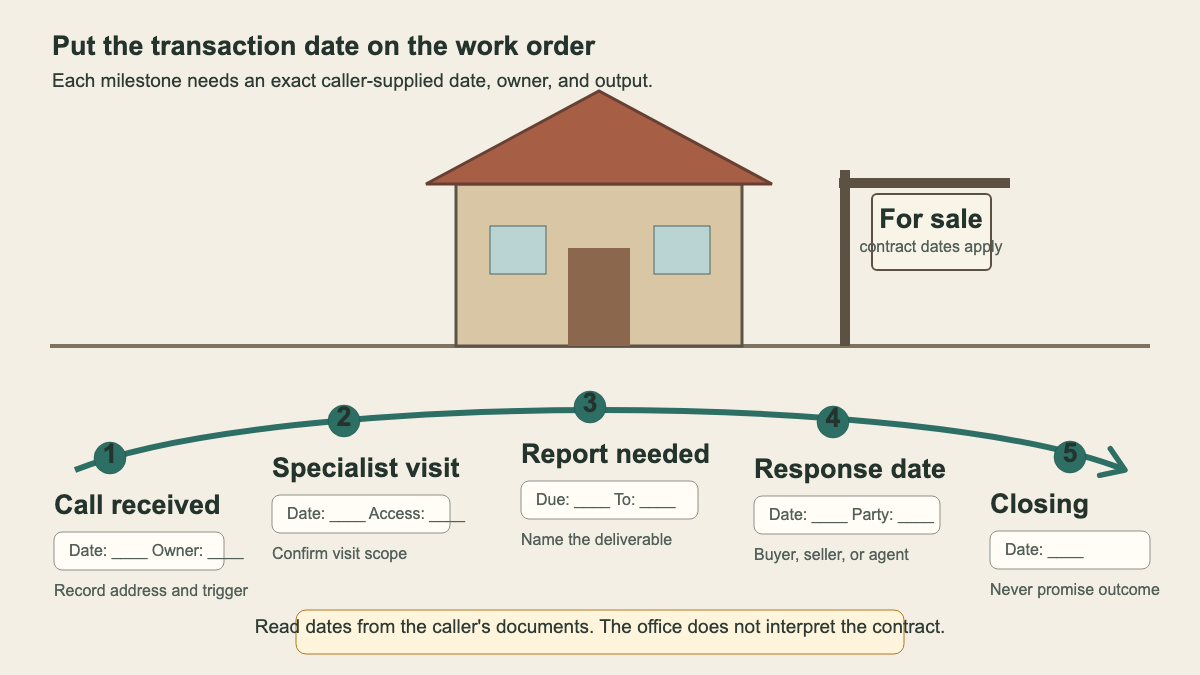
Read the dates back with their sources: “You said the contract review date is May 14, based on the purchase agreement, and you want the specialist's written findings before your agent submits a response.” That sentence exposes a missing step faster than a note marked “urgent.”
If the requested schedule cannot be met, say which service and deliverable remain possible. Perhaps the company can inspect Tuesday but cannot promise a written proposal that afternoon. The caller can take that fact to the agent or attorney who is advising on the transaction.
Identify who is calling and what they can authorize
A buyer may order a specialist inspection but have no right to enter the property alone. A seller may approve access but expect the buyer to pay. An agent may coordinate the calendar without authority to accept a repair proposal. Ask who is on the phone, who hired the company, who owns the property, who will open it, and who receives the resulting document.
Get names and direct contact details for the buyer, seller, agents, occupant, and on-site access contact when each person has a role. Confirm who can approve the appointment fee. If the caller says another party will pay, pause the booking at the company's normal authorization step.
Access deserves its own field. Record lockbox instructions only through the company's secure process. Note occupied rooms, tenants, pets, alarm instructions, crawl-space or basement access, stored belongings, low clearance, standing water, and areas the owner has placed off limits. Nobody should be told to enter a crawl space, move a heavy appliance, or remove wall material for a better phone photo.
The requested deliverable determines the appointment type. Ask the caller to choose the outcome they are seeking in plain language: an on-site contractor evaluation, a repair estimate, pricing against an engineer's plans, an independent engineering opinion, a review of prior repair records, or verification of completed work. Some companies provide several of these services. Others provide one and refer the rest.
State the real scope. A contractor's repair proposal should not be described as an independent engineering report. A general home inspection should not be presented as a repair design. The existing foundation repair estimate guide gives the office a separate way to define what a proposed scope and price will include.
Build a case file without blending the documents
Home-sale callers often say, “The foundation was inspected,” or “The repair has a lifetime warranty.” Neither statement tells the office what record exists. Ask for the document itself, who created it, the date, the property address shown on it, and any stated limits.
Keep six record types separate:
- A condition record contains dated photos, measurements, or observations about what someone saw.
- An inspection report gives findings under the inspector's stated scope.
- A repair proposal describes work being offered, assumptions, exclusions, and price.
- A repair invoice records work billed or paid for, but it may not prove present performance.
- A permit and inspection record shows what a municipality received or approved under its process.
- A warranty document defines the issuer, covered work, exclusions, duties, and transfer terms.
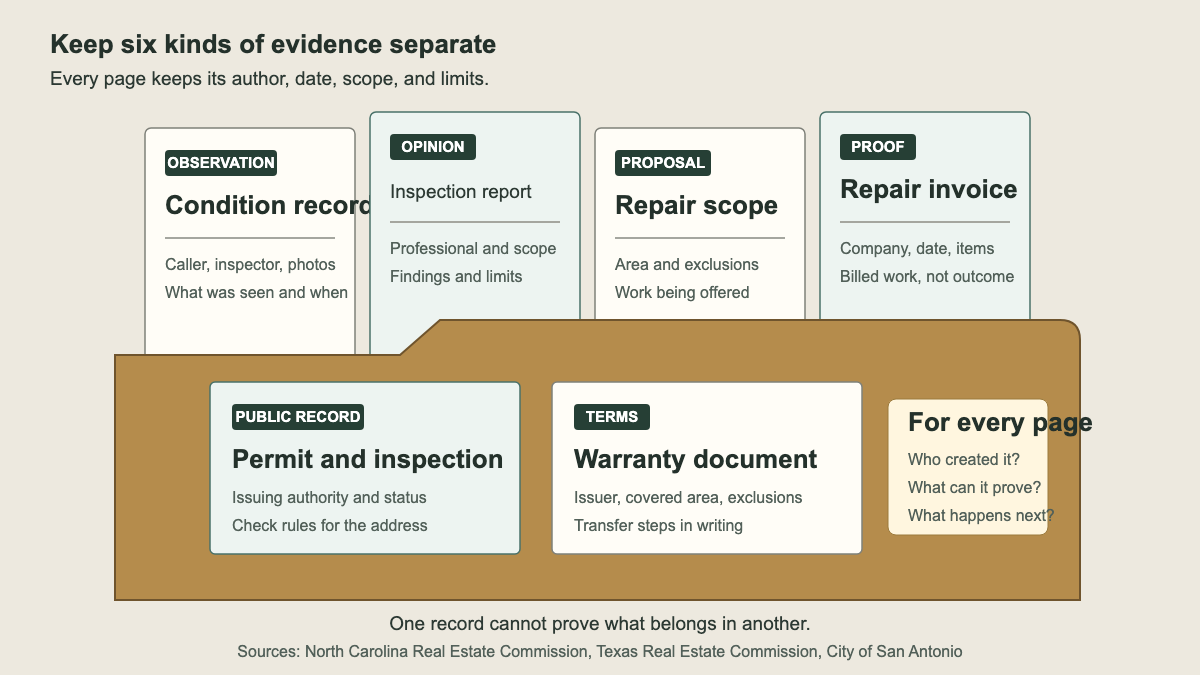
The North Carolina commission's inspection guidance treats the general inspection, specialist inspection, full report, repair request, repair invoice, and possible reinspection as distinct parts of a transaction. That distinction helps the foundation office. A photo of an invoice may support the repair history, but the office still needs the proposal or completion detail to know what was installed.
Record permission to receive and share documents. An inspection report may belong to the client who ordered it. The office should send its report or proposal only to the authorized recipients recorded for the job. If an agent sends a cropped screenshot, ask for the full relevant report through the approved intake channel. Preserve the original file name and date.
Do not translate someone else's conclusion. Write, “Page 18 states further evaluation by a foundation specialist is recommended,” then attach page 18 and the report cover that identifies the author and date. Avoid turning that note into “the home inspector found settlement.” The field specialist needs the source language.
Schedule the specialist around the reported condition
Once the transaction fields are complete, collect the physical observations. Ask where the concern appears, when it was first noticed, whether it has changed, and what prompted the specialist referral. Locate it by room, wall, exterior side, crawl-space bay, or fixed feature.
Cracks should be described by location and recent change, not diagnosed. The foundation crack call guide covers useful photo angles and location notes. If the caller reports sloping or springy floors, use the uneven-floor intake guide to map affected rooms and access below them.
Texas offers a useful example of why appointment names matter. The Texas Real Estate Commission's inspection standards define the covered real estate inspection as a limited visual survey and basic performance evaluation. Its minimum scope does not require specialized elevation equipment, destructive testing, historical-record review, repair estimates, or a determination of cause. The rules do require a written foundation opinion under that Texas inspection scope. A contractor, engineer, and licensed real estate inspector may each perform a different service, subject to local law and their actual engagement.
Ask about conditions that can change routing. Active water entry, a visibly displaced wall, a new opening, falling masonry, or an area that cannot be approached safely should follow company escalation policy. Office staff should not declare the building safe. They should tell people to stay clear of an observed hazard and contact emergency services when there is an immediate threat to people.
For a routine request, confirm how long the appointment is expected to take, which areas need access, who should attend, what records must arrive beforehand, and whether the company provides findings during the visit or later in writing.
Give the field specialist one clean handoff
Close by reading the job back as a transaction record, not as a vague emergency:
“Jordan Lee is the buyer and is hiring us for a foundation contractor evaluation at 24 Oak Street. The seller's agent, Mia Chen, will provide lockbox access. The general inspection report dated May 6 notes a crack at the west basement wall and recommends specialist review. The buyer reports a May 14 contract date and requests our written repair proposal by May 12. The basement wall is exposed except behind one storage rack. We have not promised engineering, repair design, legal interpretation, or delivery before the estimator confirms scope.”
That handoff tells the specialist where to go, what to review, who can admit them, and what the customer believes is due. It also makes the gap visible. If a written engineering opinion is the real requirement, the office can correct the appointment before a contractor arrives with the wrong scope.
An AI receptionist can collect these fields after hours and route the record under the company's policy. Dates, document permissions, professional scope, and schedule commitments still belong to the business.
The caller may remember only Friday. The work order should preserve who set Friday, what must happen before then, and which document the customer expects to hold when the clock reaches it.