A buyer calls four days before closing with a phrase copied from the listing: “transferable lifetime foundation warranty.” The seller has an invoice, the agent has a company name, and nobody has the warranty document. The buyer wants to know whether the house is covered.
The office should begin with the paperwork, not an answer about coverage. Get the property address, issuing company, original customer, repair date, contract or job number, closing date, and the document labeled warranty. Then identify the repaired area, read the transfer instructions, and confirm the current procedure with the company that issued it. A warranty is only ready for the buyer's file after the issuer acknowledges the transfer in writing.
Ask for the warranty before discussing the warranty
“Transferable” describes a possibility. It does not prove that a transfer happened, that the submission window is still open, or that the condition a buyer is worried about falls within the covered work.
Ask the caller what is physically in front of them. An estimate, paid invoice, engineer's report, installation drawing, warranty certificate, transfer form, and seller disclosure serve different purposes. Save each under its real name. A one-page invoice that says “lifetime warranty” in a footer may point to separate terms that define the covered area, owner duties, exclusions, and transfer procedure.
The Federal Trade Commission's warranty guidance tells consumers to examine written coverage, duration, exclusions, and the claims process. It also recommends keeping warranty records and putting spoken promises in writing. That is sound office practice here. If the caller says, “The salesperson told us it follows the house forever,” record the statement as the caller's account and request the governing document.
A clean opening note might read: “Buyer for 18 Willow Lane. Closing scheduled for September 18. Seller supplied a 2021 paid invoice and repair drawing from Valley Foundation, but no separate warranty terms or transfer form. Buyer asks whether warranty can transfer. Office to locate contract by address and job number before discussing procedure.”
Match the document to the address and repaired work
First confirm that the issuer recognizes the property. Street suffixes, unit numbers, owner names, and merged parcels can create bad matches. Ask for the exact address on the contract and compare it with the purchase documents. If the company changed names or ownership, route that fact for review. Phone staff should not assume that a similar business name means the current company accepted an older firm's obligations.
Next, identify what work was performed. Record the repair date, method named in the contract, number and location of installed supports when shown, and any drawing or completion report. Avoid rewriting “eight piers along the rear elevation” as “whole foundation repaired.” Those statements describe different scopes.
Granite Foundation Repair's published warranty terms provide a useful company-specific example. The page says its coverage applies to portions directly supported by the contractor's piers or pilings and says other foundation areas are not warranted. It also lists exclusions and owner duties. Other companies write different terms. The lesson for an intake team is simple: transfer status and covered repair area need separate fields in the call record.
If the buyer is still gathering inspection and repair records for a transaction, the guide to foundation repair calls during a home sale covers closing dates, reports, access, and decision-makers. Keep that broader transaction work separate from the narrow warranty-transfer task.
Read the issuing company's transfer procedure word for word
Do not quote a standard transfer window. There is no safe universal number for the office to substitute for the contract.
Two published contractor examples show why. Douglas Foundation Repair currently says its new buyer must complete a notarized transfer application and submit it within 30 days of deed transfer. Its transfer page lists a $200 fee and a specific waiver when the property sells within 180 days of project completion. Granite also publishes a 30-day condition, but its page refers to Granite's then-current procedure and transfer fee and describes a different waiver.
These are examples of two companies' terms. They do not establish a local custom or a rule for another contractor. When a caller asks, “Is the fee always $200?” the correct office response is that the fee and deadline come from the issuer's current written procedure. Look it up under the correct job.
Capture the transfer mechanics as individual facts:
- Who may request the transfer, and which party must sign?
- Which event starts the deadline: contract signing, closing, title transfer, deed recording, or another defined date?
- What form, ownership evidence, repair record, identification, notarization, inspection, or fee is required?
- Where must the package go, and what counts as received?
- Does the issuer send a new certificate, assignment, receipt, or email acknowledgment?
- Are there conditions that must be resolved before the company accepts the transfer?
Read dates back with the event attached. “Thirty days after closing” is still too loose if the document says 30 days after title transfer. If the office cannot verify which date applies, say that the file needs contract review and assign an owner for the callback.
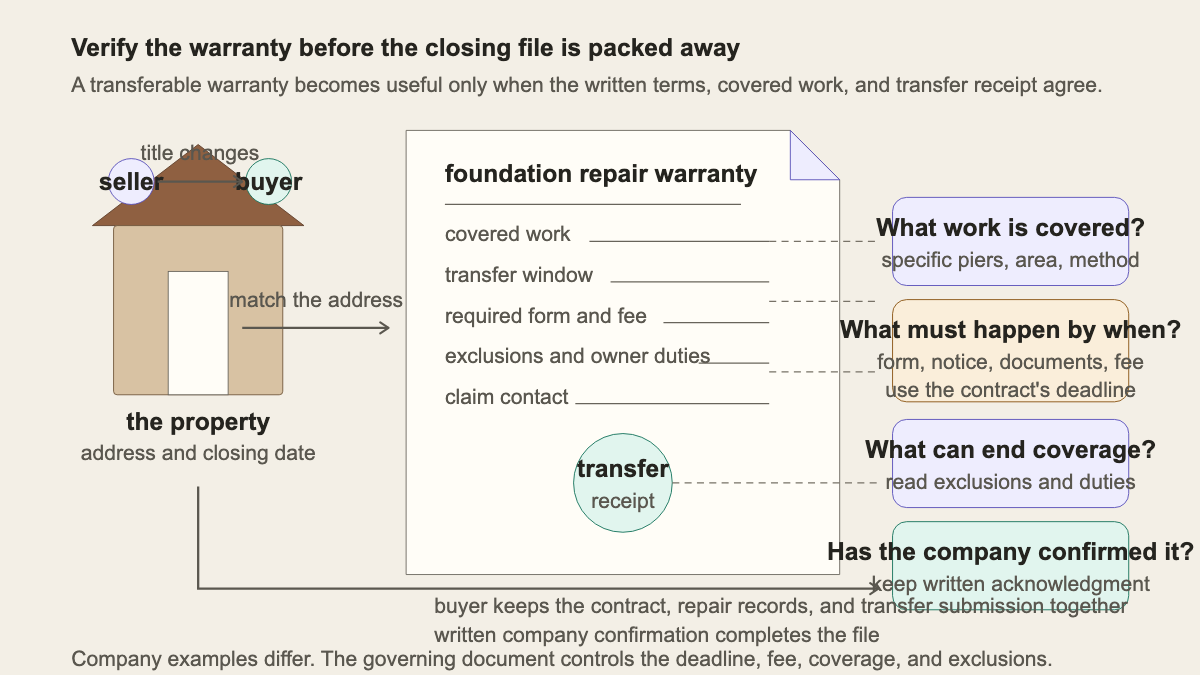
The buyer's file should connect the house to one identifiable warranty. The address and repair record establish the subject. The written terms define covered work and transfer conditions. The submission proves what was sent. The issuer's acknowledgment closes the administrative loop.
Keep a transfer question separate from a claim question
A buyer may combine two requests in one sentence: “Can you transfer the warranty, and will it fix the crack in the front bedroom?” Split them.
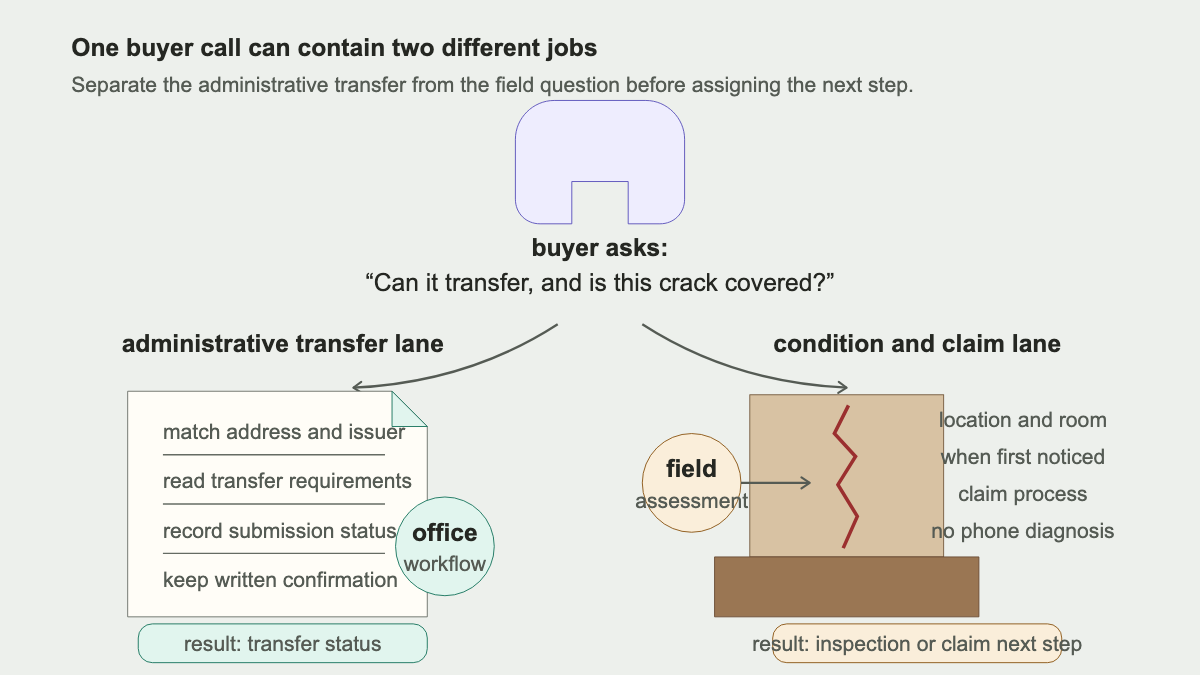
The first is administrative. The office can locate the contract, explain the company's current submission process, receive documents, and report whether the transfer has been acknowledged. The second requires the claims procedure and usually a field assessment. A completed transfer does not tell the receptionist whether a new observation is settlement, whether it lies within the repaired area, whether an exclusion applies, or whether an adjustment is owed.
Record the observation without diagnosing it. Note the room, wall, foundation type if known, when the buyer or inspector noticed it, whether it appears in an inspection report, and whether the property is occupied. Then follow the issuer's claim or inspection workflow. The separate article on foundation repair estimate questions explains how to set inspection scope without turning “lifetime” into a phone promise.
Legal questions also need a boundary. A caller may ask whether an expired transfer condition is enforceable, whether a seller misrepresented coverage, or whether another company must honor the contract. Office staff can provide the documents and describe what the company records show. They should not give legal advice. Route internal contract questions to the authorized person and tell the caller to seek qualified advice for disputes about rights or enforceability.
Confirm the transfer with a receipt the buyer can keep
Submission is not confirmation. A completed form sitting in an agent's email drafts has accomplished nothing. A check image shows an intended payment, not that the company received and accepted the package.
Assign one status to the file: documents requested, company record located, requirements sent to caller, transfer package received, under review, more information required, accepted, or declined. Add the date, the staff member or company contact, and the next action. Avoid a vague note such as “warranty handled.”
Once the issuer accepts the transfer, send or request written acknowledgment under company policy. The buyer's final file should contain the original warranty and amendments, repair contract and completion records, drawings or reports supplied with the job, the submitted transfer form, proof of any required payment, and the issuer's confirmation. If the company issues a new certificate, compare its address and owner name before closing the task.
A clear readback sounds like this: “We located the 2021 warranty for 18 Willow Lane and matched it to the rear-elevation repair drawing. I sent you the current transfer form and instructions today. Your closing is September 18. We have not received or approved a transfer package yet, so the status remains requirements sent. Once the warranty team reviews the completed package, we will send written confirmation of the result.”
An AI receptionist can gather the address, job number, document types, closing date, and callback contact after hours. The contract review and coverage decision still belong with authorized staff. The buyer should leave the process with a specific status and a named next step, not a hopeful phrase copied from the listing.