A homeowner calls after finding damp insulation and a musty smell near the hallway register. They have already decided the crawl space needs “plastic and a dehumidifier.” Then they mention that water collects beside the foundation after hard rain and a plumber repaired a leaking supply line last month.
That is an inspection request, not a product order. Start with the property address, the reason for the call, when the condition appears, what the caller can observe safely, how the crawl space is entered, and what work has already been done. Record standing water, drainage, bare soil, existing ground cover, vents, ducts, pipes, equipment, odors, visible growth, pests, insulation, and structural concerns as separate facts. The field professional should determine the moisture source and the proposed assembly.
Separate the complaint from the requested product
Ask what prompted the call today. The answer may be an odor upstairs, damp wood, condensation on ducts, visible water, fallen insulation, high indoor humidity, a pest inspection, a home sale, or a quote from another company. Each points to a different starting place for the visit.
Use the caller's words. “White fuzzy material on three joists” is a useful observation. “Mold throughout the crawl space” is a diagnosis unless a qualified assessment has established it. The office should never identify mold from a phone description or photo. It can record where the material appears, its color, whether the area looks wet, and whether anyone has already tested or treated it.
Clarify what the customer means by encapsulation. Some callers picture a sheet over dirt. Others expect sealed walls, closed vents, insulation changes, drainage work, a sump, air sealing, humidity control, or storage space. Ask which outcome matters to them and whether another contractor proposed a written scope. Do not confirm that a particular liner, dehumidifier, vent treatment, or insulation method belongs in the final design.
The distinction matters because a liner cannot repair a plumbing leak, redirect roof runoff, rebuild a failed support, or identify radon. The inspection has to begin with the house that exists.
Build a water timeline before discussing scope
Water after a thunderstorm tells a different story from damp surfaces throughout a humid summer. Ask when the caller first noticed the condition and what was happening at the time. Then work through a short timeline:
- Does water appear during rain, soon afterward, or during dry weather?
- Is it a puddle, a wet perimeter, damp soil, droplets on ducts, stained framing, or a general clammy feeling?
- Where does it begin, and does the caller know where it travels or collects?
- Have gutters overflowed, downspouts disconnected, drains backed up, grading changed, irrigation leaked, or nearby excavation occurred?
- Has any pipe, drain, condensate line, water heater, air handler, or other equipment leaked?
- Is the condition seasonal, tied to HVAC use, or present all year?
EPA homeowner guidance distinguishes leaks and seepage, moisture rising from crawl-space soil, humid air, condensation on cold surfaces, plumbing sources, and climate. Its broader moisture-control guidance also treats site drainage, foundations, plumbing, and HVAC as connected parts of the building. That is the right frame for intake. Do not collapse several possible routes into “groundwater” or “humidity” before the site has been inspected.
Ask for exterior photos taken from safe ground. Useful views show the foundation wall, grade, gutters, downspouts, discharge points, low areas, vents, crawl-space door, nearby hose bibs, HVAC lines, and any standing water. Request a wide view before close-ups. A stain without its surrounding wall and ground level loses most of its context.
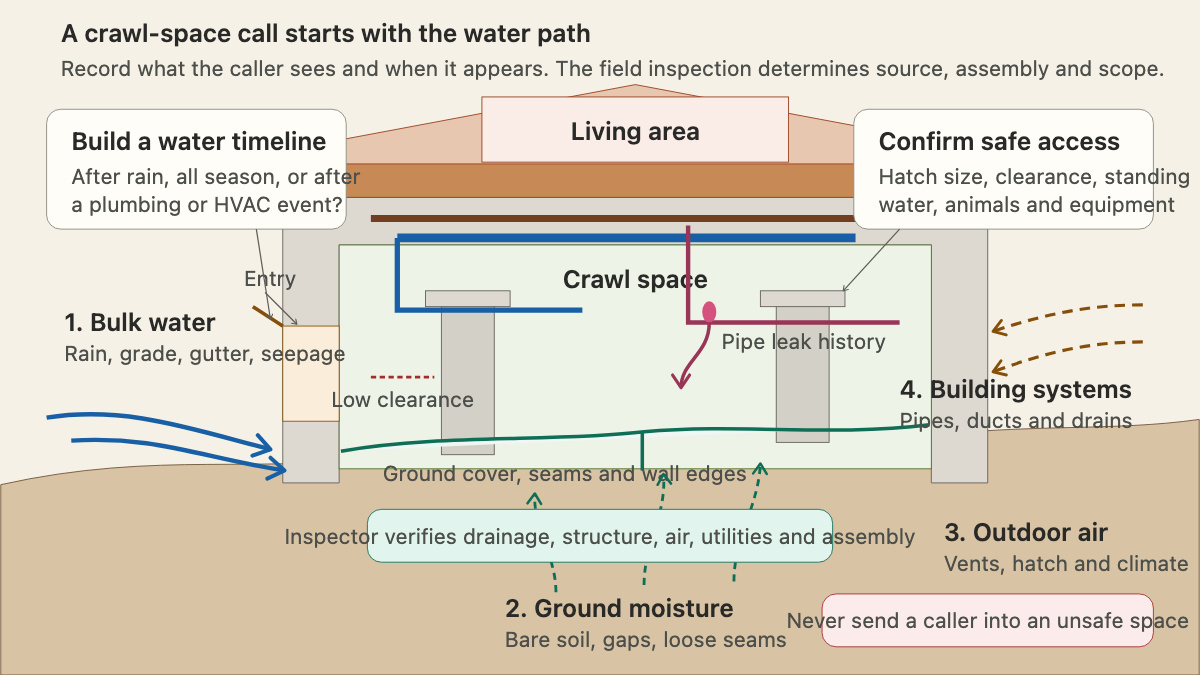
Qualify access without sending the caller inside
A crawl-space appointment can fail before the inspection starts if the technician cannot reach the area. Ask where the entrance is located: outside, inside a closet, beneath a porch, behind stored items, or through a floor hatch. Record whether the door opens, whether a key is needed, and who can move anything blocking it before arrival.
Ask the caller to estimate the opening and the general clearance only if they can do so from outside the space. A photo with a tape measure across the opening can help. Nobody should crawl under a house, move an animal, enter standing water, touch damaged wiring, or open equipment for the sake of phone intake.
Record conditions visible from the entrance. Is the ground dirt, gravel, concrete, or partly covered? Is existing sheeting loose, torn, muddy, weighted down, or pulled away from walls and piers? Can the caller see ducts, pipes, wiring, an air handler, a furnace, a sump, drains, insulation, posts, piers, or debris? Are there sharp materials, sewage, heavy odors, insects, snakes, rodents, or an unknown animal inside?
ENERGY STAR's basement and crawl-space project guidance describes crawl-space work as more than a floor covering. Its resources address continuous sealed ground cover, air leaks, rim joists, plumbing and wiring penetrations, insulation, climate, radon, and combustion appliances. Those details give the office a practical scheduling lesson: note the systems and constraints, then send the right field person with the right access expectations.
If the access is too small, locked, flooded, contaminated, or blocked, flag it before confirming an ordinary inspection window. The company may need a different visit type, another trade, protective equipment, or site preparation.
Keep structural and health concerns in their own lanes
Moisture calls often include a structural detail. A homeowner may mention a sagging beam, a leaning pier, a cracked foundation wall, a soft floor, or a door that started sticking. Record the exact location and whether the caller believes it is changing. Do not tell them encapsulation will correct it.
A shifted support belongs in a crawlspace post or pier inspection intake. Recent water from a broken line may also require the questions in the foundation inspection after a plumbing leak guide. One visit may cover several concerns, but the work order should preserve each one.
Use calm safety boundaries when the caller reports an active hazard. Sewage, electrical arcing, a strong fuel odor, a major active leak, rapidly moving water, or an unstable opening may require immediate direction from the appropriate emergency service or licensed trade. The receptionist should follow the company's escalation policy, not improvise a repair.
Radon and combustion appliances also deserve direct intake questions. Ask whether a radon system or prior test exists and whether a furnace, boiler, water heater, or other fuel-burning appliance is located in or draws air from the crawl space. ENERGY STAR warns that sealing can affect indoor pollutants and combustion safety. Testing, ventilation, and appliance review belong with qualified professionals.
Gather the records that change the visit
Ask whether the homeowner has a prior inspection report, pest report, moisture readings, lab result, radon report, drainage plan, plumbing invoice, HVAC service note, warranty, survey, or proposal. Those documents can reveal what was observed and what remains uncertain. They do not replace the new inspection.
Request photos with simple names: “north wall after rain,” “access opening,” “loose liner near furnace,” and “pipe repair below kitchen.” Date matters. A dry crawl space photographed in February may not represent conditions after an August storm.
Capture prior work carefully. Note who installed the existing ground cover, sump, drain, dehumidifier, insulation, vents, or structural supports, if known. Ask when it was done and whether a transferable warranty exists. Avoid telling the caller that another company's work failed. The inspector has not seen it yet.
Before scheduling, confirm who owns the property, who can authorize work, whether the house is occupied, and who will provide access. For a sale or rental, note the inspection deadline, tenant notice, buyer or seller role, and which parties should receive the report. General estimate questions can be routed through the foundation repair estimate guide.
Read back a field-ready handoff
A useful note sounds like this:
“Owner reports a musty odor at the first-floor hallway register and damp fiberglass visible from the east crawl-space entrance. The condition is strongest after long summer rain. Water collects outside near the northeast downspout, and the owner has seen a shallow puddle inside that corner. A supply-line leak below the kitchen was repaired last month. The caller is requesting encapsulation and a dehumidifier, but reception made no source or system recommendation.
“Exterior access is through an unlocked rear panel. Stored patio blocks will be moved before arrival. The owner estimates low clearance near the center beam and will not enter the space. Photos from the opening show dirt, partial plastic sheeting, two masonry piers, ducts, plumbing, and fallen insulation. No sewage, fuel odor, active arcing, or standing water is reported today. A gas furnace and an existing radon system are present.
“Owner supplied rain-day photos, the plumbing invoice, prior pest report, and an older encapsulation proposal. Inspector to verify drainage, bulk-water entry, ground cover, air pathways, plumbing and HVAC conditions, access, framing, supports, radon details, and suitable scope.”
That handoff gives the inspector a timeline and a building to evaluate. An AI receptionist can collect the approved fields after hours, but the company still needs a qualified person to enter the space, find the source, and write the work scope.