“I have a normal-size kitchen. How much to paint the cabinets?”
A useful answer starts with a count and ends with a site estimate. Ask for the number of doors and drawer fronts separately, then identify every other surface the customer expects painted: cabinet boxes, face frames, exposed ends, crown, toe kicks, open shelving, glass-door frames, island panels, and interiors. Record the existing material and finish, visible damage, desired color and sheen, hardware plans, kitchen use, access, and timing.
Do not turn that phone record into a final price. A photo can hide failing coating, grease, swollen material, loose veneer, damaged hinges, deep grain, old repairs, or a surface that needs a different preparation plan. The office should make the estimator better prepared, not pretend the inspection already happened.
Start with a count the estimator can use
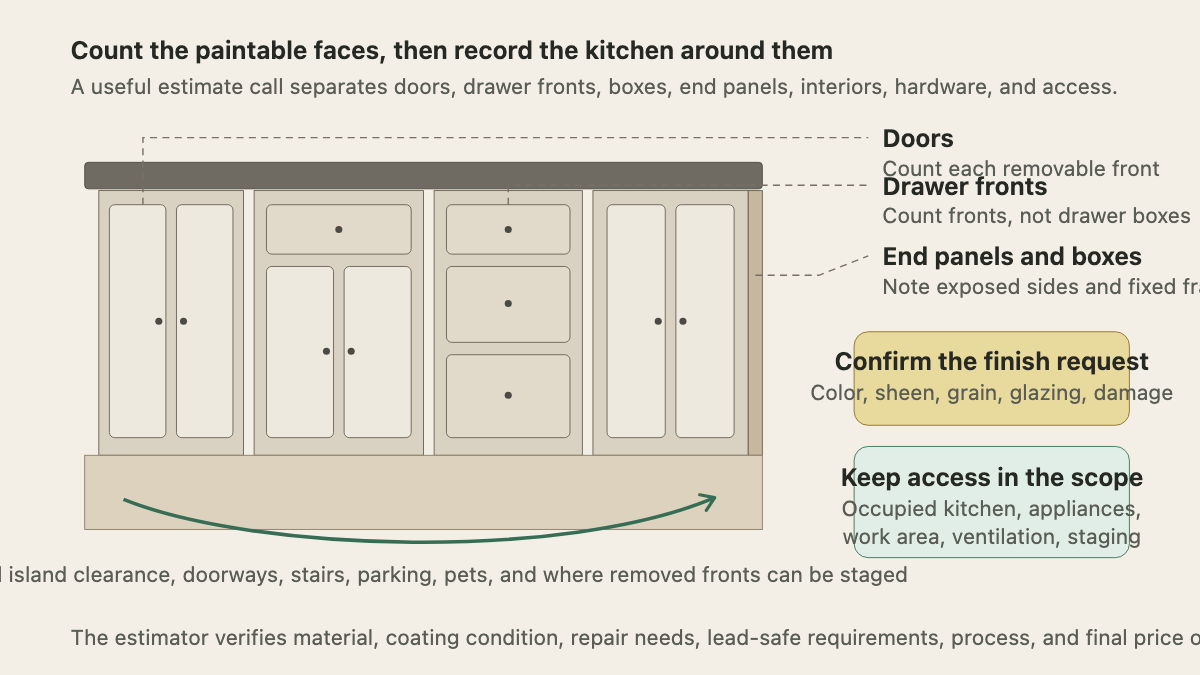
“Twenty cabinets” can mean twenty doors, twenty boxes, or twenty openings. Those are different scopes. Give the caller a simple counting method before collecting any number.
Ask them to stand at one end of the kitchen and move in one direction. Count each removable door once. Count each drawer front once, including narrow false fronts only if the company treats them as a paintable piece. Then record fixed and decorative surfaces separately. An island with three finished sides may have only two doors but far more exposed surface than a short wall cabinet.
The office record should keep these lines distinct:
- doors, drawer fronts, glass-front doors, and removable panels
- fixed boxes or face frames, exposed end panels, crown or light rail, toe kicks, open shelves, island or peninsula panels, and cabinet interiors
Ask whether upper and lower cabinets are included and whether the laundry, pantry, bar, bathroom vanity, or built-ins belong in the request. A homeowner may call all of them “the kitchen cabinets” because the same finish runs through the house.
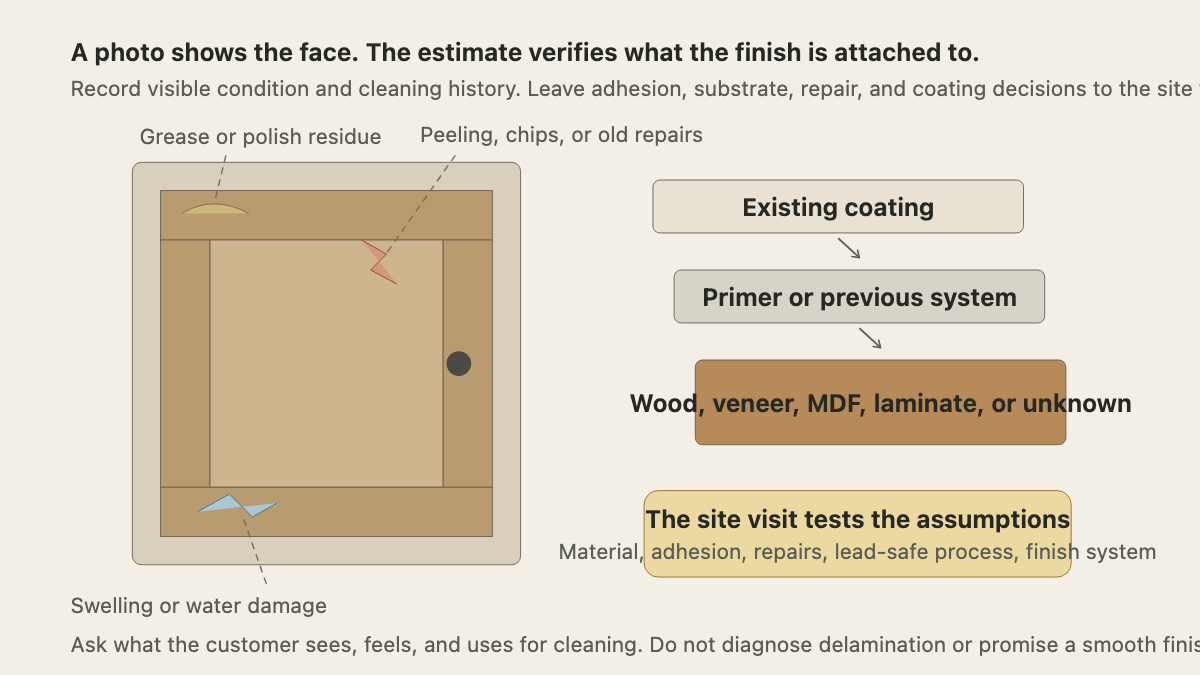
Photos help. Request one wide image from each wall, a straight-on image of the island, and close views of any damage or unusual feature. The wide shots preserve the count and layout. Close photos give the estimator inspection leads. Neither should be used to certify the substrate or promise the finished result.
Record what is on the cabinets now
Ask what the customer believes the cabinets are made from: solid wood, wood veneer, MDF, laminate, thermofoil, metal, or unknown. Record the answer as the caller's description. Do not correct it from a phone photo.
Then ask about the current surface. Is it factory-finished, stained, clear-coated, painted, glazed, wrapped, or unknown? Does it feel glossy? Are there bare spots around knobs, peeling edges near the sink, bubbling beside the dishwasher, cracks at joints, swollen panels, loose veneer, or areas where a previous coating scratches off?
Grease and cleaning history belong in the notes too. Ask whether the cabinets are regularly wiped with polish, wax, oil soap, degreaser, or another product. A painter needs to assess the surface before choosing cleaning, abrasion, primer, and coating steps. Sherwin-Williams' cabinet refinishing guide tells contractors to consider the desired result, cabinet condition, expected wear, and coating choice before work begins.
Keep repair questions concrete. “Any damage?” often gets a quick no. Ask about loose doors, stripped hinge screws, missing pulls, cracked frames, deep dents, water swelling, delamination, pet scratches, and soft material beneath the sink. Record which door or cabinet is affected. Do not promise that painting will hide structural or moisture damage.
Define the finish request without choosing the system
“White” is a color direction, not a complete finish specification. Ask whether the customer has selected a color and whether they want the same color inside and outside. Note the requested sheen, visible wood grain, glazing, distressing, two-tone island, accent panels, or a match to nearby trim.
Ask what the customer expects the surface to look like up close. Some callers expect the grain of oak to remain visible. Others expect a smooth, furniture-like face. That expectation changes the conversation about samples, preparation, filling, and what the existing cabinet construction can support. The estimator should settle it in person.
Application method matters to the schedule and work area, but the call handler should avoid promising “sprayed” or “hand-painted” before the company has reviewed the job. Record whether the caller asked about spraying, brushing, rolling, off-site finishing, or keeping all work in the home. The estimator can explain the company's process and the tradeoffs after seeing the layout.
Cabinets are high-touch surfaces. Benjamin Moore's professional cabinet refinishing guidance advises contractors to allow the complete cure time in the product instructions and to address it in the contract. The office should ask when the kitchen must return to normal use, then flag any hard deadline. It should not invent a universal cure date.
Hardware, hinges, and interiors can change the scope
Ask whether knobs and pulls will be reused, replaced, or moved. If replacements are already purchased, record the hole spacing and ask the customer to have a sample available for the estimate. New pulls with different spacing may require filling and drilling. That work should appear in the scope, not arrive as a surprise after doors are labeled and removed.
Hinges deserve their own question. Are they concealed or visible when the doors are closed? Does the customer want visible hinges painted, replaced, or left alone? The estimator needs to inspect function, alignment, condition, and compatibility. A call handler should never promise that new soft-close hinges will fit an old cabinet from a photo.
Interiors are easy to miss. Ask whether the request includes the inside faces of doors, cabinet interiors, drawer boxes, shelves, glass-door interiors, or only the visible exterior surfaces. If interiors are included, ask what is stored there and whether the customer can empty them. A kitchen with open shelving or glass doors may need a different staging plan than one with closed boxes.
Treat the kitchen as an active work site
A cabinet estimate includes the room around the cabinets. Ask whether the home is occupied, whether the kitchen is the only cooking area, and whether children, pets, tenants, or mobility needs affect access. Record the normal household schedule and any dates when the home will be vacant.
Map the route. The estimator needs to know about gated communities, parking limits, elevators, stairs, narrow entries, finished floors, tight island clearances, and the distance to a suitable work or staging area. If the company removes doors and drawer fronts for off-site finishing, ask where loading can happen and whether building rules limit work hours.
Ask about nearby appliances and fixtures. Note built-in refrigerators, range hoods, under-cabinet lights, glass panels, countertops, backsplashes, and recently installed flooring. The office is gathering scope boundaries. It should not tell the customer to disconnect gas, electricity, plumbing, or mounted equipment.
Ventilation, dust control, odor concerns, and room containment belong in the estimate conversation. Record household sensitivities or work-from-home constraints without giving medical advice. The estimator can explain the products and controls the company actually uses, then provide the relevant safety information.
Flag older-home and lead-safe questions early
Ask the year the home was built when the scope may disturb an older painted surface. If it was built before 1978, or the customer does not know, flag the estimate for the company's lead-safe procedure.
The EPA Renovation, Repair and Painting program says that anyone paid to perform work that disturbs painted surfaces in covered pre-1978 homes and child-occupied facilities must meet certification, training, and lead-safe work-practice requirements. EPA runs the program in many states and territories, while authorized states administer their own programs.
The call handler should not decide that cabinet work is exempt, declare a surface lead-free, or tell the customer how testing will come out. Record the construction year, occupancy type, known testing records, painted surfaces involved, and the company's certification workflow. The estimator or qualified lead-safe staff can determine what applies to the actual disturbance and local rules.
Book the right estimate slot
A straightforward repaint inquiry may fit a normal residential estimate. Give the estimator more time when the scope spans several rooms, includes interiors and built-ins, requests major hardware changes, shows widespread coating failure, involves water damage, or raises lead-safe questions. Commercial, rental, and occupied child-care settings should follow the company's separate compliance and scheduling path.
Before ending the call, read back the scope in plain language: “I have 24 doors, 11 drawer fronts, the exterior boxes and island panels, no cabinet interiors, existing stained wood, new pulls with a different hole spacing, and a home built in 1968. You will send wide photos tonight, and the estimator will verify the material, preparation, lead-safe requirements, finish options, schedule, and price at Tuesday's visit.”
That read-back catches the missing panel, the second vanity, and the hard move-in date while the caller is still on the line. The estimator arrives with a map of the kitchen instead of a note that says, “paint cabinets, wants white.”