“My deck is about 20 by 12. How much would you charge to stain it?”
The dimensions give the office a starting point, but the estimate still needs the rails, stairs, wood and coating history, visible damage, preparation, access, furniture, desired finish, photos, and scheduling constraints. Weather belongs in the record too. It should remain a condition to verify, not a date the receptionist promises.
A useful call note describes the deck well enough for an estimator to choose a site visit or photo review. It does not diagnose rot, select a stain, or quote a firm application window from a phone description.
Start with the deck's actual shape
Ask for the job address and confirm that the caller means a wood deck. Composite boards, concrete patios, painted porches, rooftop decks, and dock surfaces may require a different service or product path. If the caller does not know the material, request a wide photograph and record the uncertainty.
Then map the footprint. Capture approximate length and width for each level, plus landings, built-in benches, privacy screens, pergola posts, gates, stairs, railings, and skirting. A 240-square-foot platform with no rail is a different scope from a 240-square-foot raised deck wrapped by spindles and reached by two stair runs.
Ask which faces are included. Does the customer want only the walking boards, or also the rail cap, balusters, posts, stair treads, risers, outer fascia, and visible framing? “The whole deck” often means different things to the caller and the estimator.
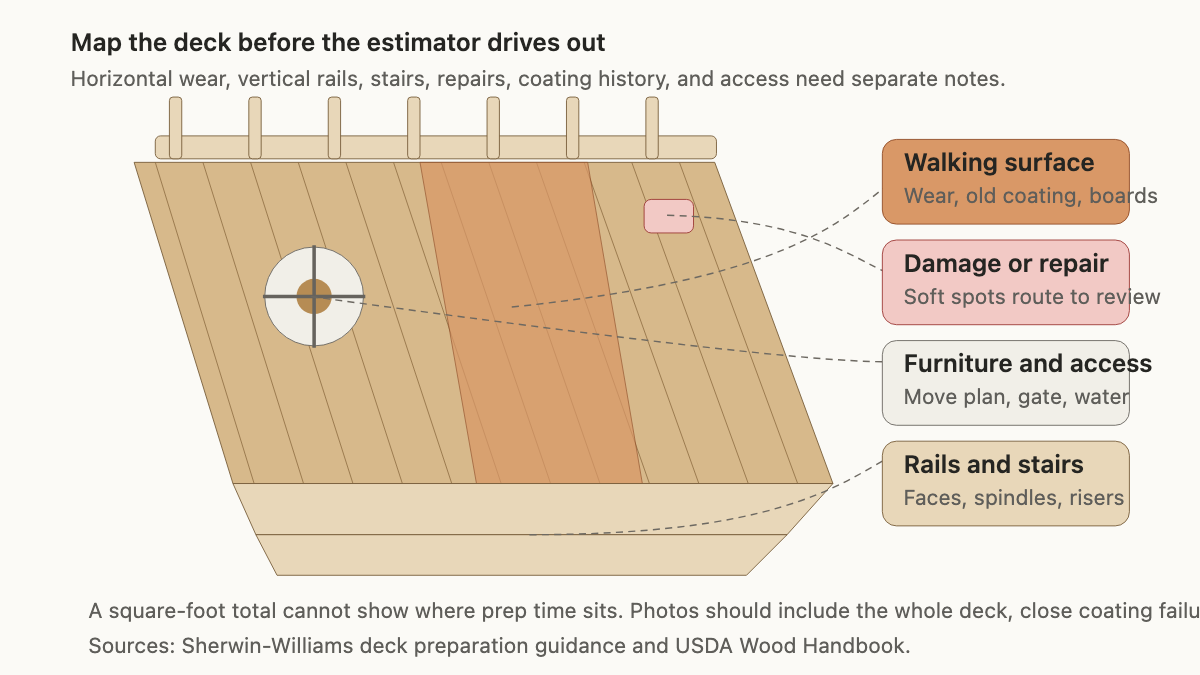
The physical map explains why square footage alone is weak intake. Horizontal boards take foot traffic and hold furniture. Rails add narrow faces and corners. Stairs add edges, risers, and access questions. One damaged patch can pause the coating estimate until somebody inspects it.
This deck-specific scope stays distinct from a fence staining estimate, where length, height, faces, gates, and vegetation carry more of the job.
Record the wood and coating history without diagnosing it
Ask whether the deck is new, previously stained, painted, sealed, or bare and weathered. Record what the caller knows about the existing finish: transparent, semi-transparent, solid color, paint, or unknown. If they have an old can, invoice, or product name, ask them to send a photo of the label.
Coating history matters because the estimator must judge compatibility and preparation. A caller may describe a solid coating as “stain” even when it behaves differently from the penetrating finish they now want. The office should preserve the customer's words and attach photographs rather than translating them into a product conclusion.
Condition needs plain descriptions. Ask what the customer sees:
- peeling or flaking coating, gray wood, dark patches, green growth, splinters, raised grain, cracked boards, loose fasteners, soft spots, or standing water
- recent repairs, board replacement, pressure washing, stripping, sanding, or a failed coating application
- heavy shade, irrigation spray, roof runoff, leaf buildup, planters, rugs, grills, or furniture that stays in place
A receptionist should never tell someone that a soft board is cosmetic or structurally sound. Mark the location, ask whether people can avoid the area, and send the note for qualified review. If a caller reports an unstable rail or stair, the scheduling record should say that clearly.
The USDA Forest Products Laboratory's Wood Handbook gives moisture relations, drying, preservatives, and finishing separate technical treatment. That is a useful boundary for call intake. “The boards look dry” is an observation. It is not a moisture reading or a finish recommendation.
Older treated wood can create another escalation point when boards may be sanded, removed, or discarded. The EPA's chromated arsenicals guidance notes that state and local governments may have specific disposal guidance for treated wood. The office can capture deck age, known treatment, and planned removal. A qualified person should decide work practices and disposal.
Separate cleaning, repair, and staining in the call note
Many customers use “stain the deck” as shorthand for the entire job. Ask what they expect before color is applied. Do they want washing, stripping, sanding, nail or screw work, board replacement, carpentry, mildew treatment, or moving furniture? Does the contractor provide each service, or must another trade handle repairs first?
Sherwin-Williams' deck staining planning guidance calls for a clean surface, drying after cleaning, and attention to old stain, splinters, and rough patches. Its specific instructions belong to its products and project method. For the office, the larger lesson is simple: preparation is part of scope, and “ready to stain” should not be assumed from a caller's dimensions.
Ask about access while the customer is on the phone. Can a crew reach the deck through a side gate? Is there an exterior water source? Must equipment pass through the house? Is the deck on an upper story? Are there neighbors or shared property below? Who moves the grill, planters, dining set, storage box, and children's toys?
Pets and occupants affect the schedule as well. Record the only door to a yard, a dog that normally uses the deck steps, or a tenant who needs that entrance. Those details help the estimator plan the sequence and explain when access may be restricted after application.
Treat weather as a gate, not a promise
A caller may ask, “Can you do it Friday? The forecast says sunny.” The office can record Friday as a preference. Confirmation should wait for the site condition, preparation plan, forecast, shade pattern, selected stain, and its technical instructions.
Manufacturer guidance shows why a universal script fails. Cabot's When to Stain page gives an ideal application example of 50 to 80 degrees Fahrenheit, says to follow shade through the day, and calls for no rain expected for 24 hours. Sherwin-Williams publishes its own drying and preparation guidance. The estimator must use the label and technical sheet for the product proposed on that deck.
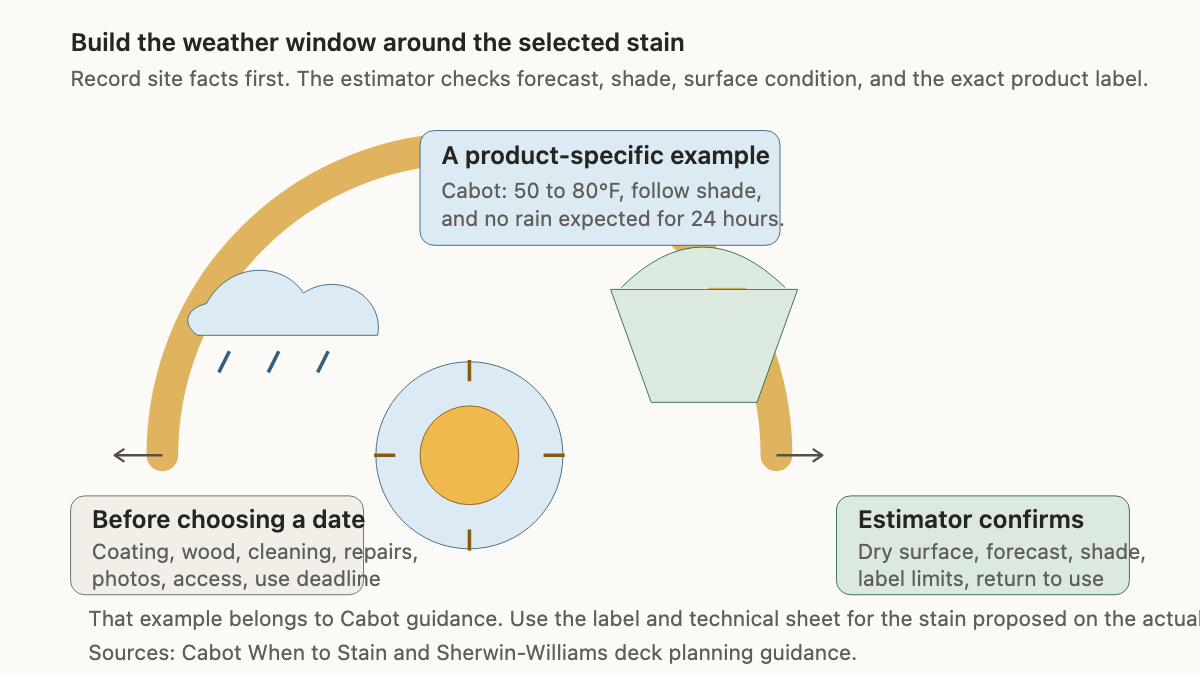
The intake questions are still concrete. Ask when it last rained, whether sprinklers hit the deck, when it was washed, which areas stay shaded, and whether the customer has a deadline such as a party, move-in, or property listing. Record the deadline without promising the deck will be ready for furniture or foot traffic by then.
A strong response sounds like this: “I can note Friday as your preferred date. Our estimator needs to confirm the surface, preparation, forecast, shade, and the selected product instructions before we confirm application and return-to-use timing.”
That sentence is honest and useful. It does not force the office to memorize one brand's limits or defend a date after the forecast changes.
Request photos that answer estimate questions
Random close-ups rarely show scale. Ask for a short set that lets the estimator understand the site:
- One wide photo from the yard showing the entire deck and height above grade.
- One photo from the house looking across each level.
- Close photos of peeling, dark, soft, cracked, or repaired areas.
- Photos of the railings, stairs, skirting, and built-ins included in the request.
- A view of the gate, path, water source, and any tight equipment access.
- A photo of the previous coating can, invoice, or label when available.
- A photo showing furniture, rugs, planters, grills, and other items that need a move plan.
Tell the customer that photos support scheduling and scope. They do not replace an on-site safety, moisture, repair, or product decision.
Give the estimator a note worth opening
A useful handoff reads like a small site record:
“Owner requests an estimate for a two-level pressure-treated wood deck, approximately 20 by 12 feet on the main level with six steps and railing on three sides. Walking boards and rails are included. Existing solid brown coating is peeling on the sunny edge; product is unknown. Two boards near the stairs are cracked, and the customer reports one soft area by a planter. Customer expects washing, prep, and staining but is unsure about carpentry. Side-gate access is 36 inches wide, exterior water is available, and the grill plus dining set must move. Photos and the old can label are pending. Saturday use is preferred, subject to inspection, repair scope, forecast, shade, and product instructions.”
That note gives the estimator surfaces, condition, preparation expectations, access, evidence still needed, and the customer's timing concern. It leaves the technical decisions where they belong.
The broader painting estimate scheduling workflow can hold contact details, decision-makers, appointment windows, and follow-up ownership. The interior and exterior painting intake guide covers the shared habit of naming substrates, access, occupancy, and preparation before offering a date.
An AI receptionist can collect these fields after hours if the contractor defines the questions and escalation rules. The final handoff should still read like that deck note: two levels, rails and steps included, coating unknown, peeling edge, cracked boards, soft area by planter, 36-inch gate, photos pending, preferred Saturday use.