A homeowner calls and says, “I need a quote to paint the house.” The office can put a name and address on the calendar in thirty seconds. The estimator will still arrive without knowing whether “the house” means three bedrooms, the front elevation, every exterior surface, or a mix of all of them.
Start with one clean split: Is the work inside, outside, or both? Then define the surfaces, their condition, access, occupancy, timing, and who will approve the work. Interior and exterior painting share a trade, but they do not share an intake path. A room count will not explain exterior height and grade. “Two stories” says nothing about furniture, pets, tenants, or kitchen cabinets.
The goal of the call is a useful estimate appointment. Do not force a final price out of an incomplete description.
Choose the correct intake lane first
Ask the caller to describe the finished result in plain terms. “Which areas do you want painted, and which parts should stay as they are?” That wording tends to produce better information than “What is the square footage?” A homeowner may know the house size while having no idea how much wall, trim, siding, or repair work is included.
Classify the request as interior, exterior, or mixed. For a mixed project, keep two scope notes under the same customer record. The interior portion may be ready for photo review while peeling trim on a steep rear elevation needs an estimator on site.
Confirm whether this is a residential repaint, a rental turnover, new construction, repair after water damage, or a property being prepared for sale. Those labels do not set the price. They tell the estimator what kind of site and decision process to expect. A vacant rental with one property manager behaves differently from an occupied home where furniture must move room by room.
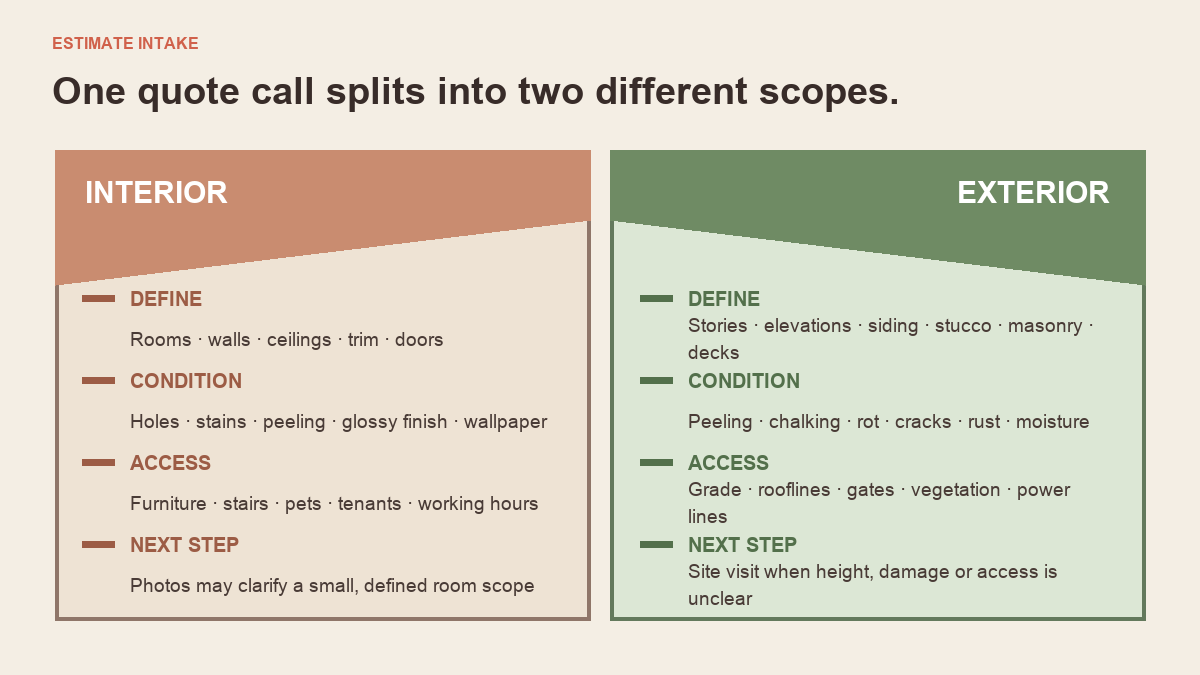
The matrix gives the office a practical rule: shared questions identify the customer and project, while lane-specific questions make the appointment worth the drive.
Interior calls are about rooms and daily life
For an interior request, walk the property room by room. Record the room name and the surfaces included. Walls alone are one scope. Walls, ceilings, baseboards, crown molding, doors, window trim, closets, cabinets, and built-ins are a much larger one.
Ask what is on the surfaces now. Fresh drywall, a glossy coating, wallpaper, heavy texture, stains, patched areas, peeling paint, and visible cracks call for different inspection questions. The office should record what the caller sees without diagnosing the cause. “Brown stain above the window after last winter’s leak” is useful. “Bad paint” is not.
Ask whether repair work is expected. Nail holes and small scuffs belong in a different note from loose plaster, recurring moisture, damaged drywall, or trim that has separated. If the caller mentions active water, the estimator needs to know whether the source has been repaired. Painting over an unresolved leak is not a scheduling solution.
Room preparation matters too. Benjamin Moore’s room-painting guidance begins with clearing as much furniture as possible and covering what remains. A contractor may offer moving and protection under its own policy, but the office needs to establish that policy before the visit. Ask:
- Is the home occupied, vacant, or between tenants?
- Which furniture or wall-mounted items are staying in place?
- Are there pets, children, tenants, alarm systems, or restricted work hours?
- Who will choose colors and finish, and has that person chosen them yet?
- Can the estimator access every room on the appointment date?
Do not promise that the crew will move a piano, disconnect electronics, remove a wall-mounted television, or handle fragile art unless company policy says so. Put unusual objects in the note. A standard bedroom estimate can change when the room contains a full library wall and a four-poster bed with no clear path around it.
Exterior calls are about substrate, exposure, and access
An exterior intake starts with elevations and components. Ask whether the caller wants the full exterior or selected sides. Then identify siding, stucco, masonry, trim, fascia, soffits, shutters, doors, porch ceilings, railings, decks, fences, and detached structures. “Paint the outside” often expands after the estimator walks around the first corner.
Record the number of stories, but do not stop there. Grade and access can make the rear of a two-story house harder to reach than the front of a taller one. Ask about steep slopes, narrow side yards, rooflines, locked gates, dense shrubs, overhead lines, pools, neighboring property, and areas above additions. The crew will make the site-specific access plan. The office simply exposes the issue early.
Surface condition drives the inspection. Ask where the caller sees peeling, chalking, cracking, rust, rot, open joints, damaged stucco, or loose material. Request wide photos and close photos when your company uses photo review. A close image shows a failed patch. A wide image shows that the patch sits three floors above a conservatory.
Moisture and weather belong in the record. Ask about recent leaks, sprinkler spray, overflowing gutters, shaded walls that stay damp, and repairs that have already been completed. Sherwin-Williams’ exterior preparation guidance ties coating work to cleaning, repairs, dry surfaces, and suitable weather. That supports a firm office boundary: weather and product questions go to the estimator or production lead after the site and coating system are known.
The office should also avoid minimizing hazards. OSHA’s painting hazard overview includes falls, access equipment, chemicals, lead, mold, and other exposures. A caller who reports an unstable balcony, strong solvent odor, live electrical contact, or another immediate hazard needs the company’s escalation process before an ordinary quote appointment.
Property age can change the route
Ask the year the home or child-occupied facility was built, especially when the scope includes scraping, sanding, window work, repair, or other disturbance of painted surfaces. If the caller does not know, record “year unknown.” Do not turn a guess based on architecture into a compliance decision.
The U.S. Environmental Protection Agency says its Renovation, Repair and Painting Rule affects contractors who disturb painted surfaces in pre-1978 homes and child-occupied facilities. The EPA contractor guidance should inform the company’s intake policy. State, tribal, or local rules may also apply.
The receptionist’s job is to trigger review. Capture the property age, areas involved, condition of the coating, and work the caller expects. Then route the record to the person responsible for the company’s lead-safe process. Do not promise that a project is exempt, quote a containment method, or tell a homeowner that an old coating is safe based on a phone description.
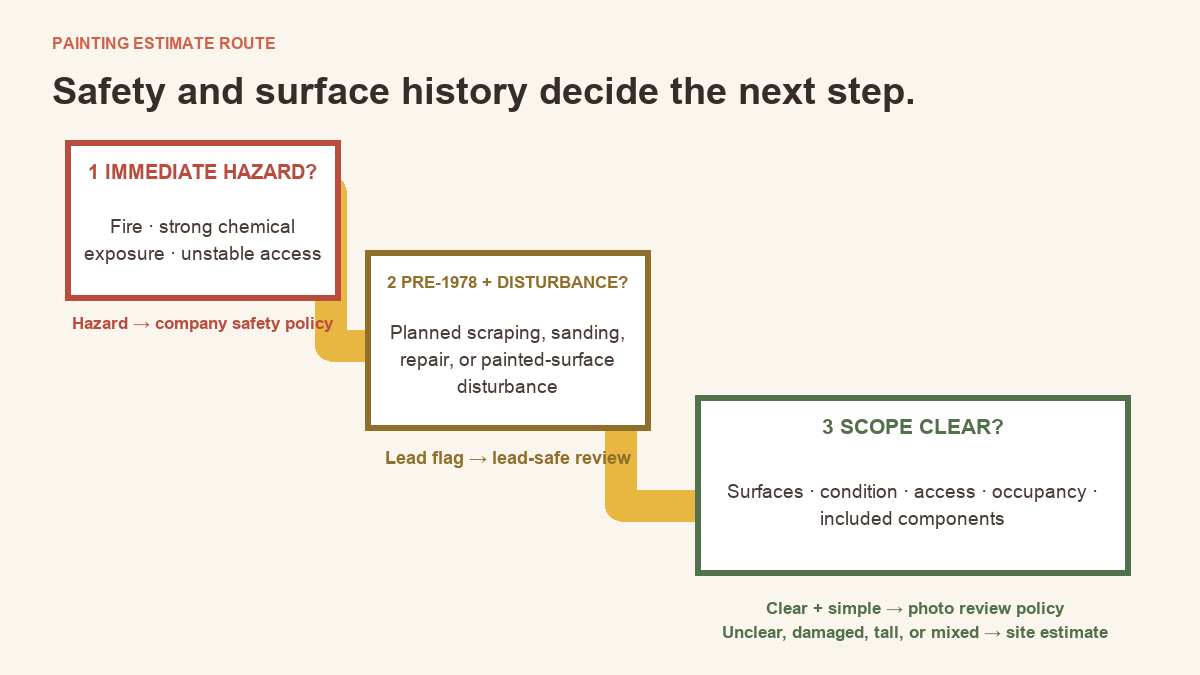
This routing sequence keeps the call useful without asking office staff to act as estimators, safety managers, or compliance specialists.
Decide whether photos are enough
Photos can make a defined call easier to route. They rarely settle an entire repaint. Use them under a written company policy, with clear instructions about what the caller should send and who reviews it.
A small interior scope may be a good photo-review candidate when the surfaces and included components are clear. Exterior work with height, failing coatings, hidden elevations, access limits, or uncertain repairs usually deserves a site visit. Mixed projects often need both: photos for triage, followed by one coordinated appointment.
Ask for images that show context. For each area, request one wide view and one closer view of damage or detail. Add a simple label such as “upstairs hall ceiling” or “north siding above garage.” Ten unlabeled close-ups of beige paint create more work for the estimator.
Never ask a caller to climb a ladder, walk on a roof, enter an unsafe area, or disturb a coating to get better pictures. If the surface cannot be photographed safely from the ground or an ordinary occupied space, leave it for the site assessment.
Write the handoff for the estimator
The final note should be readable in the driveway. Put the lane and scope first, then the unknowns.
A useful note might read:
“Occupied 1966 two-story home. Interior: living room walls and ceiling, hallway walls, six doors and frames. Water stain near front window; caller says roof leak was repaired in May. Furniture remains in living room; two cats. Exterior: front and west elevations only, wood siding and trim, peeling at second-floor windows, sloped west side yard. Color decision shared by both owners. Requested site estimate after 3 p.m. Photos received and attached. Lead-safe review required before scheduling confirmation.”
That note gives the estimator a project shape. It does not pretend the price, preparation plan, or regulatory path has already been settled.
Keep residential quote calls in the regular painting estimate scheduling workflow. Send formal plans, specifications, addenda, and bid deadlines through the separate commercial painting bid process. The broader painting contractor resource hub can hold the shared call-handling standards, but the routes should remain distinct.
When the estimator opens the next appointment, the first line should say “interior,” “exterior,” or “mixed.” The lines beneath it should explain exactly what those words mean at that address.