A homeowner calls and says, “I have about 100 feet of fence. What would you charge to stain it?” The number sounds useful. It is also missing most of the job.
The office needs the approximate length, but a responsible fence staining estimate also depends on height, the number of faces included, gates, wood condition, existing coating, cleaning, repairs, access, vegetation, and nearby surfaces that need protection. Capture those facts before offering a price or promising an appointment length. If the caller cannot document the condition clearly, route the request to a site visit.
That is the short answer. The rest of the call should turn “100 feet of fence” into a scope an estimator can trust.
Start with the surface that will actually receive finish
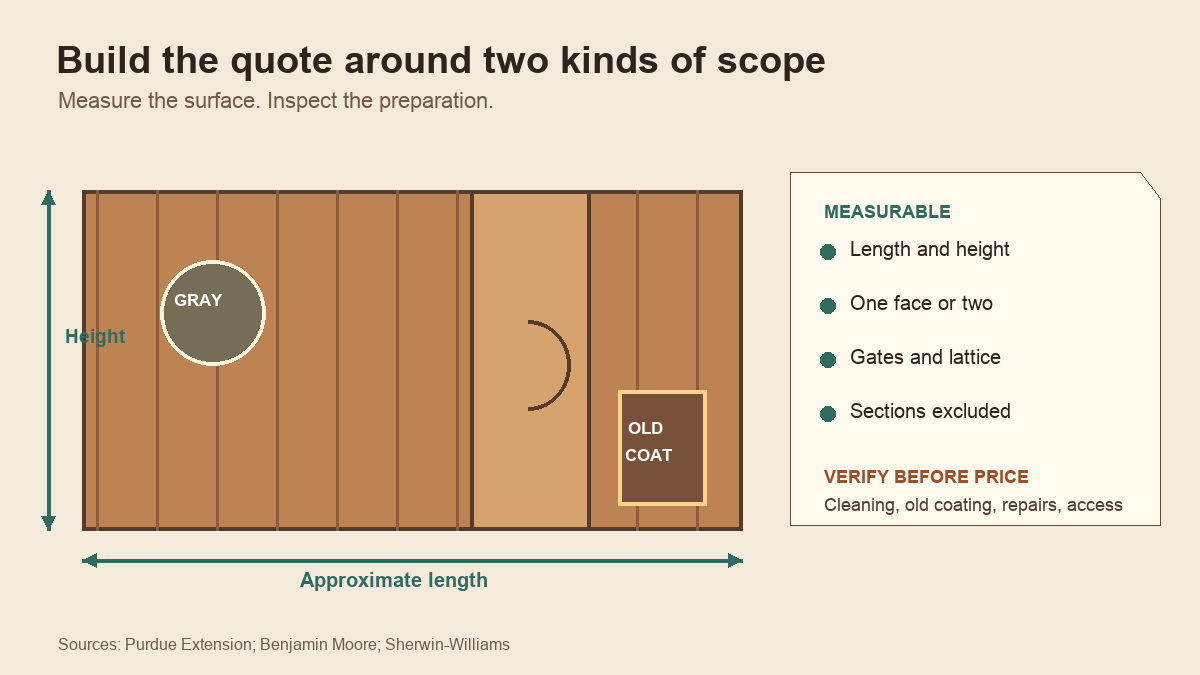
Ask where the fence starts and stops. Then record the approximate length and height for each distinct run. A property may have a six-foot privacy fence along the rear, a shorter section beside the driveway, two gates, and a decorative topper. One total length hides those changes.
Next, ask which faces are included. The homeowner may want the yard-facing side only. The other face may sit against a neighbor’s hedge or require access through another property. A shared fence can also raise a permission question that the coating contractor should not answer for either owner. Record who controls access and whether the caller has discussed the work with the neighbor.
Gates deserve their own line in the record. Count pedestrian and vehicle gates, note their approximate widths, and ask whether both faces are accessible. Lattice, cap boards, exposed posts, decorative trim, and overlapping pickets create more surface and more brush work than a plain panel.
Do not convert the caller’s measurements into a guaranteed quantity. Write “customer reports approximately 100 linear feet” and leave the final measurement with the estimator. The intake supports planning. It does not replace the tape measure.
Condition controls the preparation scope
Two fences with the same dimensions can be different jobs. One may be new wood with clean boards and open access. The other may have gray fibers, biological growth, peeling film, replacement pickets, vines, and years of dirt along the bottom rail.
Ask the caller to describe the wood in plain terms. Does it look new, gray, green, blackened, blotchy, or previously colored? Are boards rough or splintered? Is an old coating peeling, flaking, shiny, or worn away in patches? Office staff do not need to diagnose the surface. They need enough information to identify uncertainty.
Request photos that show whole fence runs and close views. A useful set includes each elevation, both sides when both are in scope, gates, the bottom edge near soil, shaded areas, and any spot where the finish looks different. One close-up of a clean board can make a weathered fence look ready when it is not.
Purdue Extension’s guidance on exterior wood finishes treats surface preparation, exposure, and the existing finish as part of the finishing decision. Manufacturer instructions follow the same practical order: inspect the weather and work area, prepare the surface, apply the selected finish, then allow it to dry under the product’s stated conditions.
Keep cleaning as a separate scope item. Ask whether the fence has been washed recently, what method was used, and when it happened. Do not promise that a quick wash is enough. Cleaning, stripping, sanding, brightening, or spot preparation may be recommended after inspection, and the selected product can change what preparation is suitable.
Separate coating requests from fence repairs
A stain can change color and help protect a suitable wood surface. It cannot stabilize a loose post, reconnect a failed rail, straighten a leaning run, or restore a rotten board.
Ask about movement and visible damage before the estimate is scheduled. Does the fence lean? Do posts move when pushed? Are rails detached? Are board ends soft or missing? Does the gate drag because its hardware is loose, or because the post supporting it has shifted?
If the answer suggests failed wood or structure, route the call through a fence repair versus replacement assessment. The repair scope should be settled before the coating quote is finalized. Otherwise the office may book a staining crew for a surface that first needs carpentry, new lumber, or a larger fence decision.
Replacement boards create another question: will the new wood and old wood accept finish the same way and produce the appearance the customer expects? The estimator should answer after seeing the materials and finish history. The office can flag mixed-age boards without promising a uniform result.
Ask what is already on the fence
Many callers use “stain,” “sealer,” and “paint” as interchangeable words. Ask what they see now and whether they know the product name. If they have a can, invoice, or contractor record, request a photo. Record the brand, product line, color, and any application date the caller can verify.
If the coating history is unknown, say so in the work order. A photo may show color and peeling, but it may not prove the chemistry underneath. Compatibility belongs to the estimator and the selected product instructions.
The desired appearance matters too. Ask whether the customer wants to preserve a natural wood look, add a transparent or semitransparent color, move toward a more opaque finish, or match an existing section. Avoid confirming an exact color from a phone screen. Light, wood species, prior coating, weathering, and device displays can all change what the customer sees.
This is also where material questions can surface. If the caller is unsure whether the fence is wood or vinyl, pause the staining script. Vinyl belongs in a different maintenance conversation. For a broader material discussion, use the wood versus vinyl consultation guide.
Access can change an easy estimate
Walk the property around the fence on the phone. Ask about shrubs, vines, garden beds, sheds, play equipment, retaining walls, pools, parked vehicles, air-conditioning equipment, and narrow side yards. The crew needs working room, and nearby surfaces may need masking or covering.
Sherwin-Williams’ fence staining guidance tells applicators to clear the workspace, cut vegetation back, and protect nearby lawn, plants, hardscape, and structures. Those are useful intake prompts. A fence buried in ivy is not ready for the same appointment as an open run along a lawn.
Ask how the crew reaches each side. Note gate width, locked yards, steep grades, stairs, pets, and any area accessible only through a neighbor’s property. If spraying is part of the contractor’s possible method, flag vehicles, windows, siding, pools, and closely planted beds near the fence. The field team decides the application method and protection plan.
Water and power availability may matter to the contractor’s preparation process. Record what is available without assuming it is required. Also ask whether the property is occupied by a tenant and who can approve changes if the caller is a landlord or property manager.
Keep weather promises out of the first call
A caller often wants a date, especially after seeing a dry week in the forecast. The office can offer the company’s scheduling process. It should not declare the fence ready or guarantee that a particular day will work before the surface and product requirements are known.
Purdue Extension says exterior wood surfaces should be clean and dry and cautions against finishing in unsuitable weather or on extremely hot or cold surfaces. Benjamin Moore’s fence staining workflow also starts with the forecast and ends with drying. The exact acceptable conditions belong to the selected product label and the field assessment.
Use careful language: “We have noted your preferred week. The estimator will confirm surface readiness, preparation, product, and weather requirements before the work date is finalized.” That tells the customer what controls the decision without inventing a universal waiting period.
Route photo reviews and site visits by what remains unknown
A photo review can work when the scope is simple and well documented: clear dimensions, visible fence runs, known coating history, open access, and no reported damage. Even then, label any remote figure as preliminary under company policy.
Choose a site visit when the finish is unknown, sections differ, vegetation blocks the surface, access is tight, weathering is heavy, or the customer expects a specific color match. Choose a repair assessment first when posts, rails, boards, or gates have failed.
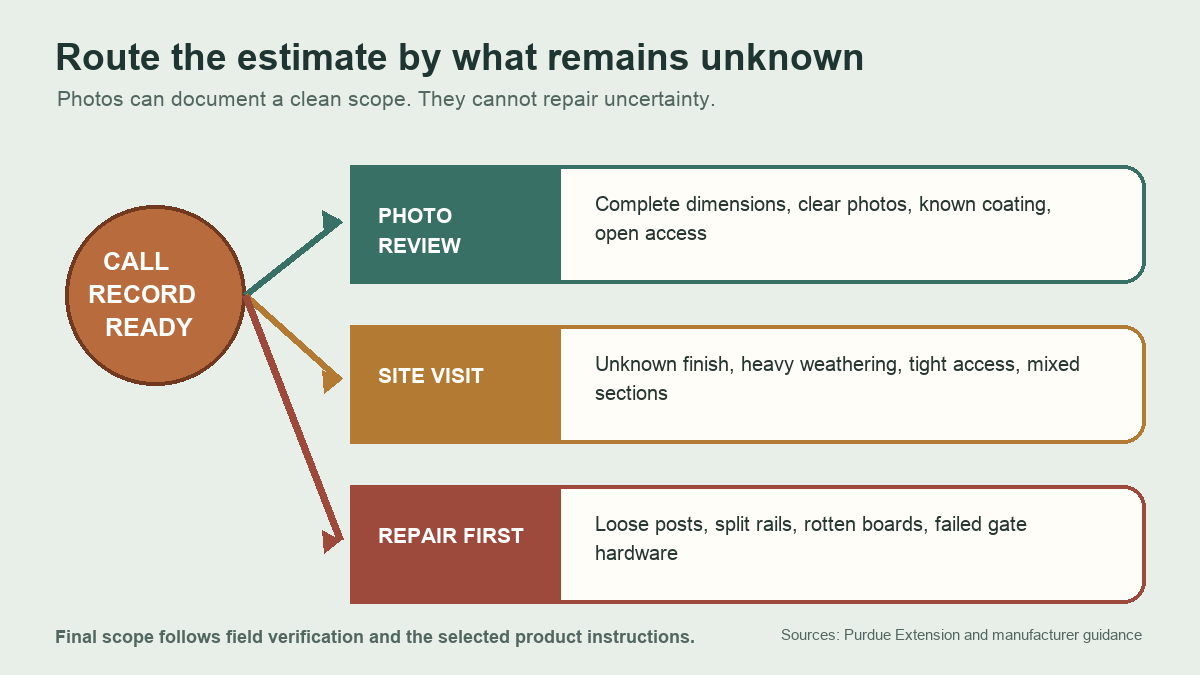
A clean handoff record should contain the address, contact and decision-maker, approximate dimensions by section, included faces, gate count, wood and coating history, desired appearance, cleaning and repair notes, access limits, nearby surfaces, photos requested or received, preferred timing, and the next review step.
Read the summary back before ending the call. “I have the rear and two side runs, both faces where accessible, two gates, an unknown older brown coating, gray boards near the shaded corner, and vines along the neighbor side. We’ll review your photos and confirm whether the estimator needs to visit.” That record gives the estimator something solid to open before calling the customer back.