A homeowner calls after looking at two dozen fence photos. She likes the grain of cedar, her spouse wants white vinyl, and both want a price before dinner. The office knows the street address and little else. There is no footage, gate count, survey, slope description, or clear reason for the fence.
The useful response begins with questions, not a winner. Ask what the fence must do, how the customer wants it to look, how much upkeep they accept, and what the property may require. Wood and vinyl can each be a sensible choice. The recommendation has to fit the selected product system, the site, and local rules.
A good call gets the project ready for an estimator. It does not turn the front desk into a remote estimator.
Start with the job the fence must do
“Wood or vinyl?” sounds like a material question. Usually it is a privacy, appearance, pet, pool, noise, or maintenance question wearing a material label.
Ask the caller to describe the outcome first. Do they want a solid backyard screen, a low front-yard boundary, an enclosure for a dog, or a gate that will be opened several times a day? Which view should remain open? Is matching an existing fence, house trim, or neighborhood style important? Has an HOA named an approved material or color?
The answer changes the conversation. A caller who wants a natural finish may accept periodic cleaning and refinishing. Someone who wants a consistent color with limited routine care may prefer a vinyl system. A large gate used for a mower, trailer, or service access deserves more attention than a seldom-used walk gate, whatever material surrounds it.
Record preferences in the caller’s words. “Low maintenance” is vague. Ask what it means to this household. One caller means “I do not want to stain boards.” Another means “I want to rinse the fence in spring and check the gates.” Those are different expectations.
Also ask whether the caller has seen a specific product, color, or fence style. “White vinyl” covers many panel designs and hardware packages. “Wood privacy fence” leaves the species, board layout, finish, posts, rails, and cap details open. Product photos or links help the estimator discuss the same thing the caller has in mind.
Compare upkeep without naming a canned winner
Wood is a natural material exposed to rain, sun, soil moisture, insects, sprinklers, and vegetation. The USDA Forest Products Laboratory’s guide to protecting wood fences explains how moisture, wood selection, preservative treatment, construction details, and finish affect decay and weathering. That supports a precise office explanation: care depends on the wood, finish, design, and exposure at this property.
Do not quote a universal refinishing schedule. A shaded fence beside irrigated planting beds lives in different conditions from an open fence in a dry, sunny yard. Ask whether the customer wants the wood to weather naturally or keep a finished color. Note sprinklers, dense vines, soil contact, and existing drainage concerns for the site visit.
Vinyl removes staining or painting from the ordinary care discussion, but “maintenance free” is too broad. Panels still collect soil, algae, lawn spray, and marks. Gates still use hardware. Landscaping can press against a fence. The selected system also controls post spacing, rails, reinforcement, gate details, and ways of handling a grade.
Weatherables’ vinyl fencing installation guide is one manufacturer example. It gives system-specific directions for layout, posts, gates, stepping, and racking. The office should therefore capture the slope and gate use, then let the estimator match those conditions to products the company installs.
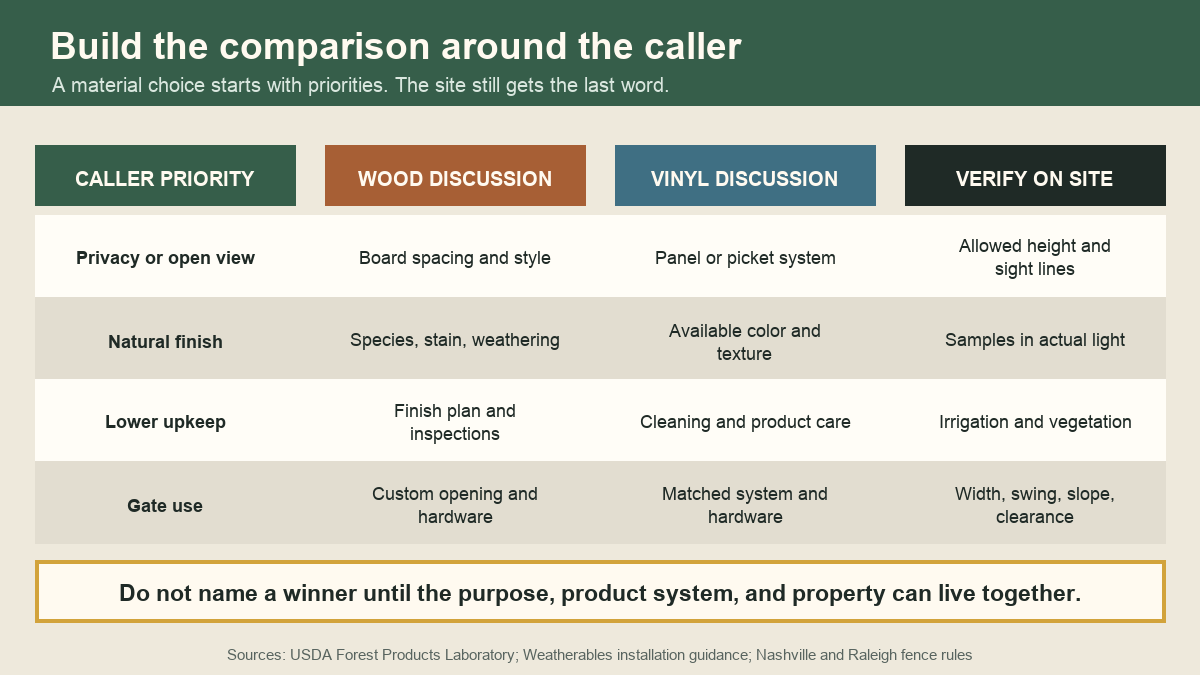
The point of this comparison is fit. A short phone call can identify the customer’s priorities and eliminate a few wrong assumptions. It cannot confirm whether a particular panel can follow the yard, whether a gate has enough clear swing, or whether the preferred height is allowed where the caller wants it.
Capture the site details that change the estimate
The office does not need survey-grade measurements. It does need enough context to assign the right visit and avoid obvious surprises.
Ask for the approximate length and number of separate fence runs. Note whether the project is a new enclosure, a replacement on the same line, or an extension from an existing fence. Get the desired height, number of walk gates, any wider equipment gate, and where each gate may sit. Ask whether the yard has a visible slope, retaining wall, drainage swale, large roots, hardscape, or steps near the proposed line.
Access matters. Can a truck reach the work area? Is there a narrow side yard, locked gate, alley, steep drive, shared driveway, septic area, or occupied rental? Are dogs normally in the yard? If an old fence must come out, ask what it is made of and whether the customer expects removal and disposal in the scope.
Photos help, especially wide views from both ends of each run. A close-up of one leaning post does not show the grade or access route. Request the address and several broad property views under the company’s normal submission process. If the customer has a survey or plot plan, ask them to have it available. Do not tell them that an informal sketch establishes a legal boundary.
Fence posts mean excavation. 811 Before You Dig specifically includes fence installation among projects that enter the utility-notification process. Each state has its own timing and rules. The call record should identify who opens and manages the ticket under company policy. Office staff should never promise that utility marks locate private lines such as owner-installed irrigation, lighting, or some service runs. Those conditions need a separate company procedure.
A price given before this information arrives is built on hidden assumptions. If the company offers a rough range, state exactly what it assumes and what can change after measurement, product selection, access review, and local checks. The written estimate should replace the phone range.
Keep boundaries and permits out of the promise column
Callers often say, “The old fence is on the property line, so the new one can go there.” That statement belongs in the notes, not in the verified-facts column.
Ask whether the customer has a recent survey, whether neighbors share or touch the existing fence, and whether any dispute is active. Record easements the customer knows about. Then explain the company’s boundary policy. A fence estimator can measure a proposed run, but the office should not present an old post, mowing line, hedge, online parcel map, or neighbor’s memory as a legal boundary.
Permit and placement rules vary enough that one national script will fail. Nashville publishes fence guidance that addresses height and corner visibility. Raleigh uses its own permit and zoning process for fences. Other jurisdictions use different height limits, setbacks, sight triangles, pool-barrier rules, historic-district review, or documentation requirements.
The safe script is plain: “We will record the height and location you want. The responsible local authority, and your HOA if one applies, decides what is allowed. Our estimator will explain which checks belong in our process and which documents we need from you.”
Do not promise approval timing. Do not interpret insurance coverage, deed restrictions, or a neighbor agreement. When the caller raises a legal boundary dispute, send the question to the appropriate surveyor, attorney, title professional, HOA, or local office under company policy.
The broader fence repair versus replacement call guide can help when the customer has an existing damaged fence and has not decided on project scope. Keep this material-comparison record focused on the proposed system.
Hand the estimator a clean consultation record
A complete record separates three stages. The call captures the customer’s purpose and known property facts. The customer supplies available photos and documents. The estimator verifies the buildable scope at the site.
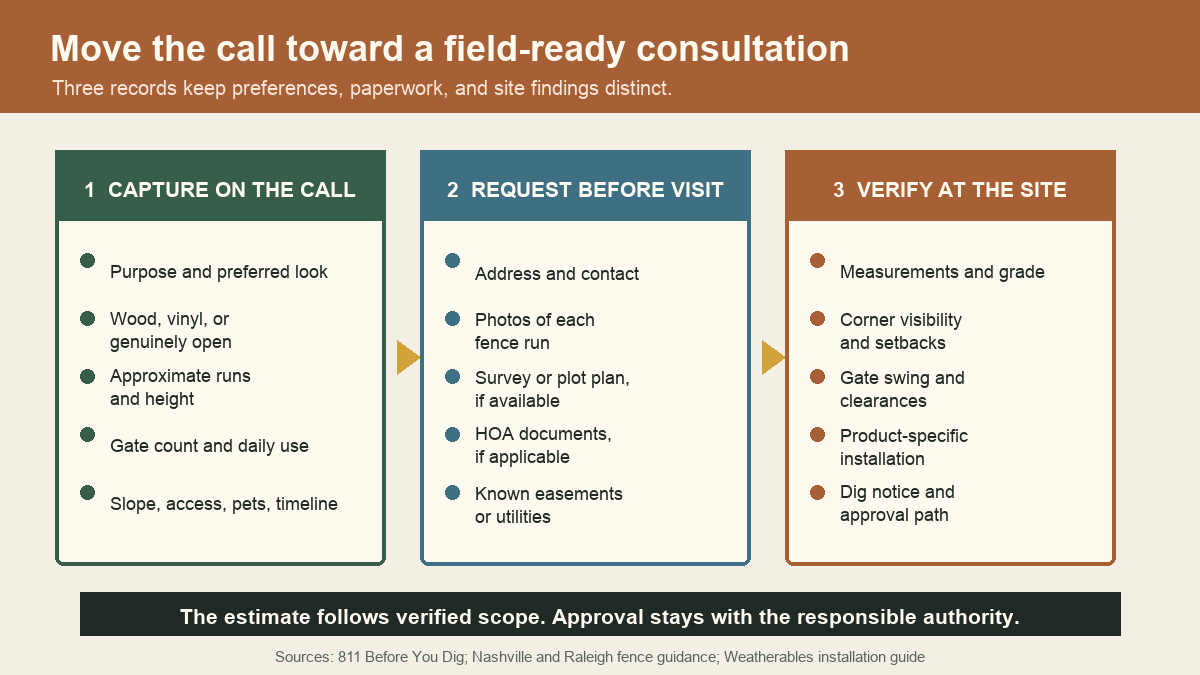
Before scheduling, the office should have these items when they apply:
- Customer name, property address, contact details, and decision-makers
- Fence purpose, preferred look, material interest, height, and rough layout
- Approximate runs, gate count, gate use, slope, access, and removal scope
- Photos, available survey or plot plan, HOA information, and known easements
- Pets, tenants, shared-fence concerns, timing, and any active boundary dispute
- A clear next step, appointment window, document request, and owner for follow-up
Close by reading back the details that will shape the visit: “You are comparing a stained wood privacy fence with a light-colored vinyl system for the rear yard. We have one walk gate, one wider mower gate, a slope toward the alley, and an old fence to remove. Please send the wide property photos and have the survey available. The estimator will measure, review access and grade, and discuss products that fit those conditions.”
An answering service or AI receptionist can capture the same fields after hours, provided the fence company defines the script and escalation rules. Material recommendations, boundary decisions, local approvals, and final pricing still belong with the people responsible for them.
That first call has done its job when the estimator arrives knowing where to look. The tape measure can then settle the questions that a phone conversation never could.