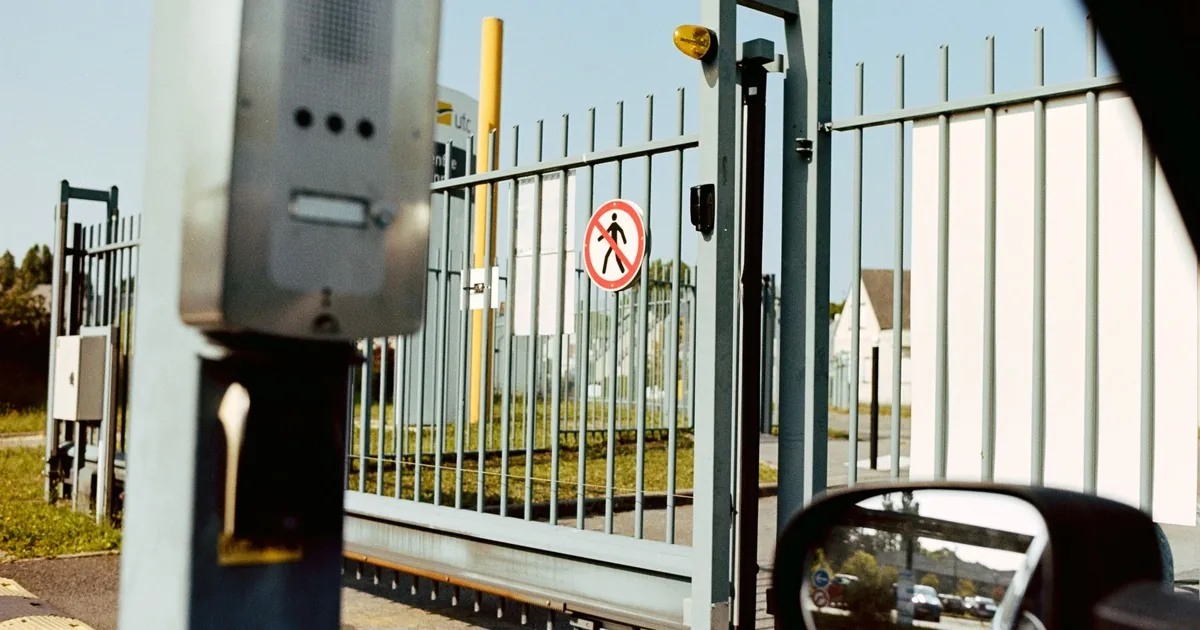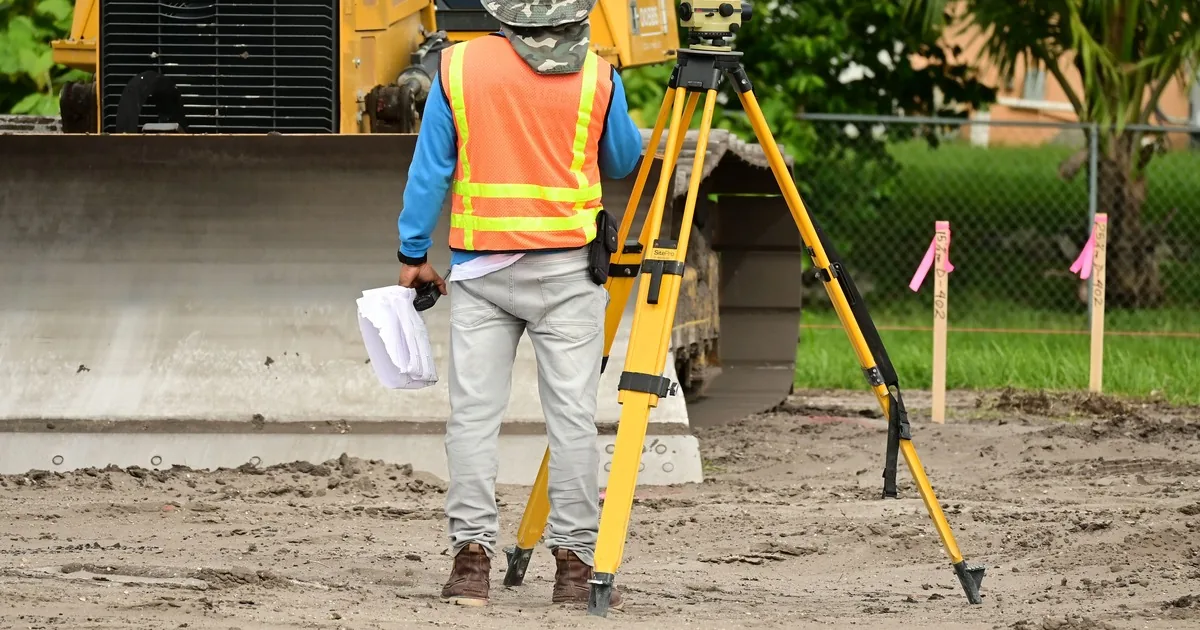
“The old fence is the property line. We just want the new one in the same place.”
That sentence can open an ordinary estimate call or a neighbor dispute that has been waiting twenty years for a post-hole auger. The office cannot tell which one it is yet.
A useful fence property line call records the proposed run, the source of the caller’s boundary belief, available surveys or plats, known easements, neighbor involvement, and any active disagreement. The office can then book an estimate, request documents, or pause the placement discussion under company policy. It should never present an old fence, hedge, online parcel map, or remembered corner marker as a verified legal boundary.
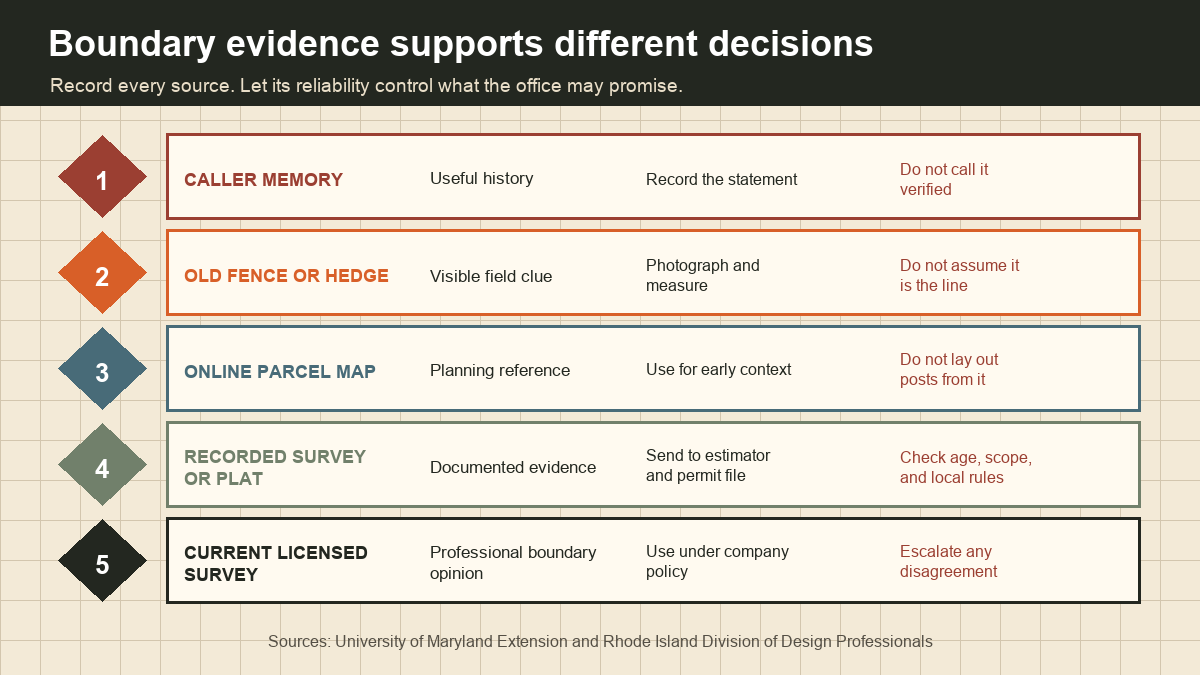
Treat every boundary statement as a source
Callers usually begin with a conclusion. “The pins are right there.” “The county map shows it.” “My neighbor agreed.” “The builder put that fence in.” Preserve the words, then ask what supports them.
An old fence is a physical fact. Its legal meaning is still unknown. It may have been installed inside the owner’s lot, placed by agreement, built without a survey, shifted during a past replacement, or accepted for reasons that have nothing to do with the deed line. A hedge and mowing line carry even less certainty. They show how people have used the yard.
Online parcel maps are useful for early context. They can help an estimator understand lot shape, street frontage, and the rough relationship between buildings. Their lines should not become post locations. Screen graphics, aerial imagery, and tax maps are built for purposes that differ from a field boundary determination.
The University of Maryland Extension guide to property boundaries describes the work through deeds, plats, survey records, monuments, measurements, and professional field research. Rhode Island’s land surveyor FAQ gives licensed professional surveyors the role of determining and physically marking a boundary under that state’s rules. Licensing language varies by state, but the office boundary is clear: a fence estimator can discuss a proposed run. A phone agent should not issue a legal boundary opinion.
Ask for the document before discussing placement
The most useful follow-up is simple: “Do you have a survey or plat you can send us?”
Ask for the date and whether the document covers the whole parcel. Find out whether the caller sees corner markers in the field and whether those markers match the document. Record the source without interpreting it. A closing survey, subdivision plat, permit site plan, title sketch, and homeowner drawing do not automatically carry the same scope or reliability.
The job address matters because local authorities ask for different records. Orange County, Florida requires a dimensioned site plan or dimensioned survey with the proposed fence location shown. Its process adds an acknowledgment when the proposed fence is in an easement. The City of Joliet, Illinois requires an accurate plat of survey with the proposed placement marked for a fence permit.
Those examples do not create a national rule. They prove why a national script should not promise that a sketch, tax map, or old permit is enough. Capture the municipality and let the responsible person check the current requirements for that address.
Ask whether an HOA, historic district, corner lot, pool, drainage easement, access easement, alley, or public right-of-way touches the proposed run. The caller may not know. Record “unknown” where the answer is unknown. That word is useful. A fabricated yes or no is not.
This document-first approach is narrower than a material consultation. For wood, vinyl, gates, grade, and maintenance preferences, use the wood versus vinyl fence consultation guide. Keep this call record focused on where the customer wants the fence and what evidence supports that location.
Route uncertainty before the crew is scheduled
A fence company needs a written policy for three moments: estimate, layout, and installation. The evidence required at each moment may differ.
An estimator can often visit a property while the owner is still locating a survey. The estimator can measure the yard, discuss materials, identify gates and access, and create a budget under stated assumptions. That does not mean the final post line has been approved.
Layout is where uncertainty becomes expensive. If the company requires visible surveyed corners, a current boundary survey, an approved permit plan, or a signed customer acknowledgment before layout, say so during intake. State who obtains each item and when it must arrive. “We can schedule the estimate now, but we cannot approve the installation line until the required boundary documents are in the file” is precise and easy to repeat.
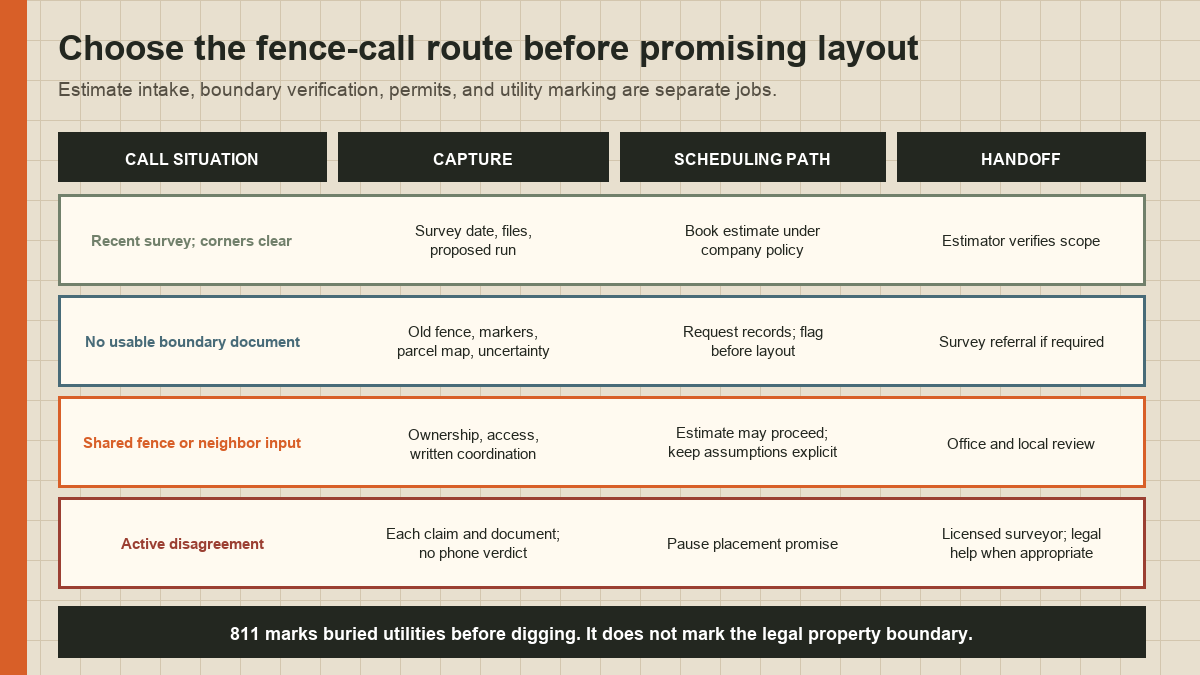
Active disagreement takes a different route. If the caller says the neighbor moved a pin, disputes the old fence, refuses access, threatens to remove new work, or has hired another surveyor, stop treating the issue as ordinary scheduling. Record each party’s statement as a statement. Do not decide who is right. The company may refer the caller to a licensed land surveyor, attorney, title professional, or local authority, depending on the issue and company policy.
Neighbor agreement can help coordination, but office staff should not convert a casual conversation into legal permission. Ask whether there is written approval, shared ownership, access across the neighboring parcel, or an agreement about removal and cost. Send the facts for office review.
Keep 811 marks separate from the property line
Fence posts require excavation, so utility marking belongs in the project file. It answers a different question.
811 Before You Dig directs anyone planning to dig to contact the applicable state 811 center so the approximate location of buried utilities can be marked before excavation. Those marks help protect people and underground facilities. They do not establish who owns the soil on either side of a fence.
Say the distinction plainly when callers blend the two processes: “The utility locate marks buried facilities for the digging work. Boundary documents and any required survey establish the placement information our company needs.”
The call should also capture known private facilities near the run. Irrigation, low-voltage lighting, invisible pet fencing, private propane lines, pool equipment, detached-building feeds, and gate-operator wiring may not be covered by the ordinary public-utility locate. The field team needs those observations even when the legal boundary is clear.
Record who opens the ticket under company policy, who confirms it is complete, and what must happen when marks conflict with the planned post line. Never promise an excavation date based only on the caller saying, “811 already came.” The ticket status, markings, tolerance requirements, and local rules need the responsible person’s review.
Write the assumption into the estimate handoff
A clean handoff separates facts, caller statements, documents, and unresolved items. That structure prevents a sentence such as “property line confirmed” from appearing in the job file when the caller actually said, “I think the hedge is ours.”
Capture these fields when they apply:
- Property address, municipality, owner or authorized decision-maker, and requested fence purpose
- Proposed runs, approximate length, height, gate locations, removal scope, and desired relationship to the boundary
- Every boundary source named by the caller, including document type and date
- Survey, plat, permit plan, easement, HOA, or neighbor documents received and still missing
- Visible markers, old fences, hedges, retaining walls, alleys, corner conditions, and access constraints
- Any disagreement, shared-fence issue, neighbor access need, deadline, or legal communication
- Permit, survey, 811, private-line, and follow-up owners under company policy
Read back the uncertainty. “You want the rear run near the existing fence. You have a 2019 survey to send us, one rear corner is visible, and the neighbor has asked to review the plan. We can schedule the estimate. Final placement will follow our document and site-review process.”
For a damaged fence where the caller has not chosen repair or replacement, the fence repair versus replacement call guide keeps condition and boundary questions in separate lanes. After a storm, use the storm-damaged fence intake guide to screen loose sections and immediate hazards before discussing a permanent line.
A trained receptionist or AI receptionist can collect these fields after hours. The tool should preserve uncertainty exactly as the caller describes it. Survey interpretation, permit approval, dispute resolution, and final layout stay with the people qualified and authorized to make those decisions.
The estimator should arrive with a proposed run, a document file, and a short list of open questions. Then the tape, records, and field evidence can do their proper work before the first post hole is opened.