A homeowner calls with a clean request: six-foot privacy fence, cedar, backyard, estimate next Tuesday. Then they add, almost as an afterthought, “The neighborhood has an HOA, but everybody has fences.” That last sentence changes the job file.
The right response is simple. Ask for the association’s current fence standards and architectural application, record what the homeowner has already submitted, and book the site measure under your company’s policy. Call it an estimate. Do not promise HOA approval, an installation date, or that the neighbor’s fence proves the same design will pass.
This lets the sales process move without turning your receptionist into an architectural committee.
Start with the association’s actual documents
The first intake question is direct: “Is this property part of a homeowners association or another community with architectural rules?” If the caller says yes, ask where the current rules and application can be found. A portal link, management-company email, PDF, or printed packet all work. The office needs the source document, not the caller’s memory of it.
That distinction matters because association rules can cover fences, exterior changes, landscaping, decks, paint colors, and other visible work. The Community Associations Institute’s homeowner guide points owners to their governing documents and architectural guidelines. Those documents control the private review for that property.
A fence across the street is useful context. It is weak approval evidence. It may predate the current standard, belong to a different phase, have a variance, or have been installed without permission. The office can note “neighboring home has white vinyl privacy fence.” It should never translate that observation into “white vinyl is approved here.”
Ask the caller to send the complete fence section, not one screenshot with the preferred style circled. Definitions, corner-lot rules, finished-side requirements, application instructions, and drawing standards may sit on different pages. Save the file with its date or version if one appears. Old standards have a habit of resurfacing in email threads.
Build the packet while the estimate moves
Most fence companies do not control the association’s decision. They can still make the application easier to assemble.
Start by assigning ownership. The association supplies its rules, form, submission channel, and written decision. The homeowner usually supplies the address, signature, requested fence run, and any property records in their possession. The fence company can provide the proposed style, material, color, height, layout drawing, product details, proposal, and company documents that the actual checklist requests.
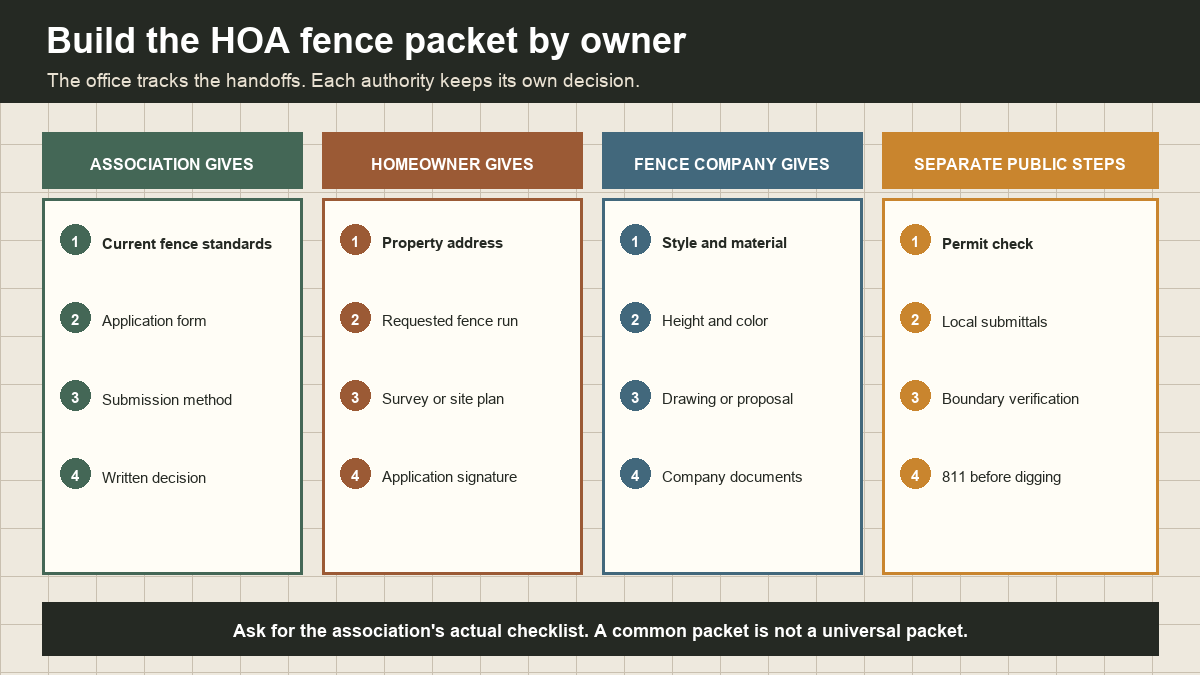
Common packet elements are useful as a starting point, but they are not a universal checklist. Fence-industry guidance often discusses material, color, height, placement, plans, and supporting documents. The receptionist should still ask, “What does this association require for this address?”
That question prevents two bad handoffs. In the first, the homeowner waits for a drawing that the fence company does not produce until after a site visit. In the second, the estimator creates a detailed proposal, then learns the application needed a marked survey and a material sample as well. Both are avoidable once every line on the checklist has an owner.
The office record should show whether each item is requested, received, missing, or outside the company’s scope. “Survey pending from homeowner” is useful. “HOA stuff in progress” is not.
Keep private approval and public requirements separate
HOA approval answers one question: has the association accepted the proposal under its private governing process? It does not answer whether the local government requires a permit, whether the proposed run follows the legal boundary, or whether buried utilities have been marked before digging.
Public fence requirements vary by address and project. For example, Orange County, Florida requires a dimensioned site plan or survey with the proposed fence location for its residential fence permit submission. Austin publishes its own fencing regulations, with local conditions that do not automatically apply anywhere else. These pages are examples of why the office needs the job address and correct jurisdiction before discussing permits.
Boundary evidence belongs on its own track too. An HOA may want a site plan, but accepting an application does not turn an old fence, online parcel image, or homeowner sketch into a verified legal boundary. If the caller is unsure where the line sits or says a neighbor disputes it, follow the company’s boundary policy and route the issue before layout is promised. Our guide to fence property-line and survey calls covers that intake in detail.
Then comes excavation safety. 811 directs people planning to dig to contact the applicable state 811 center so buried utilities can be marked. That process does not grant HOA permission, issue a fence permit, or identify the property line. Treating these gates as interchangeable is how a file marked “approved” reaches a crew while one important piece is still missing.
Match the words to the application status
Reception staff need language they can use without consulting a manager on every call. The safest approach is to describe the next action and name the authority that owns the decision.
When the caller has not checked for an HOA, say: “Let’s confirm whether the address has an association and get the current fence rules before we settle on a design.”
When the standards are available but no application has been started, say: “We can schedule the site measure and build the proposal around those written standards. The association will make its own decision after submission.”
When the packet has been submitted, ask for the receipt, portal status, or confirmation email. Say: “We’ll keep the estimate file ready and wait for the written review. If the committee requests a revision, send us the exact comment.”
When written approval arrives, confirm what it approves. Check the drawing version, fence type, color, height, gates, and any conditions. Then say: “We have the HOA decision on file. We still need to verify the project’s permit, boundary, access, utility-marking, and scheduling requirements before releasing installation.”
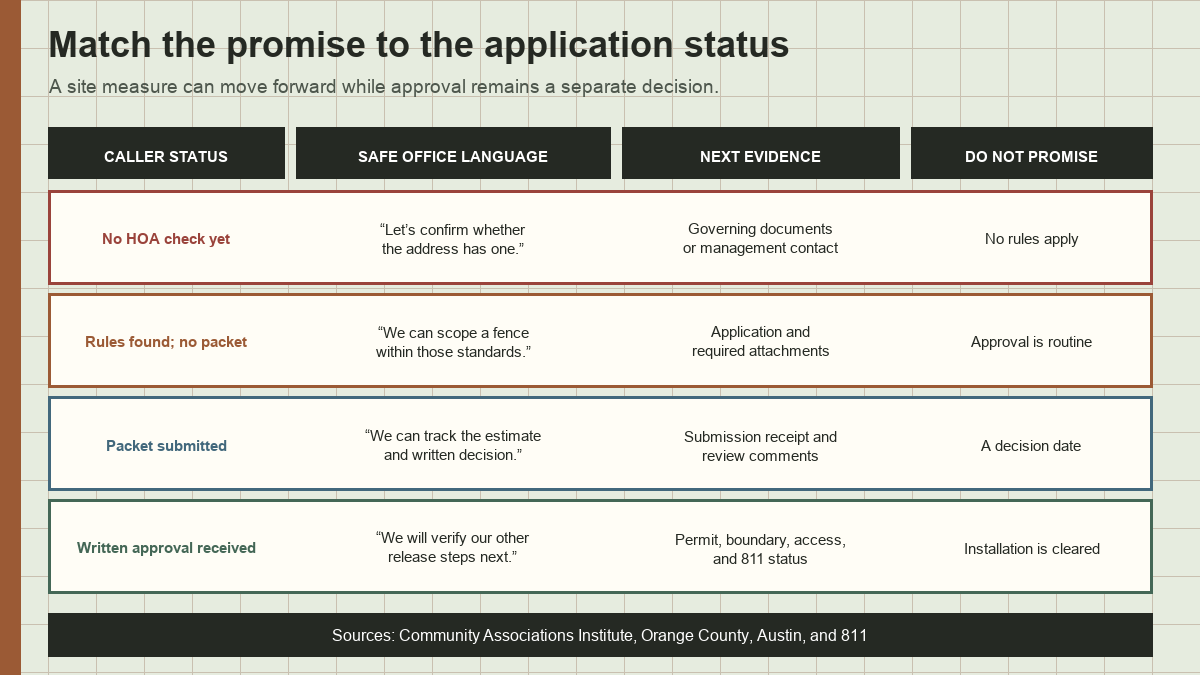
Avoid predicting how long the committee will take. The governing documents or management office may publish a process, but the fence company should not invent a review date. “Submitted Monday” is a fact. “They should approve it by next week” is a guess that will land back on your phone.
Ask questions that expose the missing handoff
A good HOA fence call record answers these questions before the estimator opens it:
- What is the property address, community name, and management or board contact?
- Which current governing document covers fences, and has the full section been saved?
- What fence style, material, color, height, gate plan, and approximate run does the homeowner want?
- Does the application require a survey, marked site plan, product sheet, drawing, proposal, contractor license, or insurance record?
- Who owns each missing item, and where will it be submitted?
- Has the homeowner received a confirmation, written comment, approval, denial, or conditional approval?
- Are there separate permit, boundary, neighbor-access, pool-barrier, easement, or utility-marking questions?
- Is the appointment a site measure, design consultation, revised estimate, or installation visit?
Read back the status in one sentence: “We are booking a measure for a proposed cedar fence; the homeowner is getting the HOA application and survey; no application has been submitted; installation has not been scheduled.” That sentence can survive a shift change.
Photos help, especially on corner lots, shared fence lines, slopes, and yards with utility equipment. Ask for wide views of the proposed run, each gate location, the house, and the street side. Close-up photos of a favorite picket do not show the constraints an estimator needs.
For broader project scoping, use the fence estimate scheduling intake guide. It covers footage, gates, grade, removal, access, and material questions that still matter after the HOA status is recorded.
Hand the estimator a file that can be trusted
The estimator should see the desired fence and the approval state without searching through a text thread. Put the governing excerpt, application, site documents, proposed design, customer messages, and written association response in one job record. Preserve dates and versions. Label assumptions.
If a committee requests a change, quote the written comment exactly. “HOA wants a shorter fence” may conceal a front-yard restriction, a sight-triangle issue, or a request for a different drawing. The field team needs the source language before revising the scope.
An AI receptionist can capture the same fields after hours, but the workflow works with any trained person and a disciplined job record. The test is what happens on installation morning: the crew should be able to identify the approved design, the drawing it matches, and every remaining release gate before the first post hole is marked.