A superintendent calls at 4:40 on Friday. The first delivery arrives Monday morning, and the site needs temporary fence before then. “We need about 600 feet with a gate” sounds like a quote request, but it leaves out the details that may decide whether Monday is realistic: the address, paved and soil sections, the largest vehicle using the gate, public sidewalk exposure, windscreen, installation access, and who can approve a layout change.
A useful temporary construction fence rental call should capture the job address, project type and stage, requested installation and pickup windows, approximate perimeter, corners, surfaces, gate traffic, screening, public exposure, delivery access, and expected changes during the project. Reception should collect the site facts and route the configuration decision to the estimator or installer. Do not promise a permit result, a safe anchoring method, or regulatory compliance from a phone description.
Start with the address, dates, and project stage
Get the exact service address first, including the gate or street where the delivery crew should enter. A large project may have a mailing address, a trailer entrance, and a separate equipment gate. “Meet the superintendent at the south entrance on Grant Street” is more useful than a pin dropped at the center of a parcel.
Ask what work is happening. New construction, demolition, utility work, facade repair, emergency stabilization, and a short roofing project create different schedules and public exposures. Record whether the site is vacant, occupied, open to customers, next to a school, or sharing access with another contractor. Those are observations for planning, not a substitute for the installer’s site review.
Then separate three dates:
- When can the crew first enter and install?
- When must the perimeter be ready for the project?
- When is pickup expected, even if the date is provisional?
The gap matters. A caller may say the job “starts Monday” while concrete trucks arrive before daylight Monday and the fence crew cannot enter until Sunday afternoon. Note gate hours, badging, a required site contact, union or building access rules, and any delivery appointment process.
Rental vendors commonly ask for location, timeline, approximate footage, access points, windscreen needs, and project stage. That is a sound opening intake. It still leaves the physical layout to map.
Turn rough footage into a usable perimeter
Callers often know a bid quantity but cannot describe the route. Ask how they arrived at the footage. Did it come from a plan, a wheel measurement, a property listing, or a quick guess? Keep the source attached to the number.
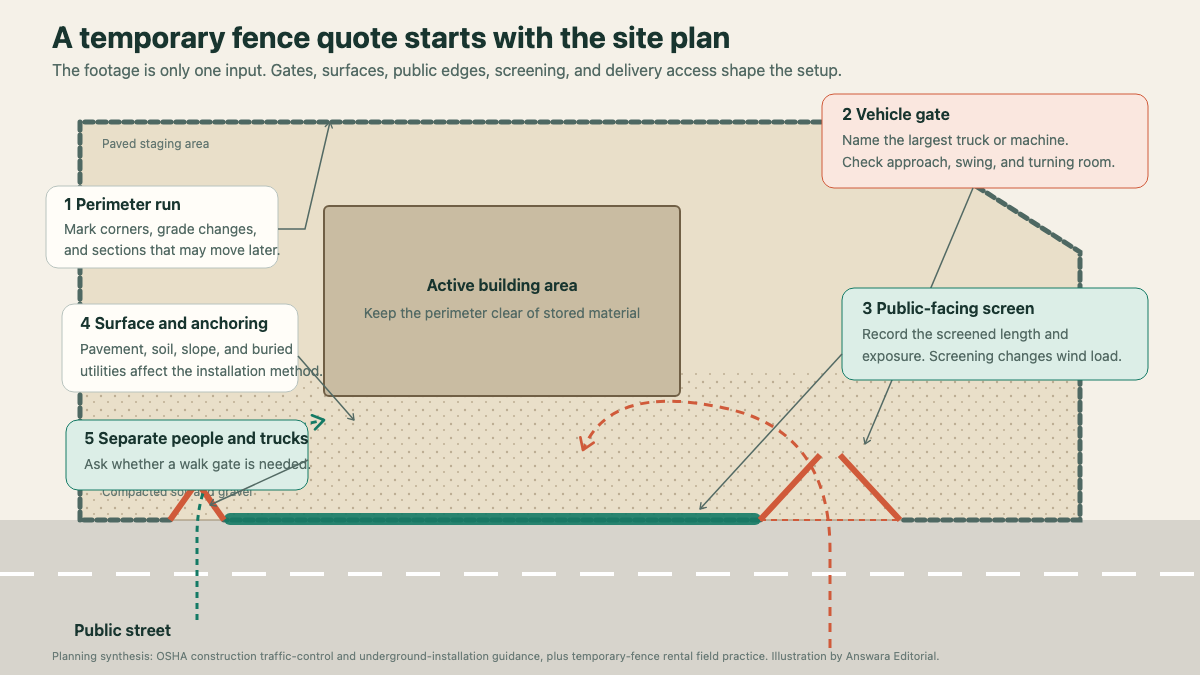
Walk the perimeter verbally. Start at a named point, such as the northeast building corner or driveway entrance. Ask where the line turns, changes grade, crosses pavement, meets a wall, or stops for a gate. Find out whether the site needs a full enclosure, one exposed edge, an interior separation around equipment, or several disconnected runs.
Surface changes deserve their own note. Freestanding panels on weighted bases and posts driven into the ground are different installation methods. Site Services USA describes panel fencing as movable and free of ground disturbance, while driven posts enter the ground and are generally considered for more stable, longer-duration installations. Reception should record pavement, concrete, compacted gravel, soft soil, slope, curbs, drainage paths, landscaping, and recently finished surfaces. The installer chooses the method.
Ask for a marked plan when one exists. A phone photo of a hand sketch can also help if the caller labels the street, building, corners, gates, and measurements. Do not clean up an uncertain line by inventing a straight segment. Mark it “field verify.”
If the request is actually for a permanent owned perimeter, use the company’s permanent-fence workflow. The fence repair versus replacement guide also covers existing fences that may be repaired, removed, or replaced. A rental has a delivery, changing project phases, and a planned removal.
Size gates around actual traffic
“Add a gate” is incomplete. Ask who or what passes through it. A walk gate for ten workers at shift change serves a different purpose than an opening for dump trucks, a telehandler, long material deliveries, or emergency access.
Get the largest expected vehicle or machine in ordinary language. Ask how it approaches, whether it must turn through the opening, and where it can wait without blocking traffic. Record whether the gate opens onto a public street, alley, loading dock, parking lot, or internal haul road. Ask who locks and unlocks it, what hours it operates, and whether the caller expects separate pedestrian access.
Do not convert a vehicle description into a final gate width. Mirrors, trailers, turning angle, grade, gate swing, hardware, traffic-control needs, and available fence line all affect placement. A useful note reads, “Tandem dump trucks enter from Mason Avenue and turn left inside the site; caller requests separate worker entry near the trailer.” The installer can work with that.
Powered or access-controlled gates need a different review path. If the caller mentions a motor, keypad, card reader, safety device, or existing operator, route the request under the company’s equipment rules. The commercial gate operator service call guide helps offices separate an operator problem from ordinary fence and gate hardware.
Treat screening and driven posts as review items
Privacy screen can change the setup because it adds surface area exposed to wind. Ask which fence sections need screening and why: public sightlines, dust concerns, an occupied neighboring property, branding, or a project specification. Record nearby open corners, street canyons, exposed lots, previous tip-overs, and any wind restrictions supplied by the site. Never promise that a screened run can use the same supports as an unscreened run.
The intake question should be concrete: “Which edge needs screen, how long is that edge, and what is on the other side?” A caller who says “screen everything” may mean the 200-foot public sidewalk, not the rear service boundary. Confirm it.
Driven-post requests also need a firm boundary. OSHA’s excavation rule says expected underground installations must be located before excavation begins. A fence office should ask whether the site has utility markings, private utilities, irrigation, temporary power, underground fire lines, recent civil plans, or restrictions on ground penetration. Reception does not clear the ground. The estimator, installer, project team, and utility-location process handle that work under the company’s policy and local requirements.
Avoid broad statements such as “OSHA requires a six-foot fence” or “this setup is OSHA compliant.” Federal construction rules address specific hazards. For example, OSHA requires traffic-control signs and devices at construction traffic hazards. Local codes, project specifications, property conditions, and the actual work may add other requirements. A generic perimeter fence does not settle those questions.
Capture delivery access and change orders before they become surprises
Fence material has to reach the run. Ask whether a delivery truck can enter, turn, unload, and leave. Note low branches, overhead lines, narrow alleys, loading limits, soft shoulders, locked entrances, active excavation, and material stacked along the proposed fence line. If the installation crew must carry panels through a building or use an elevator, say so plainly.
Find out who will meet the crew and who can approve a field change. A drawing may place a gate where a dumpster now sits. The best contact may be the superintendent, but the project manager or owner may hold cost authority. Put both roles in the ticket when they differ.
Construction perimeters move. Ask what is likely to change after mobilization: excavation limits, building access, crane picks, concrete pours, public walkways, landscaping, or turnover phases. Rental providers commonly relocate sections, add panels, and adjust gates as a project develops. The quote should state how the company handles those requests. Reception should not imply that every move is included or available immediately.
Also ask how pickup will be triggered. Does the rental end on a fixed date, continue month to month, or require a call from an authorized contact? Confirm whether the site will be clear enough for removal and whether another contractor controls the exit by then.
Set the quote boundary before discussing price
A preliminary quote may be possible when the office has a clear address, dates, mapped footage, known surfaces, gate uses, screen length, and delivery route. A site visit or estimator review becomes more likely when dimensions conflict, the line follows steep grade, driven posts are requested, screen covers an exposed run, traffic shares the gate, access is tight, or public space may be affected.
Use the company’s real pricing structure. Avoid inventing a universal rate per foot. Delivery distance, installation method, gates, screening, rental duration, site access, changes, pickup, damage terms, and local requirements can all matter. If the caller wants an immediate number, explain the next decision: “I have the footage and dates. I still need the gate traffic, surface types, screened sections, and delivery entrance before our estimator can review the setup.”
A strong read-back sounds like this:
“Commercial renovation at 418 Mason Avenue. Requested install Thursday morning before Friday mobilization. Caller estimates 620 feet from a marked site plan, with four corners and one 80-foot section on pavement. Remaining run is compacted soil. One vehicle entrance serves dump trucks and material deliveries; a separate worker gate is requested near the trailer.
“Caller requests privacy screen only along the public sidewalk. The west edge is described as exposed to wind and needs installer review. Site has current public utility markings, but the caller reports private temporary power near the proposed south run. No ground-penetration method has been promised.
“Delivery should use the Mason Avenue entrance. Superintendent Elena Ruiz will meet the crew; project manager David Chen approves cost or layout changes. Pickup date is estimated for late March and must be confirmed by David. Estimator will review the plan, installation method, gate placement, screening, schedule, and any permit or traffic-control questions.”
An AI receptionist can collect these approved fields after hours and flag a deadline or public-access issue under the rental company’s rules. The handoff should include the physical site, the unresolved decisions, and the person authorized to answer them. That is enough for an estimator to start without pretending a Friday phone call designed Monday’s fence.