A homeowner calls after a branch cracked one white privacy panel. The rest of the fence looks fine, and the caller wants “the same eight-foot panel” installed next week. Then the photos arrive. One post leans toward the yard, the bottom rail has split at the routed opening, and the fence beside it has faded to a warmer white.
The office should treat this as a system-matching request, not a generic panel order. Record the damaged bay, actual dimensions, post and rail condition, style, color, manufacturer clues, access, and the customer's tolerance for a visible difference. The estimator decides whether a compatible component exists and whether the damage stops at the panel.
Identify the system before discussing a match
“White vinyl privacy fence” still leaves most of the useful details unknown. Vinyl systems differ in post size, routed openings, rail profile, board construction, reinforcement, cap style, texture, color, and the way sections follow grade. A panel that looks close in a catalog may not connect to the posts already in the ground.
Ask the caller what they know about the original installation. The installer name, manufacturer, product line, invoice, warranty packet, permit file, spare cap, or leftover rail can turn a visual hunt into a parts lookup. A label may appear inside a cap, on a rail, or in old paperwork. Reception should record the wording exactly and request a clear photo. Do not “correct” a model name that looks unusual.
Hoover Fence's replacement-parts guidance explains that rails and pickets can be difficult to match when the manufacturer or model is unknown. It recommends comparing profile dimensions and even the internal ribbing visible in a component cross-section. That is why “six-foot white” cannot support a fit promise.
The Bufftech installation guide shows how product families use their own combinations of posts, rails, boards, accents, and variable-terrain methods. Use manufacturer literature for the identified system. Avoid turning one brand's diagram into a universal rule for every vinyl fence.
Separate panel damage from support damage
Start with a wide description. Ask where the bay sits: straight run, corner, gate, pool enclosure, slope, retaining wall, alley, shared boundary, or end post. Record what caused the damage if the caller knows. A branch strike, vehicle contact, wind event, mower impact, heat exposure, and slow movement over time create different questions for the field visit.
Then walk through the visible parts. Is a single board cracked, or has the top or bottom rail split? Did either rail pull out of a routed post? Is a U-channel loose? Are caps missing? Does the damage continue into the neighboring bay? If a gate shares either post, ask whether the latch still meets and whether the gate drags.
Posts deserve their own line in the ticket. Ask whether each post looks plumb compared with an intact neighbor, moves when the fence is touched, has a crack around a routed opening, or sits beside lifted soil or broken concrete. The caller should observe from a safe position. They should not push hard on a loose fence, dismantle a cap, or dig around a footing for the sake of the estimate.
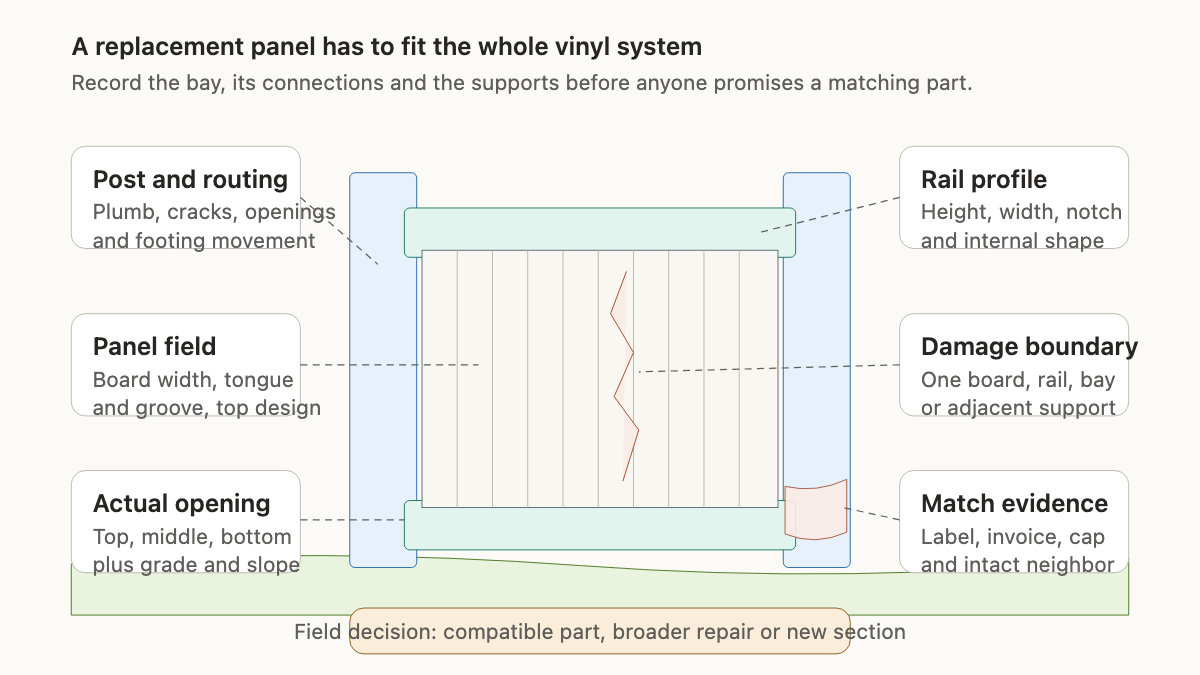
The visible break may be only part of the work. A new panel cannot pull a moved post upright or restore a cracked rail connection. Reception does not need to label the damage structural. It needs to preserve the evidence so the estimator arrives ready to inspect the right area.
Record dimensions without turning reception into the installer
Ask whether the caller can safely take measurements from the ground. If so, request the finished height, the clear space between the inside faces of the posts, post face width, rail height and width, and the distance between rail locations. For loose pieces already on the ground, a photo of the end profile beside a tape measure may help.
Use actual dimensions and state where each was taken. “Clear opening is 91 3/4 inches at the top and 91 1/4 inches near the bottom” carries more information than “eight-foot panel.” If the values differ, record them. Do not average them or tell the customer which size to order.
Slope also matters. Ask whether the rail tops remain level while the sections step downhill, or whether the whole section follows the grade. A straight-on photo should include the neighboring bays and the ground line. Another photo from the back can show channels, brackets, fasteners, and the way rails enter posts.
Royal Fence's panel-matching guide distinguishes clear opening, post spacing, post face, rail position, and board profile. Its practical point is sound: the label on a nominal panel does not tell you every dimension that controls fit.
Build a photo set that can identify the bay
Ask for a small, deliberate set of images:
- One wide photo showing the damaged bay, one intact bay on each side, the ground, and any nearby gate or corner.
- One straight-on photo of the complete section with a tape measure visible where it can be read.
- Close views of each rail-to-post connection, the damaged edge, post cracks, and any loose component already on the ground.
- Front and back views of an intact neighboring panel, including the top profile, caps, channels, brackets, and fasteners.
- A daylight color photo that includes the old fence and any spare piece, label, invoice, or product sample.
File names should identify the location: “north-run-damaged-bay-wide,” “left-post-bottom-route,” and “spare-cap-label” are useful. A stream of unlabeled close-ups forces the estimator to reconstruct the fence from fragments.
Ask the caller to leave broken pieces in a safe place. Even a short rail or board fragment can reveal wall thickness, internal ribs, tongue-and-groove shape, texture, and color through the material. The office can note that evidence without promising the supplier will find an exact replacement.
Set a careful expectation about color and age
Color names are product details. “White,” “tan,” and “gray” may cover several manufacturer colors, textures, and production generations. Years of sun, irrigation, surface dirt, mildew, and nearby landscaping can change how an installed section looks. A new part from the original product line can still stand out beside older material.
Ask where visibility matters. A rear corner behind shrubs presents a different appearance concern than an uninterrupted front run, pool enclosure, or side shared with a neighbor. Record whether the customer will accept the closest compatible match, wants the company to investigate an exact product first, or would consider replacing a larger run if one bay cannot blend well.
Do not promise that cleaning will produce a match. Do not advise bleach, solvents, pressure settings, paint, or refinishing during intake. Product care instructions vary, and a field professional should see the existing finish before suggesting treatment.
If an HOA or architectural committee governs the fence, ask for the approved product, color, height, and style documents. Record whether approval is already in hand. The fencing office can quote or inspect the requested work without guaranteeing what an association or local authority will permit.
Route the visit with access and ownership settled
Confirm the service address and which side of the property reaches the damage. Note locked gates, dogs, tenants, narrow side yards, pools, steep grade, thorny planting, stored items, irrigation heads, low branches, and parking limits. Ask whether the crew can view both sides of the fence. A shared boundary may require neighbor access, but reception should not interpret ownership rights.
Clarify who owns the decision. The caller may be a tenant, property manager, association representative, neighbor, buyer, insurance contact, or homeowner. Identify who can authorize inspection, approve a close match, and choose a larger replacement scope if the original product is unavailable.
A useful readback sounds like this:
“Replacement request for one white vinyl privacy bay on the north run beside the gate. A fallen branch cracked four boards and the bottom rail near the right post. The right post appears to lean toward the yard, and the gate latch has been rubbing since the event. Reception made no repair or compatibility determination.
“The owner found a 2016 installer invoice naming the product line and attached it. Photos include the full run, both sides of the damaged bay, each rail connection, the gate, and an intact neighboring section. Actual opening measurements are labeled by location. A loose rail fragment and cap are available at the property.
“The fence is visible from the street. The owner wants an exact match investigated first but will discuss replacing the gate-side run if the product is discontinued. The owner will attend. The yard is locked, one dog will be secured, and the estimator can access both sides.”
That record gives the field estimator a damaged system to inspect, not a catalog nickname. The broader repair-versus-replacement guide helps when several materials or long runs are involved. Use the wood-versus-vinyl consultation guide when the caller is still choosing a material. An AI receptionist can collect approved fields after hours, while fit, support condition, and match quality remain field decisions.