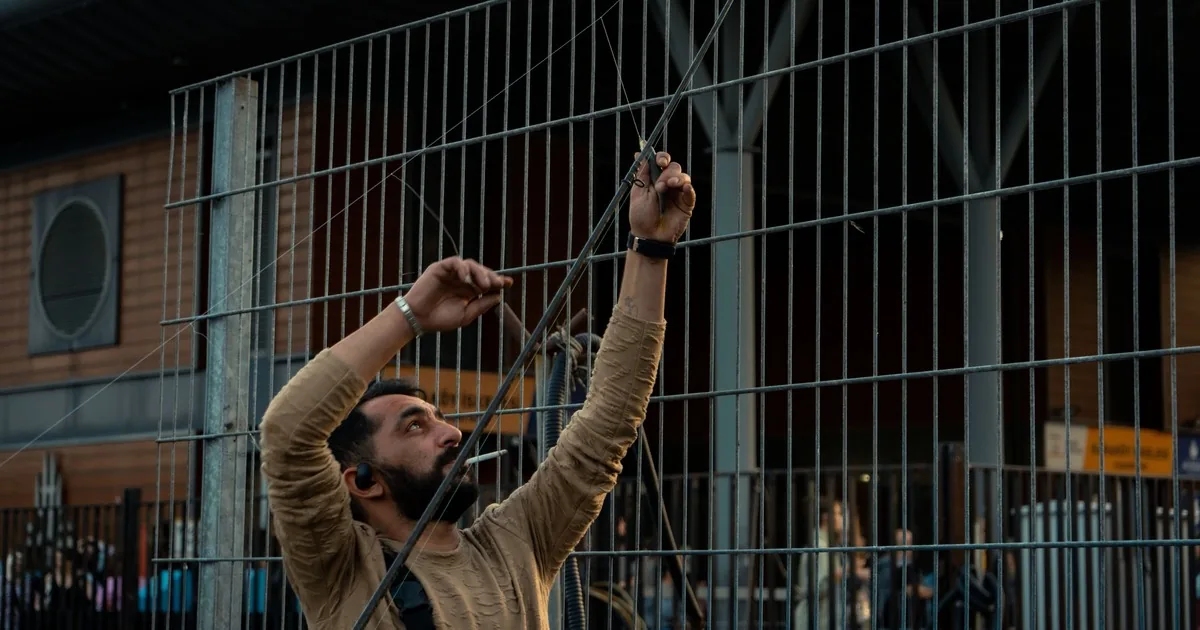
A caller says, “A delivery truck backed into my chain link fence. Can you tell me what it will cost?” They send one close photo of folded wire. The image proves there is damage, but it hides the two details that may change the job: the top rail is bowed beyond the frame, and the nearest terminal post has shifted at the footing.
A useful chain-link fence repair estimate call should capture the damaged length, fence height and finish, affected fabric, posts, rails, tension hardware and gates, the cause, any containment problem, site access, and who owns or controls the fence line. Ask for one wide photo that shows the whole run and close photos of each failed part. The estimator can then decide whether to discuss a preliminary range, request more evidence, or schedule a site visit.
Start with the damaged run, not the worst-looking hole
Begin with location and length. Ask the caller to stand back where they can safely see the affected fence and estimate the distance between the first undamaged area on one side and the first undamaged area on the other. A rough answer such as “from the corner post to the gate, about the length of one parking space” is more useful than pretending the caller has an exact measurement.
Record the fence height and finish. Galvanized wire, black or green polymer-coated fabric, and an unknown older finish create different matching questions. Ask whether the damaged run is straight, turns a corner, changes grade, or meets a gate. Those transitions often place a terminal, corner, pull, or gate post inside the repair area.
Then capture the cause in the caller’s own words. Vehicle impact, a fallen limb, soil movement, corrosion, vandalism, and an animal pushing under the fabric point to different inspection needs. If the caller does not know what happened, write “cause unknown.” Do not convert a lean into a guessed diagnosis about concrete, drainage, or soil.
The broader fence repair versus replacement intake guide helps route mixed-material and whole-line questions. Keep this call focused on the chain-link run and its parts.
Name the part that failed
“Chain link” is often used to describe the entire assembly, but the fence has several components. The chain-link industry terminology reference distinguishes the woven wire as fabric and the supporting posts, rails, and tension wire as framework. Tension bars and bands secure fabric to terminal posts. Ties attach it along rails and line posts. A gate adds a frame, hinges, latch, and its own posts.
That vocabulary makes the ticket clearer. Ask the caller to describe what they can see:
- Is the fabric torn, stretched, curled at the bottom, loose from a post, or rusty across a wider area?
- Is a post leaning as one straight piece, bent above grade, loose at the base, or broken where it enters the ground?
- Is the top rail bowed, separated at a sleeve, pulled out of a rail end, or missing?
- Are tension bars, bands, ties, or bottom tension wire loose, broken, or visibly absent?
- Does a nearby gate drag, swing open, bind, or fail to meet the latch?
The office is collecting observations. A field estimator still decides whether a post can be reset, whether a rail or fabric section can be spliced, and whether widespread corrosion makes a spot repair poor value.
The distinction matters because fabric work and footing work are different scopes. The Hawaii Department of Defense’s chain-link fence specification treats post setting, framework, fabric tension, fittings, ties, and gate adjustment as separate parts of installation. A residential repair will have its own specifications, but the component breakdown gives reception a sound way to describe the request.
Ask for photos that show scope and detail
A single close-up can hide the fence line. A single wide shot can hide a cracked fitting. Ask for both.
The first image should show the entire damaged run, including the nearest sound post on each side when possible. The second should show the failed component at conversational distance. Add close photos of the post at grade, any rail bend or separated sleeve, the fabric edge at a terminal post, and gate hinges or latch when those parts are involved. For matching, request one image of an undamaged section in the same run.
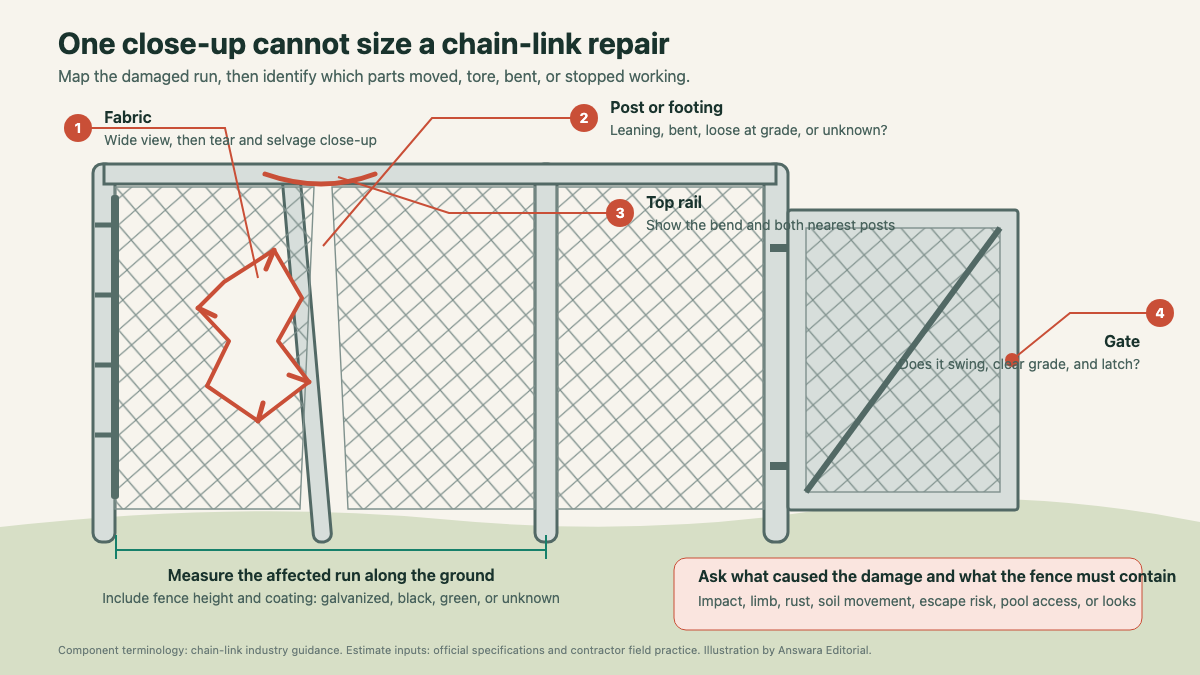
Keep the request safe. Do not ask the caller to pull sharp wire, push on a leaning post, lift a gate, remove bands, or climb over a blocked opening. If a photo cannot be taken from the caller’s side of the fence, mark that view unavailable. The crew can inspect it on site.
Photos should preserve context. A hand pointing at a small tear can help with scale, but it should not replace a full view. If the fence borders a road, pool, utility area, active work zone, or neighboring property, note that setting. Never direct the caller into traffic or onto land they do not control to improve an intake photo.
Separate urgent containment from ordinary repair
Ask what the fence currently does. A torn back boundary with no immediate exposure may be scheduled like routine repair. An open pool enclosure, dog escape route, unsecured commercial yard, sharp wire beside a public walkway, or gate that cannot secure needs the company’s priority and escalation rules.
Urgency does not authorize the office to promise a same-day permanent repair. State what the company can actually do: flag the call for review, offer the next inspection window, or have a designated person discuss temporary measures. If a pet is escaping through the opening, use the narrower dog escape fence repair call guide. Damage after severe weather belongs in the storm-damaged fence intake workflow.
Record any immediate hazards without dramatizing them. “Two wire ends protrude toward the public sidewalk” gives the dispatcher something concrete. “Fence is extremely dangerous” gives no location, shape, or exposure.
Capture access, ownership, and matching constraints
A repair crew needs to reach both sides of portions of the fence in many jobs. Ask about locked gates, narrow side yards, parked vehicles, dense vines, stored material, grade changes, pets, tenants, alarm procedures, and working-hour restrictions. If the damaged run sits behind a shed or along a drainage swale, put that in the ticket.
Confirm who owns the property and who can approve work. Shared and boundary fences can involve another owner, an association, a landlord, a commercial tenant, or a public agency. Reception should not decide the legal boundary from a photograph. Caltrans maintenance guidance, written for highway facilities, illustrates the basic problem: ownership and fence location may need to be established before repair responsibility is clear.
Ask whether the caller has an old invoice, survey, product record, or installer name. Do not promise an exact coating, mesh, wire gauge, post size, or color match from a phone description. Existing materials weather, manufacturers change, and a repair can look different beside an older run even when the specification is close.
Set the estimate boundary before discussing price
The office should explain which facts support a preliminary conversation and which require field verification. A clean fabric tear between sound posts may be easier to scope from photos than a line with moved posts, hidden concrete, widespread rust, uncertain ownership, a grade change, or a gate that no longer aligns.
Caltrans describes a method for joining new fabric to existing chain-link fabric by weaving wire through alternate meshes. That confirms that fabric can be spliced in some settings. It does not prove that a splice is appropriate for this fence, this damage, or this company’s standard. The estimator needs to consider fabric condition, orientation, finish, security purpose, and the surrounding framework.
Avoid quoting a universal price per foot. A short run can still involve mobilization, post extraction, concrete, gate adjustment, disposal, material matching, or restricted access. Give the company’s real estimate policy instead. A useful sentence is: “Once we have the wide view, the damaged length, and photos of the posts and rail, our estimator can tell you whether we can discuss a range from the photos or need to see the fence on site.”
Do not promise that insurance will pay, a permit is unnecessary, or a boundary question is settled. Record the insurer, association, landlord, or deadline when relevant, then assign the decision to the person who handles it.
Read back a ticket the estimator can use
Before ending the call, summarize the physical scope and the unknowns. A strong ticket might read:
“Delivery vehicle contacted a galvanized residential chain-link fence along the east driveway. Caller estimates 18 to 22 feet affected between the rear corner and a four-foot walk gate. Fabric is folded inward, one line post leans, and the top rail appears bowed. Gate still swings but the latch needs lifting to engage. No terminal-post movement was visible in the caller’s photos.
“Caller sent one wide view from the yard, close views of the fabric tear and leaning post at grade, and a photo of the undamaged fence for matching. Driveway access is clear. A dog uses the yard, but the owner can keep it indoors for the visit. Homeowner will approve the work. Property-line documents and prior installer are unknown.
“Reception did not promise repair method, material match, permit status, final price, or timing. Estimator will review whether photos support a preliminary range or an on-site visit.”
An AI receptionist can collect the same approved fields after hours and route an exposed pool, escaping pet, or public-side sharp wire under the fence company’s rules. The value comes from the intake design. When the estimator opens the ticket, the whole run should be visible before the close-up of the hole.