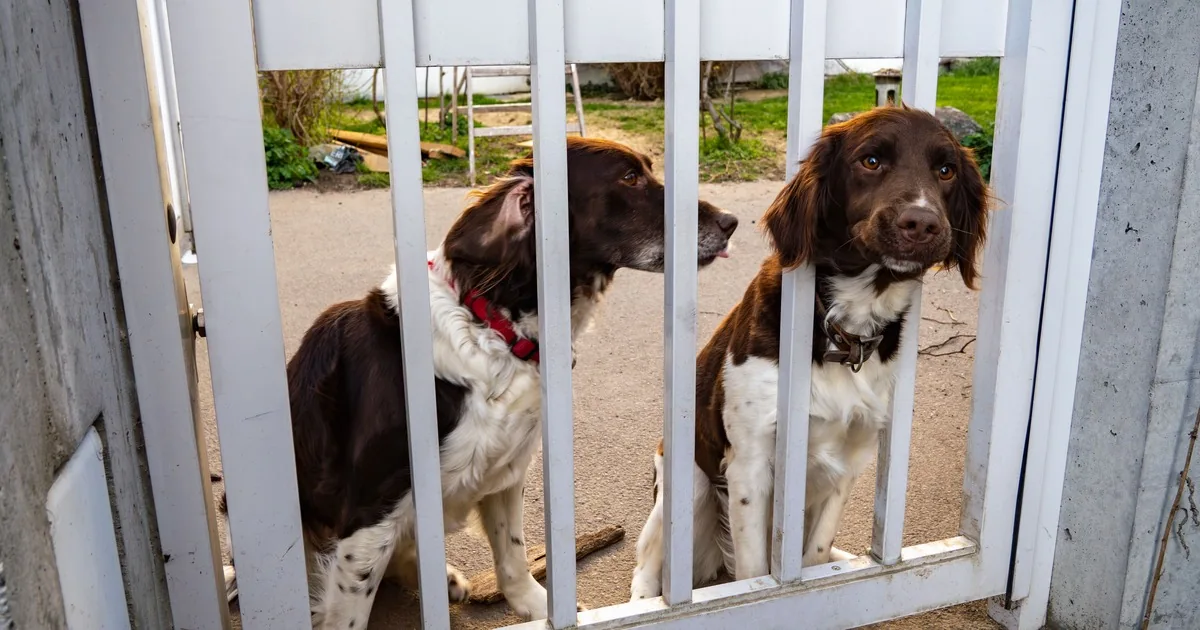
The caller opens with the outcome: “Our dog got out again.” That sentence does not tell a fence company whether the dog lifted a gate latch, squeezed through a broken picket, dug below a low spot, or climbed beside a woodpile.
A useful dog escape fence repair intake starts with the last escape. Record where the dog left, what someone actually saw, the fence and gate type, visible damage, repeat locations, immediate containment, and site access. Then book a perimeter inspection without promising that one repair will make the yard escape-proof.
Reconstruct the last escape
Ask when the dog last got out and who witnessed it. If nobody saw the exit, say so in the ticket. A muddy hollow below a panel is evidence. It is not proof that the dog used it that morning.
Have the caller describe the first place the dog was noticed outside the yard. Which gate or fence line was closest? Was the gate open, closed, or unlatched afterward? Did the dog return to one corner, pace a boundary, push through loose material, or appear on the other side with no obvious opening? Record the owner’s words before turning them into a work category.
Timing helps. Note whether the escape followed a delivery, lawn service visit, storm, fireworks, excavation, fallen branch, or recent fence work. Ask whether it happens only when the dog is alone or whether the dog attempts the same route while people are present. Those details can expose an open-gate event or a repeat physical breach. They can also show that the owner may need behavioral help beyond the fence project.
Immediate safety comes first. Ask whether the dog is back inside and can remain secured away from the yard until the visit. If the animal is still loose, the office should follow its emergency communication policy and avoid pretending a fence appointment can solve the active search. Do not advise the owner to tether the dog near a damaged fence or leave it in a questionable enclosure.
Identify the route before naming a repair
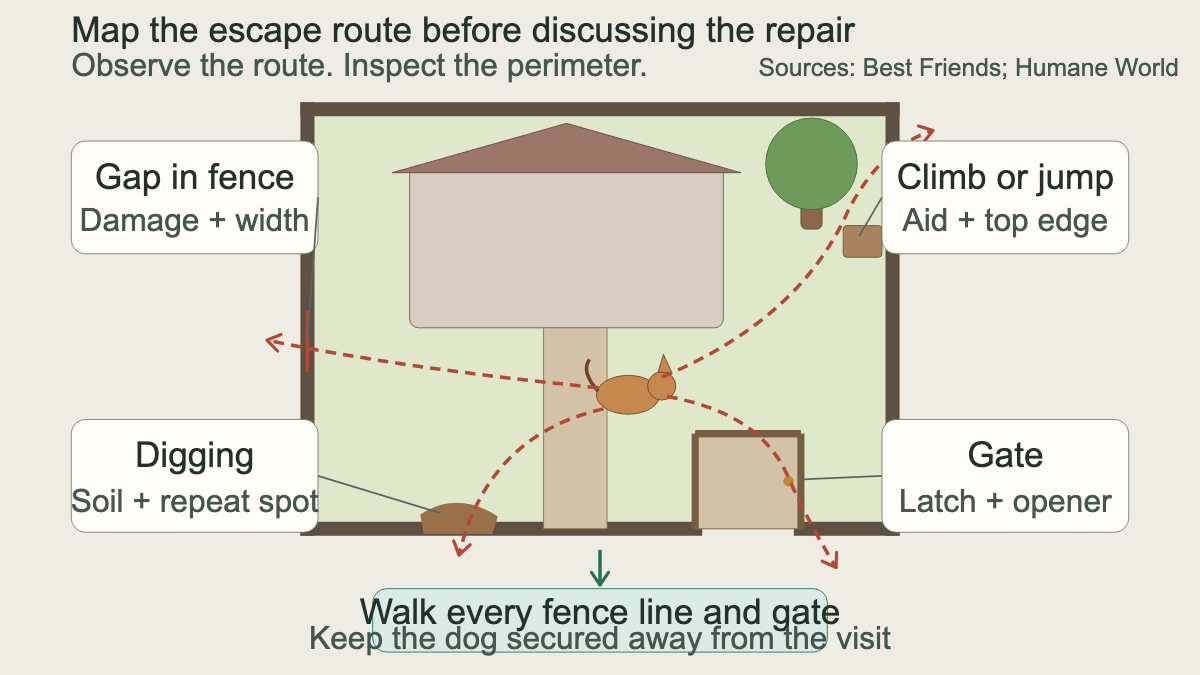
Best Friends Animal Society separates common escape routes into latch lifting, jumping or climbing, digging, and dashing through an opening. Humane World for Animals also tells owners to identify how the dog exits before changing the yard. That gives the fence office a clean intake structure.
For a gate escape, ask whether the gate stood open, failed to latch, or was opened by the dog or a person. Does the latch engage without lifting or pushing the gate? Is there a gap below, beside, or between double leaves? A sagging gate belongs in the mechanical inspection covered by Sagging Gate Repair Quote Calls.
For an under-fence escape, capture the exact location, soil condition, slope, drainage, erosion, and whether the hollow is fresh or repeatedly reopened. Ask what lies outside that line: a sidewalk, neighboring dog, alley, drainage swale, or open field. Avoid prescribing buried mesh depth over the phone. Roots, utilities, irrigation, grade, fence material, and local requirements all affect the field plan.
For an over-fence escape, ask whether anyone saw a jump or climb. Note nearby objects such as stacked firewood, a bench, planter, doghouse, retaining wall, or horizontal rails that may provide a step. Record the fence style and approximate height as reported, but do not claim that adding a certain number of inches will contain every dog.
A through-gap escape needs a clear location and scale reference. Ask whether boards are missing, chain link is separated, vinyl is cracked, rails have pulled loose, or a gap has opened where the fence meets a wall. A small dog may use an opening that the office cannot judge from a wide property photo. Request one close image with a familiar object nearby for scale, without asking the caller to place a hand next to sharp wire or unstable material.
Walk the full perimeter on the call
One visible hole can monopolize the conversation. The better intake checks the whole enclosure.
Ask the caller to walk the perimeter only when the yard is safe and the dog is secured elsewhere. They should look for open gates, loose latches, rotted boards, bent wire, washed-out soil, gaps at grade, objects beside the fence, and places where the fence meets the house, garage, shed, wall, or another fence type. Photos should include each gate and every suspected route, plus a wide view that shows the surrounding grade.
Request a rough yard sketch when the property has several gates or mixed fence materials. The sketch can mark the house, street, driveway, gates, slopes, damaged areas, and the point where the dog was first seen outside. It does not need measurements. Its job is to keep “the back corner” from turning into the wrong back corner when an estimator arrives.
Ask whether this was the first escape. If the owner has patched other spots, record the location and material used. Note any previous contractor work, temporary panels, landscape edging, buried material, electric pet boundary, or improvised latch. The field professional needs to see how those changes connect to the existing fence.
This call may widen into a multi-section project. Leaning posts, widespread rot, repeated chain-link separation, or several failing gates fit the broader intake in What to Ask on Fence Repair vs. Replacement Quote Calls.
Keep the contractor’s promise narrow
A fence contractor can inspect the enclosure, explain observed defects, and propose work suited to the site. The company should not guarantee that a dog will never escape again. Dogs differ in size, agility, persistence, and behavior, while yards change after storms, landscaping, deliveries, and ordinary gate use.
The two animal-welfare sources also stress the reason a dog tries to leave. Fear, isolation, stimulation, roaming, and learned behavior may matter. Reception should not diagnose those causes. A simple boundary works: “We can inspect the fence and gates for possible escape routes. Questions about anxiety, roaming, or behavior should go to your veterinarian or a qualified behavior professional.”
That distinction protects the estimate from becoming a behavioral prescription. It also keeps the office from recommending a product before the site is seen. An inward extension, buried barrier, smooth interior surface, gate hardware change, or panel repair may suit one property and fail another because the original route, material, grade, or access differs.
Prepare the property for a useful visit
The ticket should name the fence material, approximate age if known, yard size, number of gates, dog size as reported by the owner, observed escape route, repeat locations, recent changes, and immediate containment plan. Add the requested outcome in plain language: repair one damaged section, assess the entire yard, change a gate, or discuss a larger containment project.
Confirm that the dog will be indoors or otherwise secured away from the work area before the estimator arrives. Ask about other animals on the property. Record locked gates, tenant access, shared boundaries, HOA involvement, and who can approve work. If the crew may need a neighbor’s side of the fence, that access must be arranged before the appointment.
Ground disturbance deserves a separate flag. New posts, post resets, buried barriers, edging, or trenching may affect public utility facilities and privately installed lines. 811 routes property owners and contractors to the applicable utility-notification process before digging. The ticket should also mention known irrigation, low-voltage lighting, pool lines, propane, septic components, private power, and electronic pet-boundary wires. The field team can determine what locating and excavation steps apply.
Close by reading back the route and scope: “I have the escape point at the rear gate, a latch that sometimes stays open, one low area along the east fence, and photos coming from both locations. Your dog will be inside for the visit, and you want the estimator to walk the full perimeter.” That record gives the estimator a yard to inspect, not a mystery to rediscover at the gate.