The caller says, “My side gate drags, and now I have to lift it to make the latch catch. Can you replace the hinges?” The hinge request sounds specific. The symptom is not.
A useful sagging gate repair intake records what moves, where the gate makes contact, whether the hinge post shifts, the gate material and opening width, what the gate protects, and whether post work may disturb the ground. Book an inspection before promising hinges, an anti-sag kit, a new post, or a replacement gate. The same dragging corner can come from several places in the assembly.
Record the gate’s exact failure
Start with the motion. Ask the caller to open and close the gate normally, but only if it feels stable and safe to operate. Does the latch-side bottom corner scrape concrete, soil, gravel, or a raised paver? Does the latch pass above or below the strike? Will it close when someone lifts the gate? Does it swing open or closed on its own?
Write down when the problem appears. A gate that drags after heavy rain may be reacting to soft ground, post movement, swollen wood, or debris under the swing. One that changed after a delivery truck clipped it presents another inspection. A gradual drop over months belongs in the record too. Timing is evidence, not a diagnosis.
Ask whether the whole gate moves as one piece. From a safe position, can the caller see the hinge post flex or lean when the gate opens? Do the hinges shift against the post? Does the wooden frame look square, or has the latch corner dropped while the hinge side stayed in place? Avoid asking anyone to shake a heavy gate or force a stuck one. A wide driveway gate, loose masonry-mounted gate, or visibly unstable post can hurt someone.
Photos are valuable when they show context. Request one full view with the gate closed, one of the hinge side, one of the latch and strike, one of the post at ground level, and one of the spot that drags. A close image of a rusty hinge is incomplete if the entire post leans toward the opening.
Separate the post, hardware, frame, and opening
A gate hangs from a small system. The hinge post carries the load. Hinges and fasteners transfer it. The frame keeps its shape. The latch meets the strike at the opposite post, while the opening and ground provide clearance.
This Old House’s sagging gate repair guide checks post stability, corner-to-corner frame measurements, reinforcement, hardware, and latch alignment as separate steps. Perimtec’s diagnostic sequence likewise starts with post plumb and footing movement before moving to the frame and hardware. That order matters on the phone. A new hinge will not straighten a post that moves in the soil.
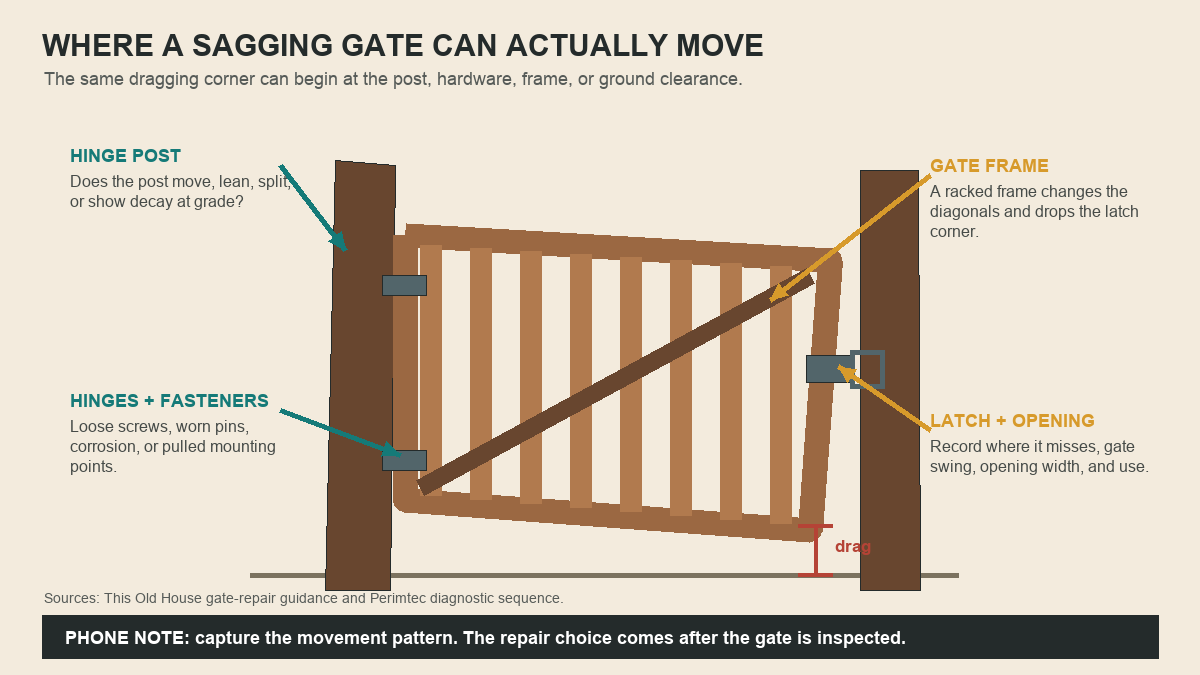
For a wood gate, ask about soft or split wood where the hinge fasteners enter. Note loose screws, rust, a bent hinge leaf, or visible play around a hinge pin. Ask whether the rails and vertical frame pieces remain tight at the corners. Unequal diagonal measurements can show that a rectangular frame has racked, but callers do not need to perform that measurement during the first call. A clear photo gives the estimator a safer starting point.
Material changes the question set. Wood can split, swell, decay, or lose fastener hold. Vinyl gates rely on their internal framing and compatible replacement components. Chain-link gates can involve hinge bands, tension, a bent frame, or shifted terminal posts. Ornamental aluminum and steel gates may use welded frames or adjustable hardware. Capture the material and visible construction. Do not tell the caller that a repair method from a wood-gate video applies to metal or vinyl.
Ask what the gate controls
A dragging garden gate is inconvenient. A failed gate around a pool, an animal enclosure, a childcare area, or a business access point carries a different consequence.
Ask whether the gate is part of a pool barrier. Does it close by itself? Does the latch engage every time? Has anyone tied it open or added a temporary latch? The U.S. Consumer Product Safety Commission’s pool barrier guidance describes self-closing and self-latching gates as part of the barrier. Local rules control the project, so the office should flag the failed function for prompt review without promising that a latch adjustment will make the gate compliant.
Pets and children matter even when there is no pool. Record whether the failed gate opens toward a street, alley, neighboring yard, or steep drop. Ask about exposed screws, sharp metal, broken pickets, and a gate that could fall. If the gate traps the only practical exit or blocks emergency access, follow the company’s urgent-routing policy.
A receptionist should not coach a caller through propping, lifting, disassembling, or rehanging an unstable gate. Safe temporary control depends on the actual site. The office can tell the caller to keep people and animals away from the hazard under company policy, then arrange the right response.
Capture dimensions, use, and access before scheduling
The estimator needs enough context to picture the opening. Ask for the gate material, approximate height and width, single or double leaf, pedestrian or vehicle use, and swing direction. Record whether the gate closes against a stop, rolls, uses a closer, or connects to an automatic operator. Automated and commercial gates belong in the company’s qualified service lane, not the ordinary wood-gate repair slot.
Then cover access. Can the crew reach both sides? Is the gate between a house and fence with little working room? Are there steps, a slope, landscaping, stored bins, an air-conditioning unit, or a pool beside it? Is the property occupied by a tenant? Who can authorize the repair?
Post work deserves its own branch. Ask whether the post sits in soil, concrete, masonry, or a metal base. Note visible washout, cracked concrete, rot at grade, or a post that moves with the gate. If replacement or footing work may require digging, the contractor must follow the applicable utility-location process. Call 811’s contractor guidance directs professional excavators to the appropriate state 811 center before breaking ground.
The call record should also flag private lines the property owner knows about, including irrigation, low-voltage lighting, pool equipment, propane, invisible pet fencing, and gate-operator wiring. Public utility marking may not identify every privately installed line. The estimator can sort out the actual excavation and locate scope after seeing the site.
Match the symptom to the field starting point
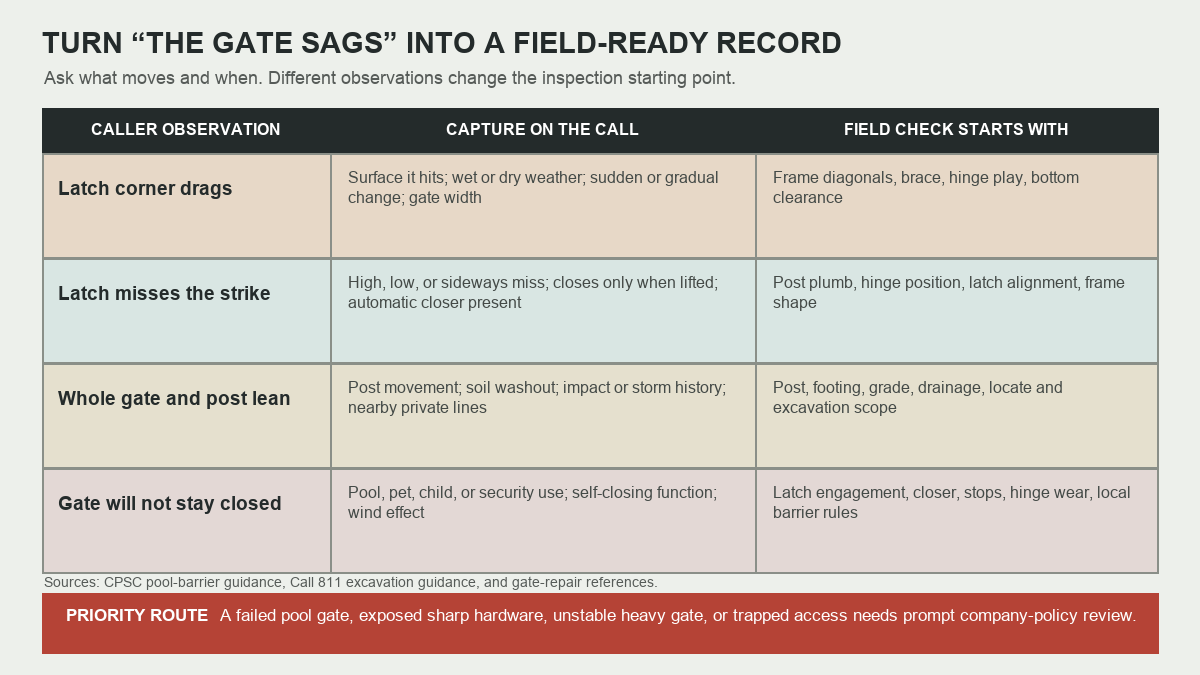
Callers often use “sagging” for four different behaviors. Keep their words, then add the observation.
A dragging latch corner directs attention toward frame shape, bracing, hinge play, and bottom clearance. A latch that misses high, low, or sideways adds post plumb and latch alignment. When the gate and hinge post lean together, the post, footing, grade, and drainage move to the front of the inspection. A gate that will not stay closed adds the closer, stops, wind effect, and safety use.
This narrower gate workflow fits beside the broader decision process in What to Ask on Fence Repair vs. Replacement Quote Calls. If the caller reports leaning posts or decay across a long run, move beyond the gate-only scope. The fence estimate scheduling guide covers the larger property, boundary, gate-count, and project-timing conversation.
Quote the visit without naming unseen parts
A caller may press for a price: “It only needs two hinges. What will that cost?” Give the company’s real service-call or estimate policy, then explain what the visit must confirm. The post, mounting wood or metal, hinge set, frame shape, latch, opening, and clearance all affect the repair.
Useful language sounds like this: “I’ll note that you have to lift the latch corner and that the hinge post appears steady. We still need to inspect the post, frame, and hardware before we can confirm the repair or final price.” If photos are part of the company workflow, say when and where to send them. Never promise that a stocked hinge fits an unidentified gate.
Leave the estimator a record with the symptom, change date, gate use, material, opening size, swing, post movement, hardware observations, contact point, photos, safety concerns, access, ownership, private lines, and requested timing. That is enough to prepare the visit.
When the truck arrives, the field professional should know whether the call sounds like a dragging wood gate, a moving post beside a pool, or a heavy driveway gate that belongs with a specialist. The repair still begins at the opening, with the gate supported and the whole assembly in view.