“I want the popcorn scraped off three ceilings. Can you give me a price?”
The useful answer starts with the rooms, the material question, and the condition of the home. Ask which ceilings are included, their approximate dimensions and height, when the home was built and last renovated, whether the texture has been tested, what damage or prior coating is visible, which fixtures interrupt the ceiling, what finish the customer wants, and whether the home will be occupied.
That record prepares an estimator. It does not identify asbestos, choose a removal method, or establish a final price. Those decisions depend on the site, testing where appropriate, company capabilities, and the rules that apply at the address.
Define the rooms before discussing price
“Three ceilings” could mean three empty bedrooms with eight-foot ceilings. It could also mean a vaulted living room, a kitchen crowded with upper cabinets, and a stairwell that needs staging. The office needs a room-by-room scope.
Start with the name and approximate length and width of each room. Record the ceiling height and shape: flat, vaulted, tray, sloped, or interrupted by beams. Ask about stairwells, open two-story areas, lofts, narrow halls, closets, and connected ceilings that continue through a doorway without a clean stopping point.
Fixtures deserve their own line. Count ceiling fans, pendant lights, recessed lights, smoke alarms, speakers, sprinklers, vents, returns, access panels, skylights, and curtain tracks attached near the ceiling. The call handler should record them, not tell the customer to disconnect anything. The estimator can decide what must be protected, removed by another trade, or left in place.
Ask for useful photographs: one wide view of each room, one image showing the full ceiling plane, and close views of stains, cracks, peeling, loose texture, prior patches, or painted areas. A phone photo helps the estimator see layout and condition. It cannot confirm what the texture contains or reveal every layer beneath it.
For a broader estimate workflow, the office can pair this record with the painting contractor estimate scheduling guide. Keep the popcorn ceiling scope separate enough that the estimator can see which rooms, surfaces, and access problems belong to this project.
Treat construction age and testing as routing facts
Ask when the home was built and whether the ceiling was added, repaired, or retextured later. Record the customer's answer as history, not proof. A 1960s house may have a newer ceiling treatment. A later renovation date still does not identify a material by sight.
The EPA says laboratory testing is the only way to be sure whether a material contains asbestos. EPA recommends testing suspect material when it is damaged or when planned renovation will disturb it, and says samples should be taken by a properly trained and accredited asbestos professional.
That guidance changes how the call is routed. If the caller reports a laboratory result, ask for the written report and note the sampled locations. Do not accept “the neighbor's ceiling was fine” or “a contractor looked at it” as a test result. If no testing has been done and the planned work would scrape, sand, drill, cut, or otherwise disturb suspect material, flag the estimate for the company's asbestos procedure.
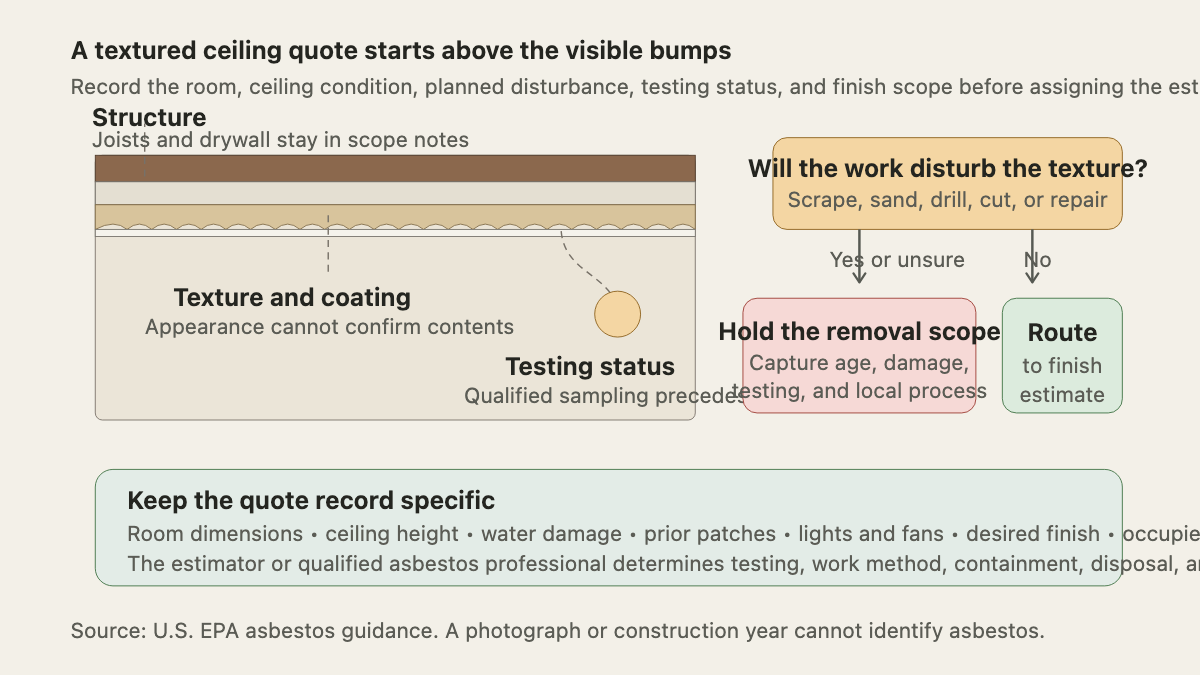
The office should never direct a homeowner to scrape off a sample. EPA's household asbestos guidance recommends trained and accredited professional sampling because poor sampling can release fibers. It also advises leaving suspect material alone when it is undamaged and will not be disturbed.
CPSC identifies older sprayed decorative material on walls and ceilings, patching compounds, and textured paints as products that may have contained asbestos. Its Asbestos In The Home guide warns that sanding, drilling, or scraping can release fibers when asbestos is present. A call handler can state the company's process and arrange the proper next step. Medical advice, legal interpretation, and material diagnosis stay off the phone script.
Separate removal, repair, and finish expectations
Customers use “remove the popcorn” to describe several different results. One caller wants the texture gone and expects a smooth, paint-ready ceiling. Another only wants loose patches repaired and blended. A third wants a new texture. Ask what they expect to see when the room is finished.
Record whether the requested scope includes texture removal, drywall repair, skim coating, sanding, priming, painting, crown molding work, or only an inspection and estimate. Note the desired finish level in the customer's words. “Smooth like the walls,” “light orange peel,” and “match the hallway” give the estimator more information than “make it modern.”
Existing coating matters. Ask whether the texture has been painted and, if known, how many times. Water stains, peeling paint, soft drywall, sagging areas, cracks that reopen, and old patch edges should be documented by room. A ceiling leak needs a source and repair plan before cosmetic work can be promised. The painting office should avoid diagnosing the leak or guaranteeing that a stain will never return.
Do not promise that every texture can be wetted and scraped. Painted texture may respond differently than unpainted material, and the drywall face or prior repairs may affect the finish plan. The estimator needs to inspect adhesion, damage, substrate condition, edge details, and the customer's tolerance for surface variation.
Map the occupied home
A ceiling project occupies the room below it. Ask whether the customer, children, pets, tenants, or home-based workers will be present. Record rooms that must remain usable, mobility needs that affect the travel path, and any date when the property will be empty.
Furniture and belongings are part of the access discussion. Ask whether rooms are empty, lightly furnished, or full. Note wall-mounted televisions, tall cabinets, built-in shelving, aquariums, pianos, medical equipment, and items the customer cannot move. The estimator should decide what the crew can move and what must be handled before work begins.
Then map the route. Capture stairs, elevators, narrow doors, gated access, parking limits, floor surfaces, and the distance between the entrance and work rooms. Ask where tools and materials might be staged without promising that the proposed spot will be accepted.
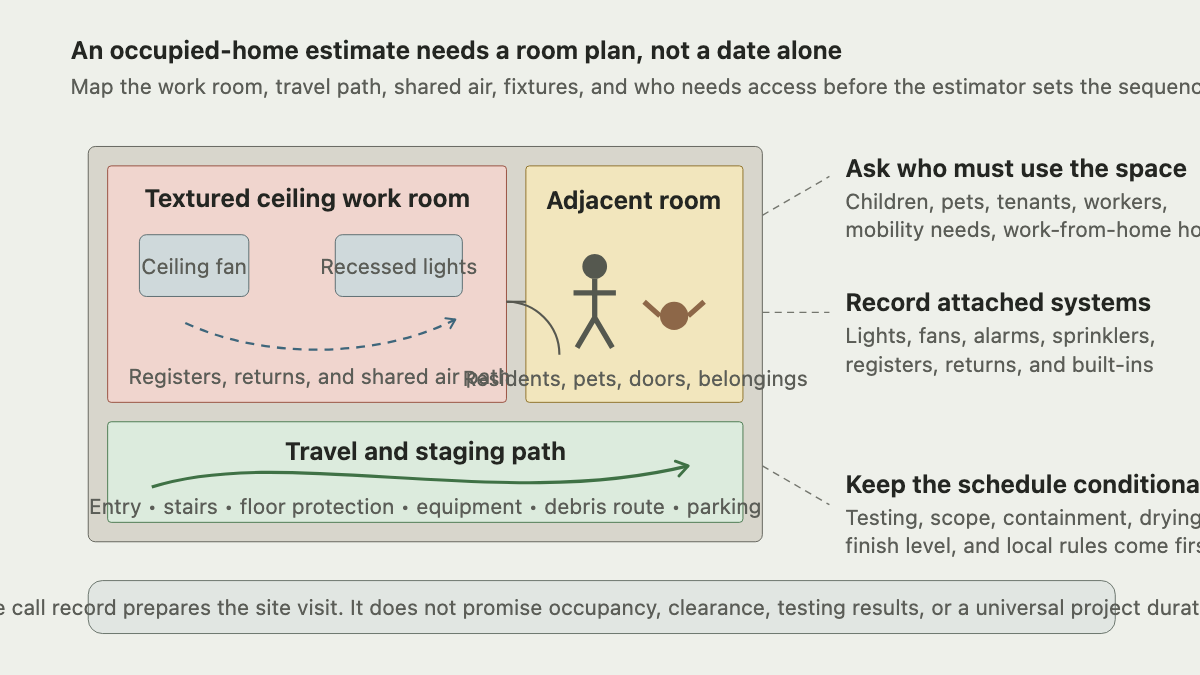
Heating and cooling details belong in the record because rooms may share registers, returns, and air paths. Ask where thermostats and mechanical equipment are located. The call handler should not promise a containment design or tell the homeowner to shut down a system. The qualified estimator or asbestos professional sets the work plan based on the actual material and scope.
If the home is a rental, confirm who owns it, who approves the work, who occupies each unit, and who can provide access. Condominiums and managed buildings may have elevator reservations, contractor documents, work-hour limits, or building procedures. Ask for the property manager's requirements before assigning a narrow appointment window.
Book the estimator who can resolve the open questions
A straightforward, tested, empty-room project may fit a normal painting estimate. Give the appointment more time when the scope includes vaulted areas, connected rooms, extensive damage, water staining, many fixtures, difficult access, an occupied multi-unit property, unclear testing, or a result that requires substantial drywall finishing.
Use a short read-back before ending the call:
- “I have the living room and two bedrooms, about 740 square feet total, with eight-foot flat ceilings. The house was built in 1972. You do not have a test report. The living room has painted texture, a water-stained patch, four recessed lights, and a ceiling fan. The home will be occupied, and the bedrooms are furnished. You want a smooth primed and painted finish. The estimator will verify the material process, repairs, access, finish scope, schedule, and price on site.”
If the company does not perform asbestos inspection or abatement, say so plainly and explain how the estimate proceeds after the appropriate documentation is available. Rules and licensing vary by location. OSHA also maintains a construction asbestos standard for worker protection, while state and local agencies may impose additional requirements.
An AI receptionist can capture the same room, testing, fixture, and occupancy fields after hours, but the escalation rules must be written by the contractor. The most useful handoff is still a specific one: three named rooms, one stained patch, no test report, an occupied 1972 home, and a customer who expects a smooth painted ceiling.