A homeowner hears heavy footsteps above the bedroom at 2 a.m. By morning, the noise has stopped. They want someone to “seal the hole today.” The office needs to slow that request down long enough to learn whether an animal entered a living room, a bat may have contacted a person or pet, young animals could be present, and the technician can reach the attic safely.
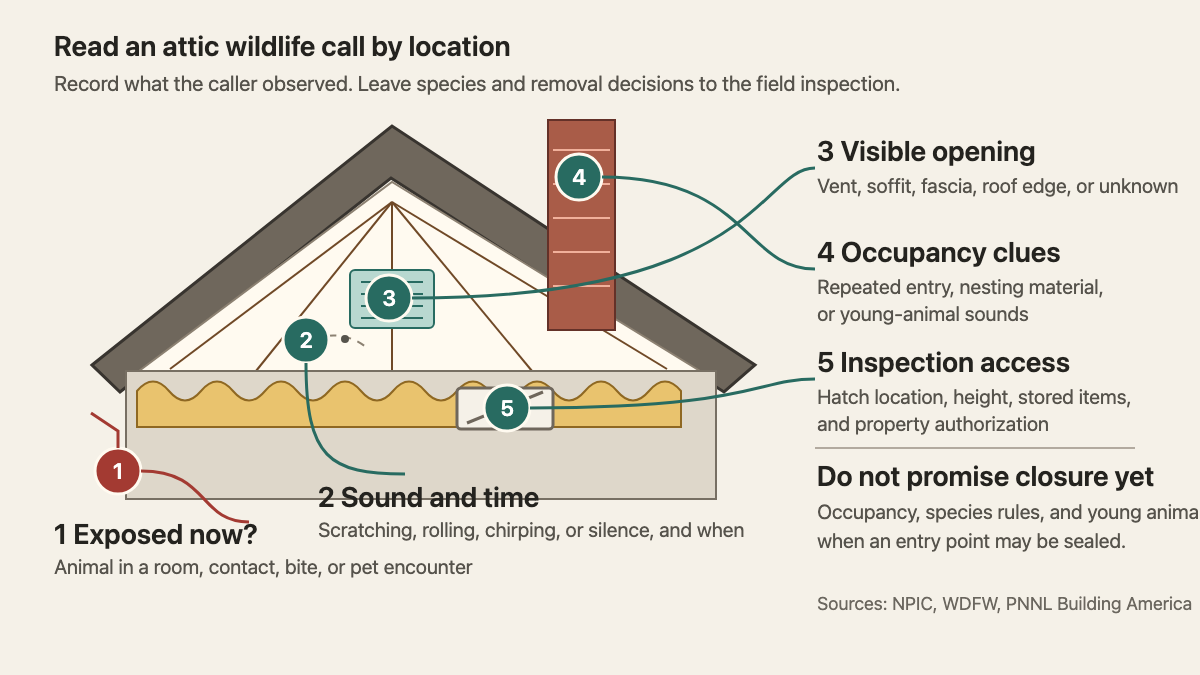
Start with exposure. Ask where the animal is now, whether anyone saw it, and whether it entered occupied living space. Then build a record of the sound, timing, roofline location, visible damage, attic access, occupants, pets, and property authority. Reception records observations. A qualified wildlife professional identifies the animal and decides whether removal, exclusion, repair, or another referral is appropriate.
Separate attic activity from an animal in a room
“Something is in the attic” describes a stable service call. “A bat flew through the bedroom” may require a different response. Get the current location before asking for a species guess.
Ask whether the caller can see the animal now. Record the room or building area, whether a door can be closed without approaching it, and whether children or pets are nearby. If the animal appears injured, acts strangely, has bitten or scratched anyone, or had possible contact with a person or pet, use the company’s emergency and public-health escalation policy. Do not keep the caller on a routine booking script.
Bat reports deserve exact wording. Record whether the bat was only seen outside, appears to be roosting in an attic, entered an occupied room, or may have contacted someone. State wildlife and public-health guidance varies. New Jersey Fish and Wildlife’s bat guidance, for example, treats a colony in a building differently from a bat encountered in living space. The office should route possible exposure to the caller’s local public-health or animal-control authority under its written policy.
Avoid asking the caller to catch, corner, touch, or photograph an animal at close range. The National Pesticide Information Center advises people not to approach wildlife and to keep children and pets away. A distant exterior photo can help. Personal safety comes first.
Build a useful sound and sighting record
Callers often lead with “scratching,” but the technician needs the whole pattern. Ask what the sound resembles: light scratching, running, thumping, rolling, chirping, flapping, gnawing, or movement inside a wall. Capture the caller’s words without translating them into an animal name.
Time changes the evidence. Record the first date noticed, the most recent event, the usual time, how long it lasts, and whether it occurs every day or only after rain, wind, or a temperature change. Ask whether the noise follows the same route. Movement from the soffit to the ceiling above one room is more useful than “all over upstairs.”
Sightings can narrow the inspection area without settling identification. Ask where the animal was seen, its approximate size compared with a familiar object, how it moved, and whether the caller noticed a tail, wings, markings, or more than one animal. A blurry glimpse at dusk remains a blurry glimpse. Write “caller reports a bushy tail at the west soffit,” not “squirrel confirmed.”
Other evidence belongs in the record too: nesting material near a vent, staining around an opening, displaced screening, damaged soffit, droppings on a patio, odor near one ceiling bay, or flies appearing below the attic. Tell the caller not to handle droppings, nesting material, or a dead animal while waiting for service.
Map the roofline before dispatch
Ask the caller to describe the side of the building where activity seems strongest. Use street side, backyard side, garage side, or a compass direction if they know it. Then name the building feature: soffit, fascia, gable vent, roof vent, ridge, chimney, dormer, roof-to-wall joint, gutter line, or an unknown spot near the eave.
Do not send someone onto a roof for a phone photo. Ground-level images are enough for intake. Ask for one wide photo that shows the roof section and one closer photo taken from a safe location. If the opening is visible, record whether screening hangs loose, wood appears damaged, a vent cover is missing, or material protrudes from the gap. Those are observations, not repair instructions.
The Building America Solution Center identifies vents, soffits, roof-wall joints, and chimneys as building details that may need durable pest-resistant construction. That guidance supports a better intake map. It does not mean reception should choose mesh, a cap, or a closure method before inspection.
Ask whether branches touch or overhang the roof, recent roof or gutter work occurred, or a storm damaged the area. Note whether the home has solar panels, a metal roof, a steep pitch, fragile roofing, overhead lines, or restricted exterior access. The dispatcher can then assign equipment and a technician whose scope fits the site.
Check attic access without sending the caller inside
An attic hatch can be in a hallway ceiling, closet, garage, knee wall, or pull-down stair. Ask where it is and what sits beneath it. A closet packed to the ceiling, a hatch over a stairwell, or a garage full of stored items changes the visit before the truck arrives.
Record whether the attic has a floor, narrow framing, deep insulation, low clearance, exposed wiring, HVAC equipment, or no known walking surface. The caller may know this from prior work. They do not need to climb up and verify it during the call.
Ask who can authorize access. A tenant may hear the noise but lack permission for entry, repairs, or exclusion work. For a condominium, apartment, rental, school, or commercial property, identify the owner, manager, onsite contact, unit number, shared roof area, notice rules, keys, gate codes, and any escort requirement.
The pest-control resource hub covers related intake and scheduling problems. Wildlife work adds roof access, species law, occupied dens, and a sharper boundary between an observation and a confirmed diagnosis.
Keep young animals and protected species in the plan
Repeated adult movement at one opening, high-pitched sounds, nesting material, or activity concentrated in one season can matter. Record the clue. Do not promise that young animals are present or absent.
This is where a rushed “seal it today” promise can fail. Closing the apparent opening before occupancy is assessed may trap an animal inside or separate dependent young from an adult. NPIC specifically warns against capping a chimney until animals are gone. It also notes that state and federal laws protect many animals, including most birds and their nests.
Rules differ by species, state, municipality, and season. Washington Department of Fish and Wildlife uses state-specific guidance for certified wildlife-control operators, trapping, and eviction from buildings. A company operating elsewhere needs the corresponding local authority and license rules in its call script.
Ask whether another company set traps, installed a one-way device, applied repellent, or closed an opening. Record the provider, date, location, and current condition. Do not tell the caller to reset equipment or reopen a repair. Route active equipment and possible trapped-animal reports to a qualified manager.
Book the next step with clear boundaries
Read the useful facts back: “You heard heavy movement over the west bedroom between midnight and 2 a.m., saw an animal-sized gap at the rear soffit from the ground, have not seen an animal in living space, and the attic hatch is inside a full closet.” That summary catches wrong directions and access surprises while the caller is still on the line.
Book the service the company can support. It may be an exterior and attic inspection, a manager callback, an exposure referral, or a visit by a licensed wildlife-control operator. Say what the appointment includes and who must be present. Keep removal method, repair scope, cleanup, warranty, and final price open until the property and applicable rules are reviewed.
The related rodent emergency intake guide is useful when evidence points to mice or rats inside occupied areas. Wildlife-in-attic calls need a wider species boundary and more attention to roof access, young animals, protected nests, bat exposure, and regional operator rules.
An AI receptionist can collect the approved questions after hours and escalate living-space exposure or authorization problems. The script must use the company’s real service area, license scope, emergency contacts, inspection limits, and callback rules. A good record leaves the technician with a safe place to start: the west soffit, the bedroom ceiling below it, and a closet that needs to be cleared before the hatch can open.
Sources
- National Pesticide Information Center: Problem Wildlife in the House
- Washington Department of Fish and Wildlife: Nuisance Wildlife
- U.S. Department of Energy Building America Solution Center: Screens and Other Deterrents for Birds, Rodents, and Other Pests
- New Jersey Fish and Wildlife: Bats in Buildings