The morning after a hailstorm, a homeowner calls and says, “The west side looks peppered with dents, and one piece is loose beside the upstairs window.” That is enough to schedule the right conversation. It is not enough to confirm hail damage, choose a repair, or say what an insurer will cover.
A useful siding inspection call records the present condition first. Then it identifies the siding material, exact wall elevation, story, nearby window or door, storm date, active water, safe access, photos, prior repairs, and the customer's deadline. The field inspector should arrive knowing which wall to walk toward and what the caller actually observed.
Start with the present condition
Ask whether anything is open, hanging, sharp, falling, or letting water inside now. A loose panel above a walkway needs a different response than shallow marks on a sheltered wall. So does broken glass, damaged electrical equipment, or water entering around a window.
Follow the company's written safety and escalation policy. Keep the caller away from loose material and any area they describe as unsafe. Do not ask someone to climb a ladder, reach from a window, walk below hanging siding, or pull a panel aside for a better photo. Ground-level pictures are useful when they can be taken safely.
The Iowa Insurance Division's hail guidance tells property owners to inspect only when it is safe and to look at siding, windows, roofing, outdoor structures, and signs of interior leaks. It also recommends photos and video. That makes a sound phone boundary: capture what is visible, note current exposure, and leave close inspection to someone equipped for the site.
If there is an opening in the exterior, record what is exposed and where. Do not coach the customer through siding removal or a structural repair. If they already placed a tarp or temporary cover, note who did it, when, and whether it remains secure. The office can route the call under company policy without judging whether that work is adequate.
Map the exact wall elevation
“The side of the house” makes a poor work order. Ask the caller to face the front door and name the wall: front, back, left, or right. Many contractors use compass directions, street-facing descriptions, or numbered elevations instead. Pick one house standard and read it back.
Add the story and a fixed landmark. “Right wall, second story, two courses below the rear bedroom window” is far more useful than “damage up high.” For a long wall, divide it by features such as the garage corner, chimney, hose bib, deck ledger, utility meter, or downspout. Record nearby windows, doors, vents, light fixtures, and trim because an impact or loose edge may sit at the transition.
Ask whether the caller sees one isolated spot, a band across the wall, or marks spread across several walls. Preserve those words. “Round dents,” “half-moon cracks,” “chips,” “holes,” “loose course,” “open seam,” and “paint missing” are observations. The receptionist should never rewrite them as confirmed hail impacts.
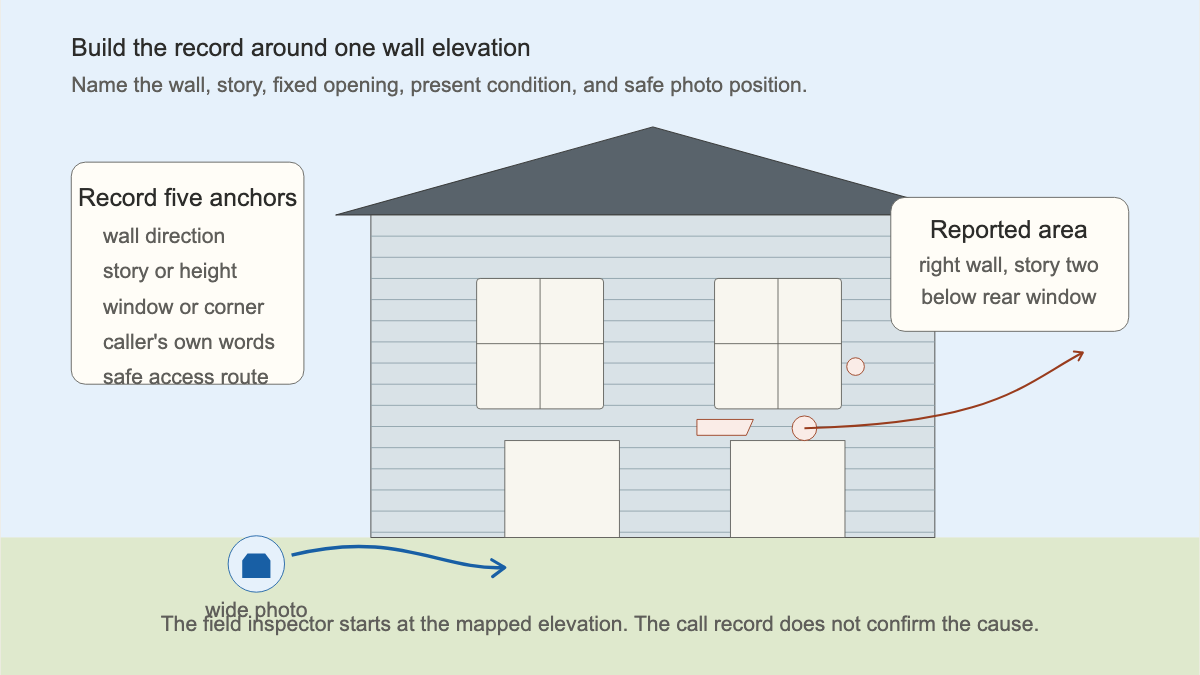
Photos should follow the same map. Ask for one wide ground-level image that identifies the wall, then a closer image only if the spot can be captured safely. A file name such as “right-wall-second-story-rear-window” survives handoffs better than IMG_4831. Keep the original timestamp when the intake system allows it.
Identify the siding and wall clues
Start with material, but let “unknown” remain an acceptable answer. The caller may describe vinyl panels, aluminum or steel siding, fiber cement lap boards, wood boards, engineered wood, stucco, brick veneer, or something else. Ask how the pieces are shaped and joined if they are unsure. Do not identify a product from color alone.
Material changes the inspection setup and replacement questions. Capture whether the finish is painted, factory-colored, textured, smooth, horizontal, vertical, shingle-shaped, or panelized. Ask whether the homeowner has leftover pieces, an old invoice, a product label, or a prior repair record. Those clues can help the field team research the product after inspecting it.
Record what sits around the reported area. Window trim, corner posts, utility penetrations, flashing, vents, and transitions to brick or stone can affect access and scope. Ask whether an addition joins the original house there. Note decks, fences, shrubs, air-conditioning equipment, steep grade, overhead lines, locked gates, and pets. A two-story wall above a glass sunroom is not the same inspection setup as a ground-floor panel beside a driveway.
The Texas Department of Insurance's storm-repair guidance discusses vinyl and fiber-cement products, manufacturer installation instructions, and inspection of wall sheathing after existing siding is removed. Its rules are specific to covered Texas work, but the assembly lesson applies more broadly. A phone photo shows the exposed surface. It cannot establish the condition of concealed sheathing or the correct installation method for an unidentified product.
That distinction should be stated plainly. The office can say, “We'll document the siding and visible condition, then the inspector will determine what can be evaluated on site.” Avoid promising a spot repair, full-wall replacement, color match, or hidden-wall repair before the visit.
Preserve the storm and claim timeline
Ask for the date and approximate time of the storm, when the condition was first noticed, and whether another storm occurred afterward. If the caller does not know, record that. Do not supply a date from memory simply because the office took many calls that week.
Separate three clocks in the job record: the weather event, the property condition, and the customer's administrative deadline. A panel may have been found two days after the storm. The customer may have an adjuster appointment next Thursday or a request for an estimate by month-end. Those dates explain urgency, but they do not authorize the office to promise an inspection slot that does not exist.
Ask whether the customer has contacted an insurer, received a claim number, met an adjuster, or received a written scope. A contractor can document visible conditions and describe its proposed work. Coverage, settlement, depreciation, deductibles, and matching treatment belong to the policy and the authorized claim process.
Colorado offers a useful warning against universal scripts. The Colorado Division of Insurance hail FAQ says Colorado law does not require an insurer to replace undamaged sides solely to match siding or paint. That answer is state-specific. A siding office serving another address should direct coverage questions to the insurer or licensed professional and avoid turning one state's FAQ into a nationwide promise.
Useful documents may include wide and close photos, videos, the claim reference, adjuster scope, prior siding invoice, product paperwork, repair estimate, and receipts for temporary protection. The Iowa Insurance Division advises consumers to save receipts for mitigation work and notes that policy terms may include hail deductibles or filing deadlines. The office should preserve those records without interpreting them.
Route by exposure, access, and requested outcome
A stable inspection request fits visible marks or suspected damage with no open exterior, no active water, and ordinary access. Book the company's inspection lane and attach the elevation map.
Prompt company review fits loose material, an exposed wall area, current water entry, broken openings, damage near utilities, or access that may require special equipment. A manager or designated field professional should set the response under company policy. “Prompt review” does not confirm storm cause or insurance coverage.
An unsafe scene stays outside ordinary photo intake. The caller should not stand below hanging material, touch damaged electrical equipment, or climb for evidence. Use the company's emergency and referral procedure.
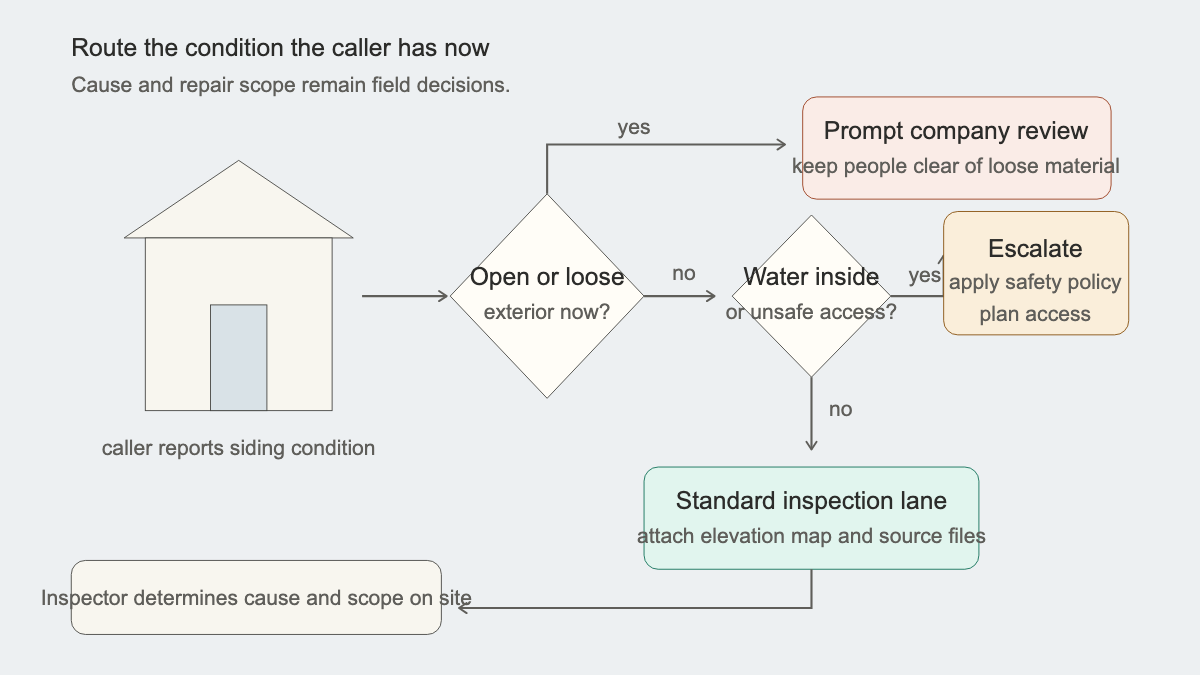
The requested outcome matters too. The caller may want a condition inspection, repair estimate, bid against an adjuster scope, temporary-protection visit, material-match research, or a second opinion. Name the appointment accurately. If the company performs only some of those services, say so before taking a slot.
Close with a field-ready handoff
Read back the address, contact, reported wall, story, landmark, siding description, present exposure, storm date, discovery date, safe access, documents, claim status, requested service, and deadline. Correct any mismatch while the caller is still on the line.
A strong handoff sounds like this: “Inspection request for the right elevation of a two-story vinyl-sided home. Caller reports scattered round marks and one loose lower edge beneath the rear bedroom window. No interior water reported. Area is above a fenced side yard beside the air-conditioning unit, with no safe ground-level close-up. Storm occurred Friday evening; condition noticed Saturday morning. Wide photos and claim reference are attached. Customer wants a written repair estimate before an adjuster follow-up next Thursday.”
An AI receptionist can collect the same fields after hours and route them under the siding company's rules. The contractor still controls safety response, inspection findings, repair scope, material research, price, and every insurance statement.
When the inspector opens the work order, “right wall, second story, below the rear bedroom window” should be the first thing they see.