A homeowner calls for new siding, then mentions that six windows are also being replaced. The siding crew is booked for Monday. The window installer says the units may arrive Tuesday. Someone asks, “Can your crew flash around whatever they leave?”
That question cannot be settled with a calendar change alone. The office needs to identify the window replacement method, the wall's water-resistive barrier, the exterior trim plan, the work sequence, and the person responsible for connecting those pieces. Get that handoff in writing before either crew opens the wall.
The practical rule is simple: treat the window perimeter and wall drainage layer as one shared interface. A siding contract and a window contract may divide the labor, but rain still needs one continuous path out of the assembly.
Start with the window scope, not the calendar
Ask whether each opening will receive an insert window or a full-frame replacement. An insert unit generally works within the existing frame. A full-frame job removes the old frame and exposes more of the rough opening, which changes the exterior work around the unit. The office should record the caller's answer without assuming it is technically correct. Proposals, product schedules, and an estimator's site review carry more weight than “I think they are replacement windows.”
If the caller has not chosen a replacement method, route that decision to the estimator. Our guide to full-frame and insert window consultation calls covers the intake differences in more detail.
Next, ask which openings are included. “The front windows” can mean two units beside the entry, every window on the front elevation, or a bay assembly with several components. Record the room, story, elevation, operating style, and approximate quantity. Note any doors, shutters, hose bibs, lights, or trim bands close to the work.
Then establish what stays. Are the exterior casings being removed? Will the siding crew install new trim? Is the existing water-resistive barrier staying in place, receiving repairs, or being replaced across the wall? Is exterior foam being added? These details affect the plane where the window, flashing, WRB, trim, and cladding meet.
The U.S. Department of Energy's Building America retrofit guidance treats window status, window type, WRB condition, installation sequence, and added exterior insulation as connected decisions. That is why a call note that says only “windows first, siding second” is too thin.
Assign the drainage-plane handoff
Water that gets behind exterior cladding must be directed back out. Window flashing has to connect with the wall's water-resistive layer, and upper materials need to lap over lower materials in the direction of drainage. The University of Minnesota Extension describes the window and door surfaces as parts of the exterior drainage plane, not isolated objects.
The exact detail varies. A finned window, a block-frame insert, old building paper, new house wrap, exterior foam, wood trim, vinyl J-channel, and fiber-cement trim do not create the same junction. Current manufacturer instructions, the approved project detail, local code, and site conditions should control the field work.
The office can still force a useful decision before installation. Ask the project lead to name who is responsible for each interface:
- preparing and repairing the rough opening;
- installing the sill or pan detail, jamb flashing, and head flashing;
- connecting the flashing to the WRB or other drainage plane;
- installing exterior trim, head flashing or drip-cap components required by the selected system;
- repairing discovered sheathing or framing damage;
- approving and photographing the assembly before it is covered.
One company may own every item. On a split contract, the list may cross two crews and a general contractor. Either arrangement can work. The bad arrangement is a blank line where each contractor assumes the other one handled the connection.
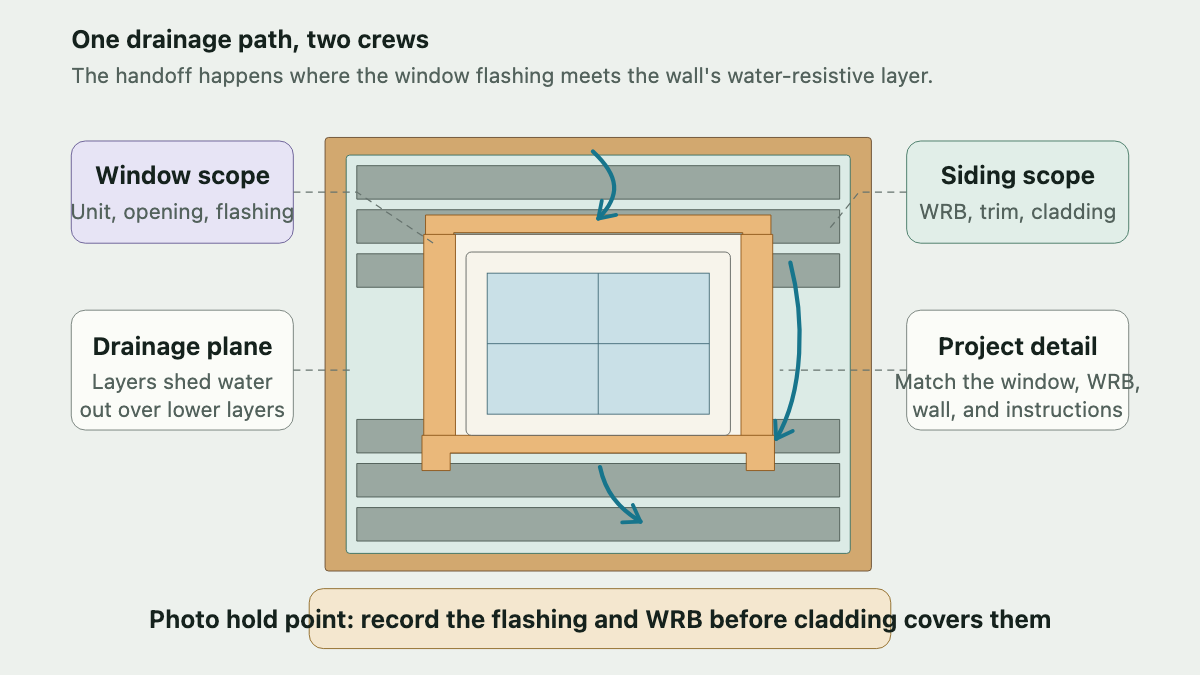
The diagram is a coordination map, not a universal installation detail. Its useful point is the shared boundary. The window installer can complete a technically sound unit installation while leaving an unclear connection for the siding crew. The siding crew can install attractive trim while covering an unresolved drainage path. A named owner and a visible checkpoint close that gap.
Set the sequence and a photo hold point
The Home Innovation Research Labs flashing technical note explains that window and WRB sequencing can depend on builder preference and subcontractor responsibility. It recommends putting flashing details, installation sequence, and scopes into project documents, then inspecting the components during construction.
For the office, sequencing means more than placing one crew before another. Build a short handoff schedule around observable conditions:
- The wall area and opening are exposed enough to inspect existing materials.
- Concealed damage and scope changes are documented before repairs proceed.
- The approved window, flashing, and WRB connection is completed.
- A named field lead photographs and accepts the visible interface.
- Trim and siding are installed after that hold point is released.
Record who can release the hold point and how a failed review changes the schedule. If the siding crew finds an unfinished head detail at 7:30 a.m., the crew should know whom to call and whether another elevation can proceed. “Call the office” is a weak plan when the right decision-maker is driving to a different site.
Photos should show context and detail. Take a full elevation, the complete opening, and clear close views of the sill, both jambs, and head while those areas remain visible. File them under the address and opening identifier, such as “kitchen east window,” rather than leaving them in a text thread labeled IMG_4821.
Prepare for what the old siding may hide
A combined siding and window project creates a good inspection opportunity because parts of the wall that are usually concealed may be exposed. It can also reveal missing WRB, reversed laps, deteriorated sheathing, damaged trim, or a previous patch that does not match the planned system.
Do not promise that the original quote covers every concealed repair. Ask how each contractor handles discovery work: who documents it, who determines the repair, who prices it, who approves it, and whether the schedule pauses. The office should also record signs already reported by the homeowner, including staining below an opening, soft trim, peeling interior paint, repeated caulk failure, or musty odors near the wall. These are inspection clues, not a remote diagnosis.
Material compatibility belongs in the same conversation. Home Innovation notes that flashing, WRB, sealants, adhesives, and window products need to work together, and that manufacturers may specify particular materials. Capture product names and instruction links before the job starts. Do not let “use the usual tape” become the specification.
For projects that add house wrap or exterior insulation, see our house wrap and insulation consultation guide. A broader re-side also needs the measurements and access details covered in whole-house siding replacement quote calls.
Build a call record both crews can use
A clean intake record begins with the address, caller, decision-maker, preferred timeline, and whether separate companies are already under contract. Attach both proposals if the customer has them. Then capture the operational facts:
- window count, location, replacement method, manufacturer, model or series, and expected delivery date;
- siding and trim material, wall elevations, WRB plan, exterior insulation plan, and known penetrations;
- existing leak, stain, rot, insect, or prior repair observations by exact location;
- crew sequence, site access, scaffold or lift plans, material staging, and weather constraints;
- named responsibility for the opening, flashing-to-WRB connection, trim, concealed repairs, inspection, photographs, and final acceptance;
- the hold-point date, reviewer, required photo set, and escalation contact.
Read the responsibility section back to the caller or project lead. A useful confirmation sounds like this: “We have North Shore Windows completing the full-frame units and opening flashing. Harbor Siding will connect the new WRB and install the exterior trim. Maya is reviewing each opening before cladding covers it. Is that the agreed scope?”
That sentence may expose a disagreement while the project is still on paper. Good. A ten-minute scope call is much easier than pulling new siding off a wall to discover what happened around the window.
An AI receptionist can capture the same opening, product, schedule, and responsibility fields after hours, then route incomplete handoffs to a project manager. The final assembly decision still belongs to qualified people with the contracts, instructions, and wall in front of them.
The best close to this call is a named checkpoint: one person, one opening identifier, one photo set, and one approval before the interface disappears.