A homeowner calls on a gusty afternoon and says, “The back wall sounds like someone tapping a plastic bucket.” Nothing appears to be missing. The noise stops when the wind drops, then starts again near an upstairs window.
That is enough to book an inspection, but “noisy siding” is not enough for the work order. The office should capture the exact wall, story, sound, trigger, visible movement, current exposure, material, recent work, and safe access. Leave the cause open. A rattle may come from a panel field, corner trim, soffit, downspout, shutter, or another exterior component that carries sound through the wall.
Separate a noise complaint from active exposure
Start with what is happening now. Ask whether any panel, trim piece, soffit section, or attached component is visibly lifting, hanging, flapping, or missing. Ask whether wall wrap or another layer is exposed, whether water is entering, and whether loose material sits above a door, walkway, driveway, deck, or neighboring property.
Those answers control routing. A sound with no visible movement may fit a normal inspection slot under the contractor’s policy. Material moving above an occupied entrance, an opened wall during rain, or water showing inside needs a different handoff. Keep the caller on the ground and away from the affected area.
FEMA’s building-envelope guidance after Hurricane Michael documents cladding damage and wind-driven water entry as related concerns after severe weather. The office does not need to turn that guidance into a remote diagnosis. It supports one practical boundary: current exposure comes before ordinary noise troubleshooting.
If the caller can already see a displaced or missing piece after a storm, use the separate loose or missing siding intake. Keep this ticket for sounds whose source remains uncertain.
Preserve the trigger before the weather changes
The most useful question is, “What has to happen before you hear it?” Record the answer in the caller’s words.
A wind-linked report should include whether the sound occurs during steady wind, sharp gusts, or wind from one direction. Ask whether it stops between gusts. Note recent storms, branch strikes, hail, exterior work, and the first date the customer noticed the change.
A temperature-linked report has a different history. Ask whether the noise begins when direct sun reaches the wall, while the wall cools in the evening, or during a sharp outdoor temperature change. Record the wall’s sun exposure and approximate time of day. “South wall pops for about ten minutes after direct sun reaches it” is much more useful than “siding makes noise sometimes.”
The Vinyl Siding Institute installation manual explains that vinyl panels need room to move and gives fastening rules intended to retain them without pinning the nail hem tight. That makes timing worth recording. It does not prove that a noisy wall was fastened incorrectly. Product instructions, wall conditions, trim details, and an on-site inspection still matter.
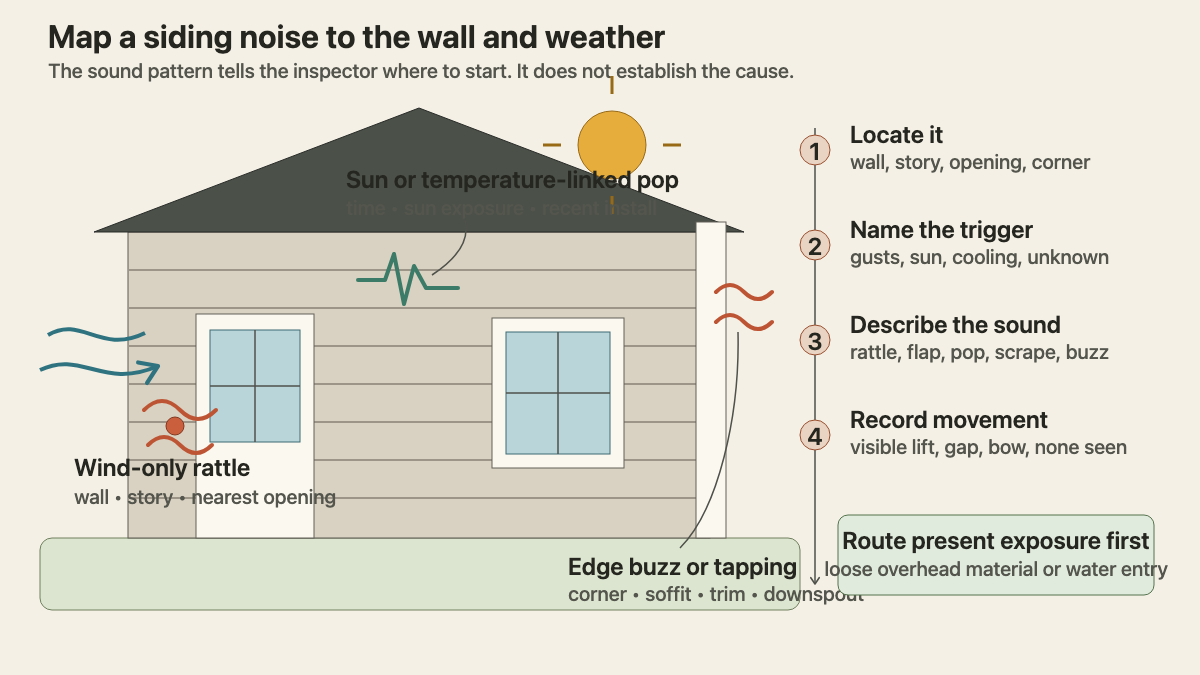
Pin the sound to one wall feature
Sound travels. “Near the bedroom” may describe where the customer hears it indoors, not where an exterior component moves. Build the location from fixed landmarks.
Have the caller identify the front, back, left, or right wall while facing the front door. Add the story and the nearest opening or corner. Useful locations sound like “right wall, second story, between the two rear windows” or “back wall, ground floor, beside the outside corner above the deck.”
Then ask where the sound is strongest. Does it seem to come from the middle of a panel field, the bottom course, a corner post, window trim, the eave, or the roofline? Does it shift when the caller moves to another room? Record uncertainty when needed. “Heard inside the rear bedroom; exterior source unknown” is an honest, usable note.
The sound itself belongs in the record too. Ask the customer to choose plain words: rattle, flap, tap, buzz, scrape, creak, snap, or pop. Avoid translating “buzz” into “loose panel” or “pop” into “overdriven nail.” InspectAPedia’s siding noise diagnostic guide distinguishes wind-related movement from sun and temperature-related sounds, then calls for closer inspection and installation history. The office should preserve those clues without announcing the verdict.
Record what the customer can see safely
Ask for observations from the ground. A caller may notice a lifted lower edge, a gap at a seam, a bowed course, trim that moves during gusts, a loose downspout strap, or no visible change at all. “No movement seen from the yard” does not mean the wall is sound. It tells the inspector what the customer could observe from that position.
Photos help when they show context. Request one wide image of the whole wall and one closer image taken with normal phone zoom from a stable place. Ask the customer to mark the suspected area on the wide photo if your intake system supports it. Do not ask anyone to climb, pull on a course, press a second-story panel, remove trim, or stand below moving material.
A short recording can preserve the rhythm and trigger. Label it with the location, date, weather, and whether the customer was indoors or outside. A recording may show that a sound repeats with gusts. It cannot show which concealed attachment or wall layer needs work.
Get the material and installation history
Ask what the siding appears to be: vinyl, aluminum or steel, fiber cement, wood, engineered wood, shingle-style material, panels, or unknown. Horizontal courses alone do not identify the product. An invoice, leftover carton, warranty packet, manufacturer label, or prior proposal may answer the question.
Capture the approximate installation date and any recent work on that wall. Window replacement, cable installation, exterior lighting, a new deck ledger, a repair, painting, gutter work, or storm cleanup may help the field team reconstruct the sequence. Ask whether the noise began immediately after the work or much later. Do not imply fault.
The Texas Department of Insurance’s storm siding repair guidance tells contractors to check wall sheathing, follow manufacturer instructions, use specified fasteners, and avoid underdriving or overdriving them. That is a useful scope reminder. An inspection may need to look beyond the surface panel. The office should not prescribe tighter fasteners as a phone fix, especially because different materials and products have different attachment requirements.
If the caller reports waves, buckles, ripples, or courses that change shape in sun, cross-reference the buckled or wavy vinyl siding inspection guide. Keep the noise history in the ticket because the timing may still help the inspector.
Match the visit to access and customer expectations
A ground-floor wall beside a driveway presents a different visit from a gable above a glass sunroom. Record gates, fence width, parked vehicles, pets, sloped grade, decks, pools, overhead lines, shrubs, soft ground, and any need to cross neighboring property. Ask whether the suspected area can be seen from a public or customer-owned walking surface.
Name what the customer expects. They may want a noise inspection, repair estimate, installation review, storm assessment, warranty visit, or written documentation. If the work may involve a warranty, collect the installer’s name, installation date, contract, product documents, prior service history, and claim number. Promise only the appointment and deliverables the company actually offers. Coverage and responsibility stay open until the proper party reviews the records and wall.
Before closing, read back the core ticket:
- exact wall, story, and nearest opening or corner
- caller’s sound description and indoor or outdoor listening position
- wind, sun, cooling, temperature, or unknown trigger
- visible movement, gap, bowing, missing material, or no change seen
- water entry, exposed wall layer, and any overhead loose material
- reported siding material, installation date, recent work, media, access, and requested service
A strong handoff might read: “Noise inspection for right wall of two-story home. Caller hears a rapid plastic rattle inside the rear bedroom during west winds; it stops between gusts. Strongest area seems between the two second-floor windows. No missing panel or interior water seen from the yard. Vinyl reported from a 2019 invoice. Window work was completed on that wall last month. Wide photo and twenty-second audio clip attached. Wall sits above a fenced side yard with a narrow gate. Customer requests inspection and written repair estimate.”
An AI receptionist can collect the same fields after hours and route them under the siding company’s rules. The field team still decides where the sound starts, what assembly is present, whether a defect exists, and what repair fits the wall.
When the weather changes before the appointment, the ticket should still preserve the moment: “rapid rattle, right wall, second story, between rear windows, during west gusts.”