A homeowner calls about six cracked siding panels beside the garage. They know the house is gray. They do not know the manufacturer, product line, profile, installation year, or whether spare pieces are tucked above the rafters. Their first question is simple: “Can you match it?”
The office should promise an assessment, not an invisible patch. A useful color-match intake records the siding material, manufacturer clues, exposed panel height, lap profile, texture, approximate age, affected wall, repair size, prior work, spare material, and photos. It also captures what the customer means by “match.” Some callers want the same product. Others care most about how the repair looks from the street.
That distinction saves an estimator from arriving with a color fan when the real problem is a discontinued profile.
Set the expectation before discussing a color name
Start with the requested outcome. Ask, “Are you trying to replace damaged pieces with the same product, find the closest available panel, or understand the options if the original is unavailable?” Record the answer in the caller’s words.
Do not say that gray, beige, or white will be easy to match. A catalog name identifies a marketed color within a product line. It does not establish the panel geometry, surface texture, production lot, or current appearance of material that has spent years on one side of a house.
The National Institute of Standards and Technology studied weathering and formulation in commercial vinyl siding, including color and gloss retention. That research supports a practical office rule: age and exposure belong in the record. It does not supply a universal fade rate, and the receptionist should never invent one.
Use a restrained response:
“An estimator can identify the siding, check what is available, and compare options at the house. Color is one part of the match. The panel shape, exposure, texture, age, and affected wall matter too.”
That answer is honest and still moves the call toward a site visit.
Identify the siding material first
Ask whether the siding appears to be vinyl, aluminum, steel, fiber cement, engineered wood, natural wood, or another material. If the caller is unsure, mark it unknown. Do not identify material from “plastic-looking” or “wood grain” over the phone.
Photos help. Request one wide image of the full wall, one medium image showing the damaged area and nearby corners or openings, and one close image of the panel face and edge. The caller should remain on the ground and avoid pulling, cutting, or lifting installed siding for the sake of a picture.
Then ask for records:
- Was the siding installed during the caller’s ownership?
- Is there an invoice, proposal, warranty, product label, leftover carton, or builder specification?
- Does a garage, shed, basement, or attic contain spare panels?
- Is the original installer, builder, or supplier known?
A product name copied from an invoice is more useful than a phone photo under porch lighting. Ask the caller to photograph the full label or document page, including model numbers and color codes, while covering personal or payment information.
The Vinyl Siding Institute’s installer resources treat dimensions, weatherability, surface distortion, and color retention as separate product considerations. The front desk does not need to teach those standards. It should collect the clues that let the estimator and supplier identify the product correctly.
Capture the panel geometry
Two gray panels can look close in a phone image and still be physically incompatible. The exposure may differ. One may be traditional lap and the other Dutch lap. The texture, edge shape, thickness, or locking geometry may not line up with the existing courses.
Ask the caller for the visible height of one course, measured without disturbing the wall. Call this the exposure in the work order, and include the unit. “About four inches” and “about four feet” cannot be allowed to share a bare number field.
Ask whether each course appears single, double, or triple. Record a straight face, a recessed groove, a rounded bead, or an unknown profile. Add smooth, brushed, embossed woodgrain, or unknown for texture. These are observations, not a remote product identification.
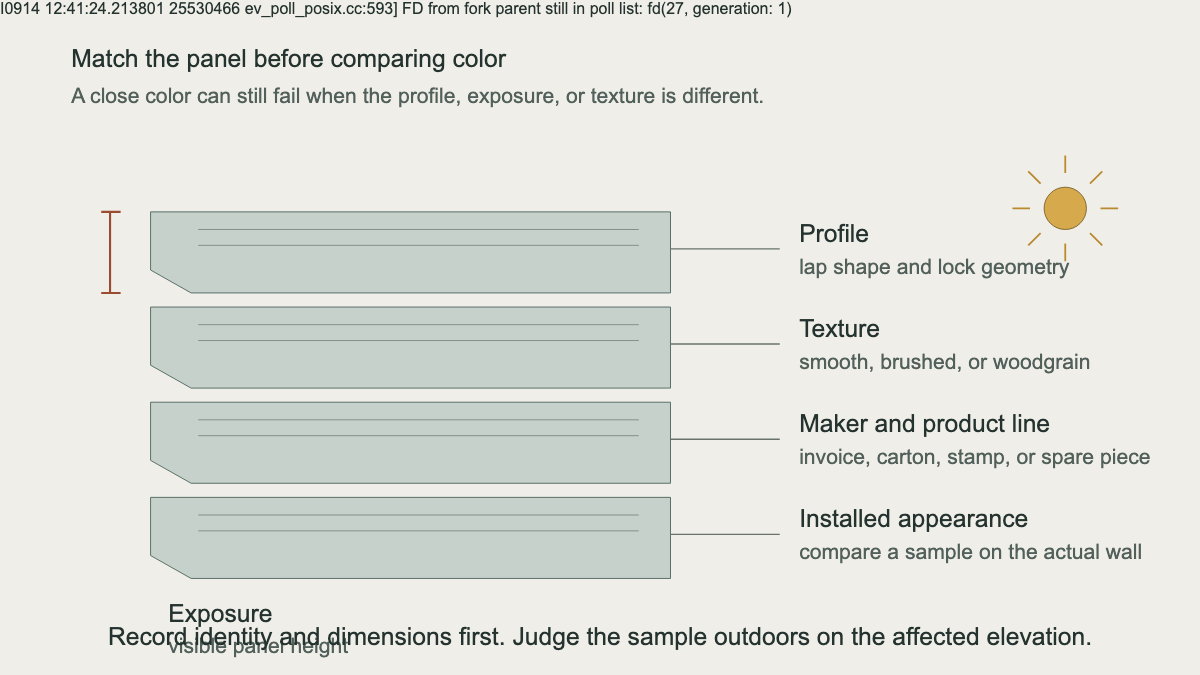
ARCH Exteriors’ practical guide to matching vinyl siding recommends checking manufacturer marks or records, measuring exposure, identifying the profile and texture, and comparing samples outdoors. It also notes that old or discontinued products can turn a simple panel swap into a sourcing problem.
Phone staff should not ask a homeowner to remove a panel to find a stamp. If a loose spare piece already exists, request clear photos of its front, back, lock edge, nail hem, markings, and full length. The field team can decide whether an installed panel should be handled.
Put age and wall exposure in separate fields
Ask when the siding was installed. A specific year is ideal, but “before we bought the house in 2018” is still useful. Record additions and partial replacements separately. A garage gable installed later may look similar while using a different product line.
Next, locate the affected wall. Use front, rear, left, or right while facing the front door, then add the story and a landmark. “Left side, first floor, between the hose bib and the rear corner” gives the estimator a place to stand.
Ask which direction the wall faces if the caller knows. Note whether it sits in open sun, under deep eaves, behind trees, beside another building, or under a covered porch. Record the observation without claiming that shade or sun caused a specific color change.
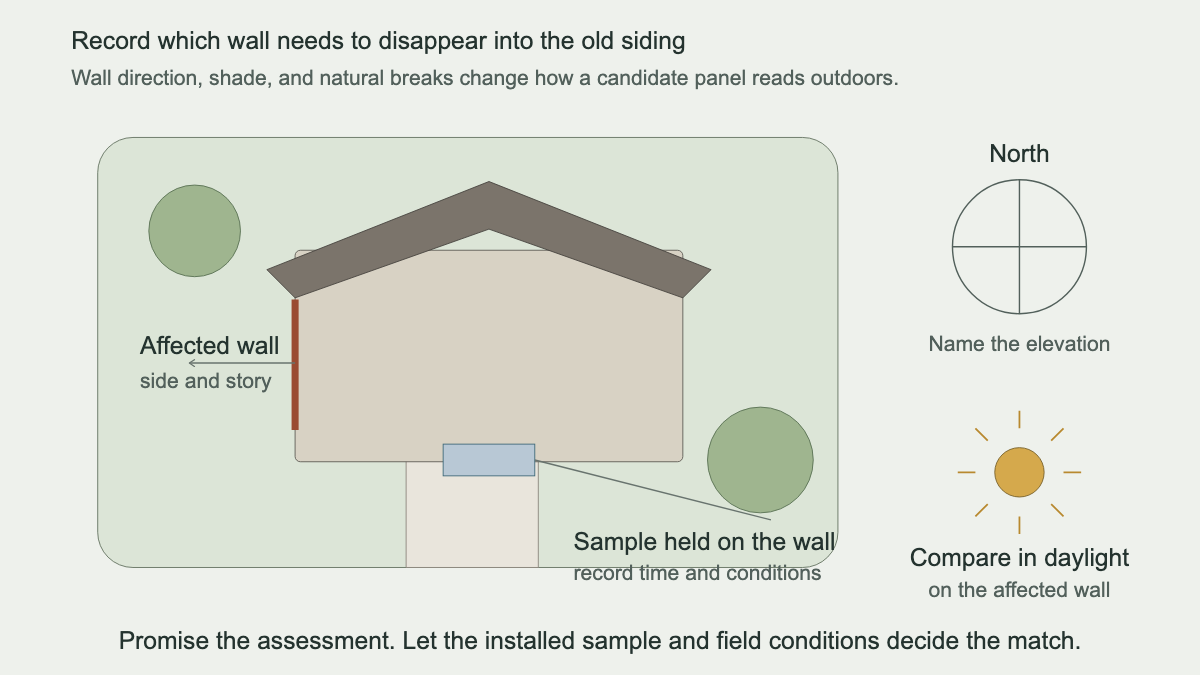
The final color comparison should happen on the affected elevation under ordinary outdoor light. A sample that looks right under warehouse lamps can read differently beside the installed wall. The office can prepare that comparison by recording the wall and access conditions before the visit.
Define the repair area in courses and landmarks
“Six damaged panels” can mean six small punctures in one course, six full lengths, or a two-story impact area. Ask how many locations are involved and whether they sit together. Record the approximate width and height of the full affected area, plus the number of visible courses.
Add fixed boundaries. Corners, windows, doors, utility penetrations, trim bands, additions, and changes in wall plane can affect how a repair section is planned. They may also provide natural breaks if the original product cannot be sourced, but the estimator must make that call on site.
Ask what caused the request. Hail, wind, heat, a grill, lawn equipment, a vehicle, removed fixtures, renovation work, or an unknown crack creates different condition and scope questions. If the problem followed a storm, use the company’s loose or missing siding call intake for safety and exposure details too.
Document condition without diagnosing it. Useful phrases include “two punctures below the kitchen window,” “one loose course near the rear corner,” and “melted area behind the patio grill.” Avoid “cosmetic only” until someone qualified has inspected the wall and the material behind it.
Separate product availability from visual acceptance
A manufacturer may still exist while the exact product line, profile, or color has changed. The caller may also have enough spare material for the repair. Ask about both possibilities before anyone discusses replacing a larger area.
When no exact stock is immediately known, the field team may investigate distributor inventory, manufacturer records, salvage stock, a sample match, or a larger section bounded by a corner or trim line. Those are possible routes, not promises for the receptionist to select.
Paint deserves the same caution. Some siding products and colors have specific coating limits or manufacturer instructions. Phone staff should not prescribe paint, a coating color, or surface preparation. Record whether the caller is open to painted options and leave material compatibility to the contractor and product guidance.
If the caller is considering a broader material change, send them to the vinyl versus fiber cement consultation guide. Keep the current color-match work order focused on the localized repair unless the customer explicitly requests a replacement consultation.
Insurance questions belong in their own field. Collect the claim number, adjuster date, written scope, and deadlines supplied by the caller. Do not say whether matching, a full elevation, or any specific material will be covered.
Prepare the site visit
Ask whether the affected area is at ground level, above a porch, behind shrubs, inside a locked yard, beside a pool, or close to overhead wires. Note pets, gates, steep ground, soft soil, parked vehicles, and neighboring-property access. Keep callers off ladders.
Confirm who owns the property and who can approve work. For rentals, collect the tenant contact, owner or manager contact, entry permission, and billing contact. For an association-managed exterior, record the association contact and any written material or color requirements the caller already has.
Attach the photos and documents to the job record before the estimator leaves the shop. Label each image by wall and distance. “Left wall wide,” “garage damage medium,” and “spare panel back label” are better filenames than three copies of IMG_4821.
An AI receptionist can gather the same approved fields after hours and route the record for human review. Product identification, supplier research, repair design, price, and final acceptance stay with the contractor.
Read the handoff back to the caller:
“Color-match assessment requested for a localized vinyl siding repair on the left garage wall. Six punctures span two courses below the exterior light. The siding was installed around 2012. The caller found an invoice with a manufacturer name but no product line, and two spare pieces may be stored in the garage rafters. The wall receives afternoon sun. Wide, medium, and close photos are attached. The customer wants the closest available repair option and understands that appearance will be assessed at the house.”
The estimator now has a wall, a product trail, a measured repair area, a spare-material lead, and a clear customer expectation before opening the truck door.