A homeowner calls six years after a siding installation. Three panels on the west wall look wavy, the original installer changed ownership, and the caller has a folder marked “lifetime warranty.” She wants to know who will fix it.
The office should open one neutral service record before discussing responsibility. Collect the written product warranty, any contractor workmanship terms, the original invoice, product identity, installer, installation date, exact wall location, photographs, prior repairs, and the result the caller wants. Then promise a records review or inspection. Do not promise coverage or decide by phone whether the material or installation caused the condition.
That distinction matters because “the siding warranty” may refer to separate agreements. A manufacturer writes terms for its product. A contractor may write different terms for installation work. The documents can have different contacts, procedures, exclusions, and evidence requirements.
Start with the paper the caller actually has
Ask the caller to read the title at the top of each document. “Limited warranty,” “product warranty,” “workmanship warranty,” “labor warranty,” and “installation guarantee” are useful descriptions. So are the company names printed on the pages. Save copies under the service record instead of relying on a summary such as “the salesman said it was covered forever.”
Identify who issued each document. Record the manufacturer, installing company, dealer or distributor if named, original customer, property address, installation date, and any registration or claim number. If the current owner bought the house after installation, note the purchase date and whether any transfer confirmation exists. Do not infer that coverage transferred because the document uses the word “transferable.” The written transfer terms control.
James Hardie's contractor-planning guidance tells homeowners to ask contractors about workmanship coverage beyond the manufacturer's product warranty. Its contractor finder also makes clear that contractors are independent businesses. That is a useful model for intake: keep the product document and contractor document separate, even when the contractor sold and installed the material.
If no warranty can be found, collect the invoice, proposal, canceled check, product label, leftover carton, permit record, or closing file. These may help identify the job and product. They do not create terms that were never written.
Identify the siding without forcing a guess
The manufacturer and product line determine which document applies. Ask whether the caller has an invoice, color receipt, carton label, sample, registration email, or prior claim letter that names the product. Record the words exactly. A broad answer such as “gray vinyl” or “cement board” may help a technician prepare, but it cannot identify the governing warranty.
CertainTeed, for example, maintains warranty information by product grouping. Other manufacturers organize their documents differently. Office staff should find the document tied to the reported product and installation period, then save that version with the service record. Avoid quoting a term found on a current sales page for material installed years earlier.
Ask whether the caller knows who purchased the material. It may have been bought by the homeowner, contractor, builder, previous owner, or a restoration company. Capture the distributor and order number when available. A photograph of the back of a saved offcut or an original label can be more useful than a color description.
Do not ask the caller to pull a panel loose in search of a stamp. Product removal may create damage, disturb evidence, and conflict with claim instructions. Existing loose pieces can be photographed or retained safely under the manufacturer's direction.
Document one wall and one condition
Warranty calls often arrive as broad judgments: “everything is fading,” “the siding is buckling,” or “the installer did it wrong.” Turn the judgment into observable details.
Locate the condition by front, back, left, or right wall; story; nearest corner, window, door, meter, or downspout; and approximate extent. Record whether the caller sees waviness, gaps, cracks, loose pieces, color difference, chalking, staining, fastener marks, trim separation, or another condition. Preserve their words. The office record can say “three horizontal courses appear wavy below the right upstairs window.” It should not say “improper nailing” unless a qualified field report already established that finding.
Ask when the caller first noticed it and what has changed. Was the condition present after installation, discovered during a home sale, visible only in direct sun, or noticed after a storm? Has another contractor removed material, added a fixture, replaced a window, mounted a deck ledger, or repaired the same wall? Prior work belongs in the record because it can affect both the inspection and the document review.
Safety still comes first. If siding is hanging above a door, material is near electrical equipment, water is entering, or the wall was opened by wind, route the present condition under the contractor's safety policy. The wind-damaged siding intake guide covers location, exposure, and safe access in more detail. Warranty paperwork should not delay response to an active hazard.
Request photographs that preserve context
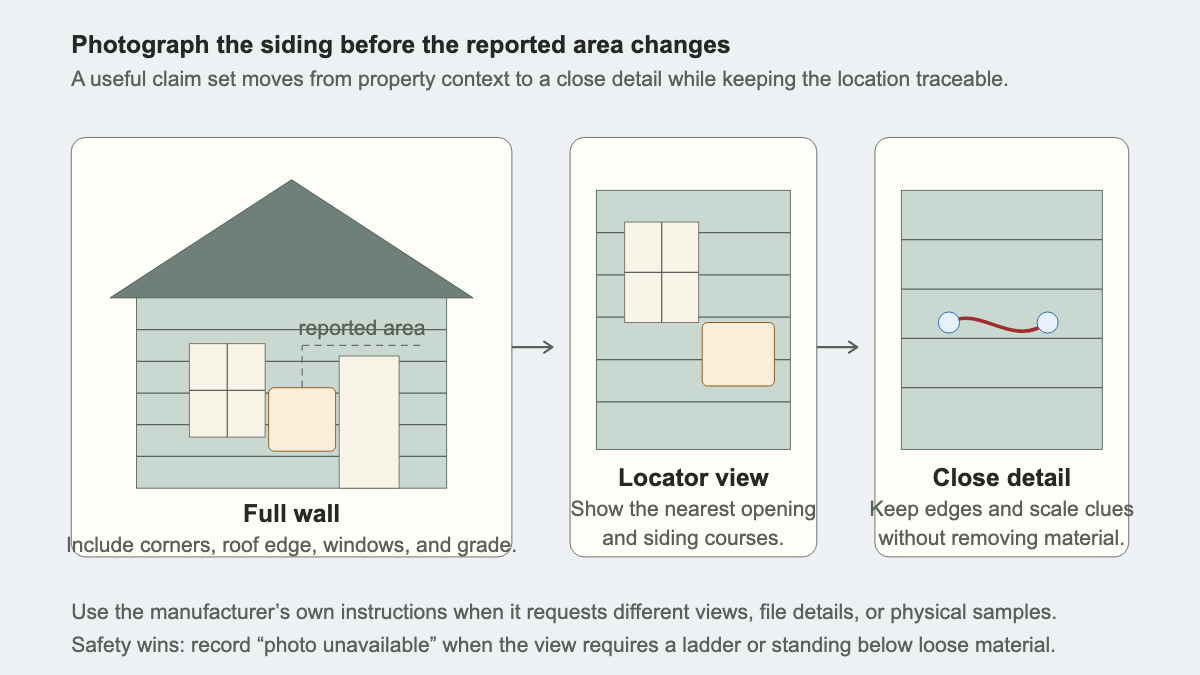
Ask for wide photographs showing the full wall and closer photographs showing the reported condition. Add an intermediate view when it helps connect the detail to a window, corner, or course. Keep the original files when your system allows it. Screenshots of compressed text messages may strip useful detail.
Norandex's current vinyl siding warranty claim form gives a concrete example of why evidence intake matters. It asks for proof identifying the product, photographs of full walls and close-ups of the issues before product removal, and physical samples that meet its instructions. Those are Norandex requirements, not universal rules. They support one safe office habit: check the applicable claim procedure before removal, repair, or sample collection.
Never tell a homeowner to climb a ladder, lean from a window, or stand below loose material for a better picture. “Photo unavailable because the area cannot be reached safely” is a useful note. The field team can plan the needed access.
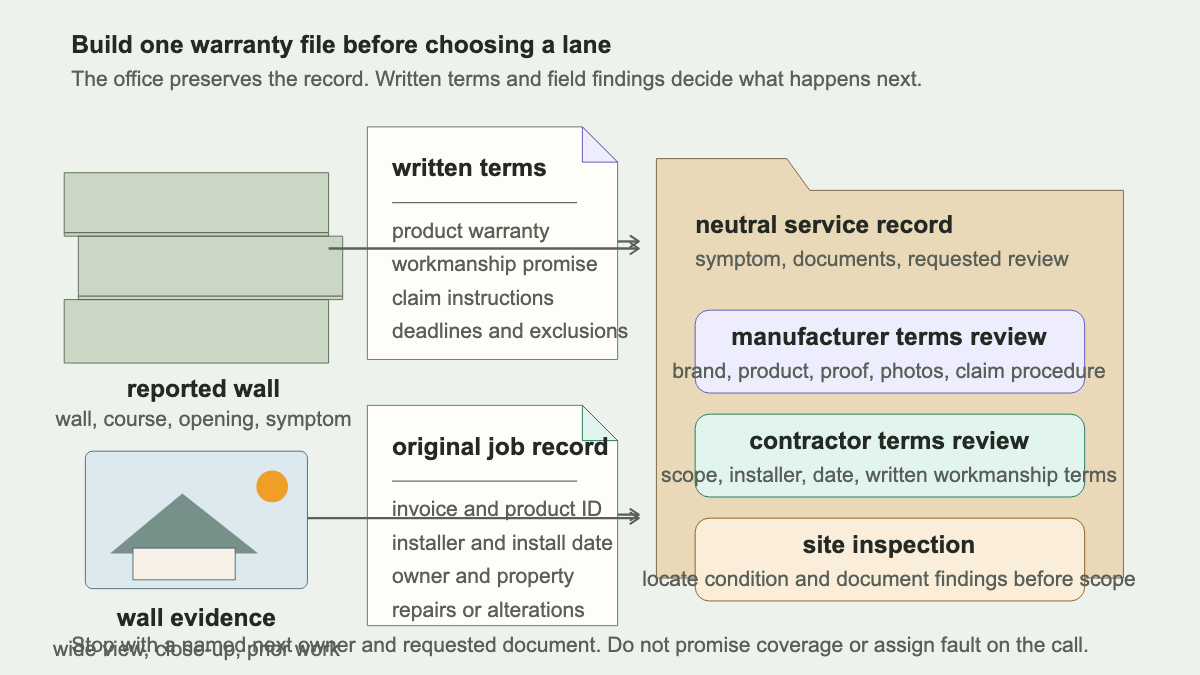
Keep three review lanes open
A clean intake file can move through more than one lane. The office does not need to choose a winner during the first call.
The manufacturer lane starts with the product identity and the warranty issued for it. Record the claim contact, documents requested, photo instructions, sample instructions, submission method, and any deadline found in the written terms. If a manufacturer representative asks for an inspection report, assign that request to a named person and record the due date.
The contractor lane starts with the signed proposal, scope of work, change orders, completion date, payment record, and written workmanship terms. Add crew notes, installation photographs, punch-list records, and prior service visits if the company has them. If the caller is contacting a successor company or a business with a similar name, verify the legal party on the original contract before discussing obligations.
The inspection lane answers physical questions that documents cannot. A field professional can identify the product clues visible on site, map the affected area, note adjacent openings and transitions, record prior alterations, and document observed conditions. The inspection should report what was found. Coverage is a separate decision made under the relevant terms.
A condition may touch all three lanes. For example, the manufacturer may need product photographs, the contractor may need to review installation records, and the siding may need temporary service because a piece is loose. One shared record prevents the customer from repeating the story while each reviewer receives the evidence needed for a defined task.
Ask what resolution the caller expects
“Warranty service” can mean an inspection, a repair appointment, replacement material, labor reimbursement, a written report, help filing a manufacturer claim, or a callback from the original contractor. Ask the caller to name the requested outcome. Record it without agreeing that the warranty provides it.
Use plain scheduling language. “We will review the documents and photographs, then tell you whether we need a site visit” is specific. “This sounds covered” is premature. So is “the manufacturer will pay for it.” Product replacement, labor, shipping, finishing, access, disposal, and related repairs may be treated differently by different documents.
If the office charges for inspections or service calls, explain the company's actual policy and when the charge is due. Do not say that a warranty will reimburse the fee unless the responsible party confirms that in writing.
Read back a claim-neutral handoff
Before ending the call, confirm the customer and property, current ownership, installation date, installer, manufacturer, product line if known, documents received, exact wall and landmark, observed condition, when it began, prior work, current safety concerns, photo status, requested outcome, and next owner inside the company.
A useful summary sounds like this: “Records review for the west wall of a two-story home. Current owner bought the property in 2023. Siding was installed in 2020 by Harbor Exterior Co.; invoice names Cedar Ridge vinyl in Slate. Caller reports waviness across three courses below the right upstairs window, first noticed this month. No loose material or water entry reported. Product warranty, contractor proposal, one full-wall photo, and four close-ups are attached. Customer wants to know whether an inspection is needed before a claim is opened. Maya will review the documents by Thursday.”
An AI receptionist can capture the same fields after hours and assign the record under the contractor's rules. The manufacturer, contractor, or qualified inspector still controls its own findings and decisions.
The last line in the file should name a person and an action: “Maya reviews the 2020 warranty and requests the missing invoice page by Thursday.” That is a real handoff. “Warranty issue, please call back” is where the job disappears.