A homeowner calls after noticing a jagged line through one fiber-cement siding board below a second-floor window. The close-up on their phone is sharp, but it gives the office no idea which wall is pictured, how high the damage sits, or whether nearby boards show the same condition. They ask for a patch and a price.
A useful cracked fiber-cement siding repair call starts somewhere else. Locate the board on the building, describe the crack and the material around it, capture impact and moisture clues, screen for loose pieces, identify the product when possible, and set an inspection appointment that leaves the repair decision open. A crack can be visible evidence. It is not a remote diagnosis.
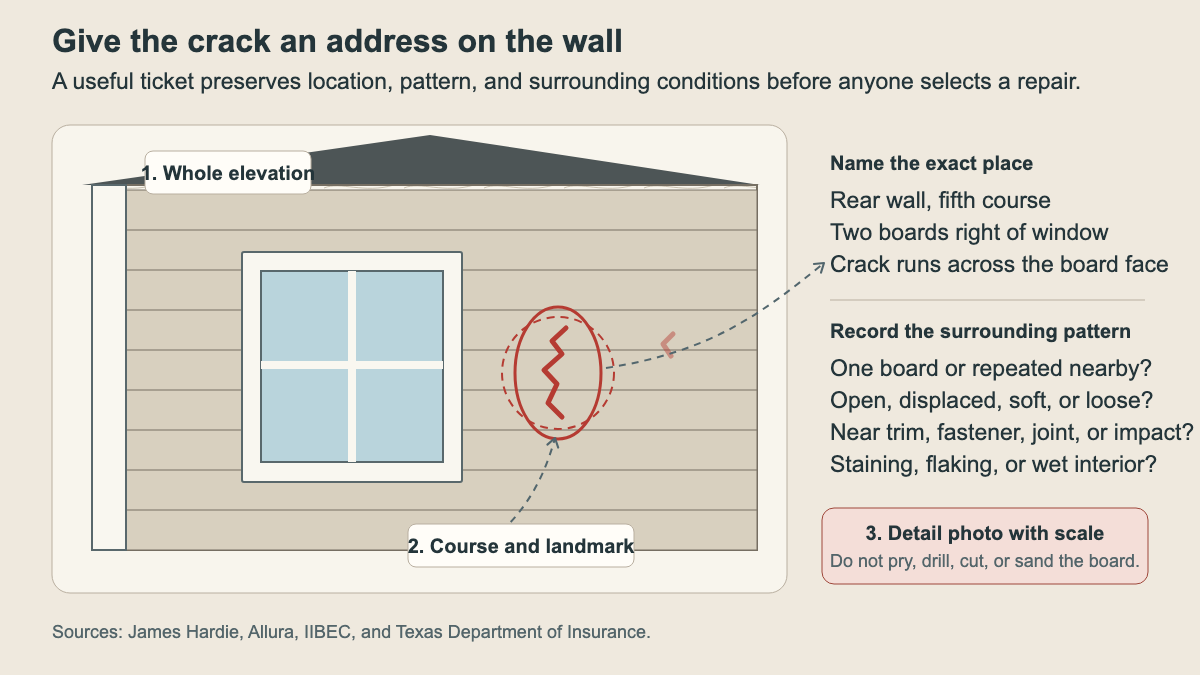
Give the crack an address on the wall
Start with the elevation. Ask whether the damage is on the front, rear, driveway side, or opposite side of the house. Record the floor level and a fixed landmark such as a window, exterior corner, hose bib, meter, deck, or roof intersection.
Then locate the siding course. A caller can usually count upward from the lowest full board or downward from a window sill without touching the wall. A note such as “rear elevation, fifth visible course above the deck, two boards right of the kitchen window” will guide the estimator to the defect. “Crack by window” may send them around the house twice.
Find out whether the product is horizontal lap siding, vertical panel, shingle-style siding, or trim. Ask if the crack crosses the face of one board, begins at an end, follows a corner, or appears around a fastener. Do not let a caller’s guess about the cause replace the location record.
The location matters because fiber-cement installation details change around openings, penetrations, joints, rooflines, and changes in the wall. Allura’s fiber-cement installation manual treats fastening, structural support, weather-resistant barriers, flashing, clearances, and cut edges as connected parts of the assembly. Reception does not need to interpret those details. The field team needs enough context to inspect them.
Describe the crack and the boards around it
Ask the caller to describe the line in plain language. Is it hairline or visibly open? Straight, branching, diagonal, or crescent-shaped? Does it run through the middle of the board, start at an edge, or connect to a nail location? Are the two sides still level with each other?
Record whether the board bows, shifts when the wind blows, rattles, or has a loose corner. The caller should observe from the ground or another safe location. Do not ask anyone to press on a high board, climb a ladder, or pull at the crack.
Then widen the view. Ask whether the boards directly above, below, and beside it show smaller cracks, gaps, flaking paint, discoloration, swelling, warping, or movement. IIBEC’s technical advisory on fiber-cement siding lists cracking among several conditions that may appear during an enclosure assessment. It also cautions that product, installation, drainage, and moisture-protection issues can overlap. That is the right posture for the call: preserve the pattern and avoid assigning blame.
One isolated line after a lawn mower threw a stone tells a different story from similar cracks repeating beneath several windows. Neither story proves the repair. The pattern helps the contractor choose the right inspection scope.
Capture what happened before the crack appeared
Ask when the caller first noticed the damage and what changed beforehand. Useful events include hail, wind-blown debris, a ladder strike, work on a nearby window, a new deck ledger, cable installation, landscaping equipment, or moving furniture through a narrow side yard. If no event comes to mind, record that too.
Timing deserves a second question. Was the crack found today, or has the homeowner watched it for months? Has it widened, lengthened, or stayed the same by their observation? Are there older photos that show the wall before the line appeared? Avoid asking the caller to mark the board, because paint, tape, or a scratch can alter the surface the contractor needs to inspect.
Ask about water without declaring that moisture caused the crack. Does rain strike that wall directly? Is the board near a gutter end, roof-to-wall intersection, window, door, vent, light block, faucet, or deck attachment? Is there staining, peeling finish, soft interior drywall, or a musty odor on the other side? Record only what the caller sees or smells.
The loose or missing siding after high winds guide is the better intake path when boards have detached or an opening is exposed. A cracked board that is still in place remains an inspection call unless the company’s safety policy calls for faster routing.
Screen for loose material and immediate risk
A crack becomes more urgent when a section is displaced, hanging, or likely to fall over a walkway, driveway, entrance, play area, or neighboring property. Ask whether any fragment is missing and whether the board moves visibly in the wind. Keep people, pets, and vehicles away from the area under loose material. Follow the company’s escalation policy for an exposed wall or active interior water.
Do not coach the caller to remove the damaged piece. Fiber-cement can break further during handling. Cutting, drilling, sanding, or abrading it can also produce respirable dust. Allura’s manual includes specific silica controls for workers who cut or drill its products. A homeowner does not need to create dust to help with intake.
Safe temporary action is limited. The caller can keep the area below a loose board clear and take ground-level photos from a stable surface. The siding contractor should decide whether temporary protection is needed and how it can be installed without interfering with the water-management layers.
Keep patching and replacement open until inspection
Homeowners often call after reading that small cracks can be patched. James Hardie’s repair guidance says small cracks, chips, and dents in its siding may be repaired with a cementitious patching compound. That statement is useful, but it does not turn every visible crack into a patch appointment.
The field team still needs to establish the manufacturer and product, depth and extent of damage, board stability, finish, nearby conditions, installation details, and whether the repair method is allowed under current product guidance. A crack through a board is different from a shallow surface chip. Repeated cracks deserve a wider assessment. An unknown product should not inherit another manufacturer’s instructions.
Single-board replacement has its own questions. Can the contractor obtain the same profile, thickness, texture, and exposure? Is the finish factory-applied or field-painted? Does the homeowner have leftover material, an invoice, a warranty record, or the original paint information? Even when a compatible board is available, sun and weather may have changed the surrounding color.
For calls where appearance is the main concern, the siding color-match repair guide covers age, manufacturer, affected area, spare material, and finish records in more detail. Reception should promise a color evaluation, not an invisible repair.
Request photos that preserve scale and context
Ask for a short sequence. The order matters because a close-up alone can erase location and scale.
- One photo of the full wall, with the roof edge and ground visible when safe.
- One medium view that includes the crack and a fixed landmark such as a window or corner.
- One view of the affected siding course and the boards immediately above and below.
- One close detail with a ruler held near the surface, or a common object beside the crack, without touching or prying the board.
- Additional views of repeated cracks, loose corners, staining, penetrations, or an impact mark.
Have the caller send original files when possible. Heavy markup and screenshots can hide texture. Name the files by view in the work order, such as “rear-wide,” “kitchen-window-context,” and “course-five-detail.”
If a label, invoice, leftover plank, paint can, or warranty document is already available, ask for a separate photo. Do not instruct the caller to remove a board, trim piece, outlet block, or caulk joint to look for identification.
Book the inspection the evidence supports
Confirm the service address, property type, affected elevation, approximate height, ground conditions, gates, pets, parking, and access to the interior side of the wall. Ask who owns the property and who can approve inspection and repair. Note shrubs, fencing, air-conditioning equipment, a steep grade, or a deck that may restrict access.
Set the first visit clearly. It may be a visual inspection, diagnostic visit, warranty assessment, or repair estimate under the company’s policy. State any fee and what it covers. Avoid promising that the technician will patch or replace the board during the first appointment. Product identification, safe access, matching material, hidden damage, or a broader wall condition may change the work.
Read back a compact ticket:
“Rear elevation, second floor, horizontal fiber-cement lap siding. Crack is on the fifth course below the left kitchen window and two boards right of the corner. Caller describes one diagonal line across the board face; edges appear level and the board does not move in wind. No similar cracks seen on adjacent courses. Damage was first noticed after a ladder company worked near the window last week, but no impact was witnessed. No staining or interior moisture reported. Full-wall, window-context, course, and detail photos attached. Homeowner has a leftover plank in the garage but no product label yet. Clear side-yard access; estimator should confirm ladder needs. Homeowner will attend the inspection.”
That note gives the field team a physical location, visible pattern, event history, safety screen, product clue, photo set, and access plan. An AI receptionist can collect the same fields after hours when the siding company supplies its service area, fees, appointment types, and escalation rules. The contractor at the wall still decides what the crack means.