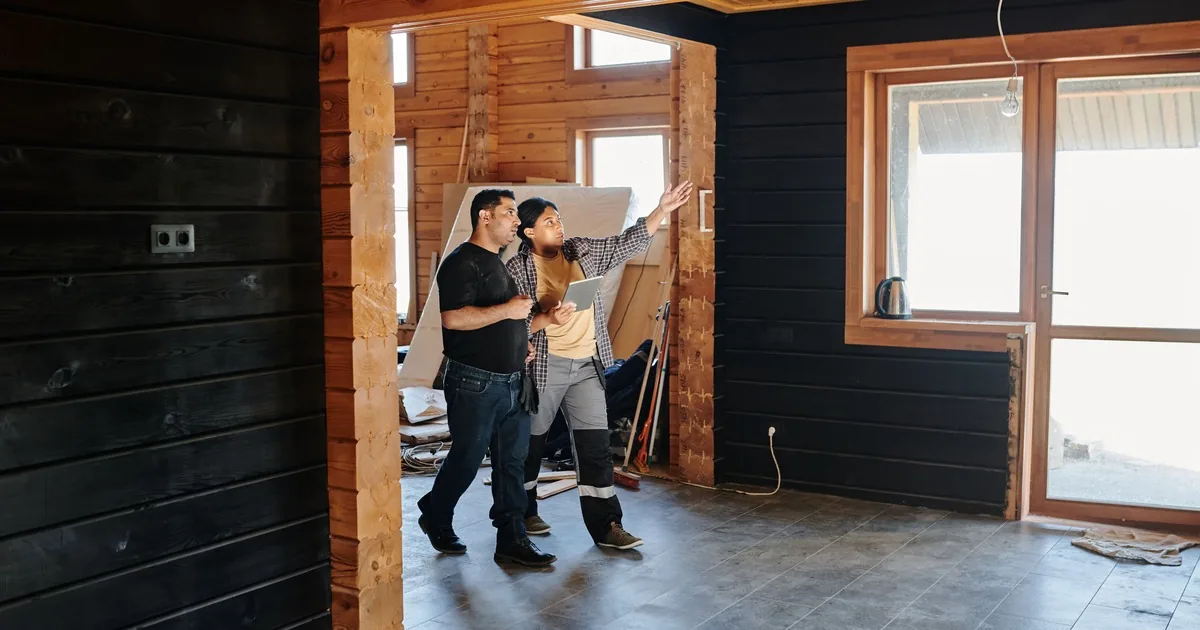
“The drying equipment is gone. When are you putting my kitchen back together?”
That question can reach the office before anyone has assigned a reconstruction project manager. The mitigation file may show removed toe kicks, an opened wall behind the sink, and a section of flooring taken up near the dishwasher. The caller hears that mitigation is complete and assumes the rebuild has already been approved and scheduled.
A water damage reconstruction handoff should identify the current phase, preserve the room-level mitigation record, show what repair scope has been proposed or approved, list every open dependency, and name the person responsible for the next contact. Treat reconstruction as a distinct phase with its own scope and authorization. Keep it attached to the same property history.
Identify the phase before answering the status question
Start by opening the job record and reading the latest field note. Do not infer completion because equipment was picked up. Confirm what the mitigation lead recorded: extraction status, equipment removal, containment changes, material removal, remaining openings, temporary protection, contents status, and any work still assigned to mitigation.
Ask the caller what they mean by “rebuild.” They may be asking when an estimator will visit, whether a repair estimate was sent, whether the insurer responded, who will select cabinets, or when a crew will arrive. Put the request in one phase before offering a next step.
A clean phase label helps:
- Mitigation active: extraction, demolition, drying, monitoring, cleaning, or containment work remains open.
- Handoff review: mitigation field work has reached its recorded stopping point, but the repair scope or responsible reconstruction lead is still being assembled.
- Reconstruction estimating: measurements, repair methods, trade input, selections, or pricing are under review.
- Ready for scheduling: the company has the required authorization, defined scope, dependencies, materials, and site access under its own policy.
Those labels belong to the company workflow. They do not decide whether an insurer owes for the work.
The commercial water-loss intake guide covers the first call, operating areas, site authority, and crew access. This handoff begins later, when the office must transfer what the mitigation team learned into the repair phase.
Transfer the room record, not a summary sentence
“Kitchen mitigation complete” throws away the details the repair estimator needs. The handoff should carry the sketch, affected-area boundaries, photographs, measurements, material notes, equipment and monitoring records, removal limits, contents moves, and any condition discovered after finishes were opened.
Tie each item to a room and surface. “Drywall removed” is weak. “North kitchen wall, drywall removed from the sink base to the pantry return, approximately 24 inches above finished floor; insulation condition photographed; cabinet end panel remains; electrical receptacle isolated by electrician per field note” gives the next person a place to start. Keep measurements labeled as field-recorded until the reconstruction lead verifies them for repair estimating.
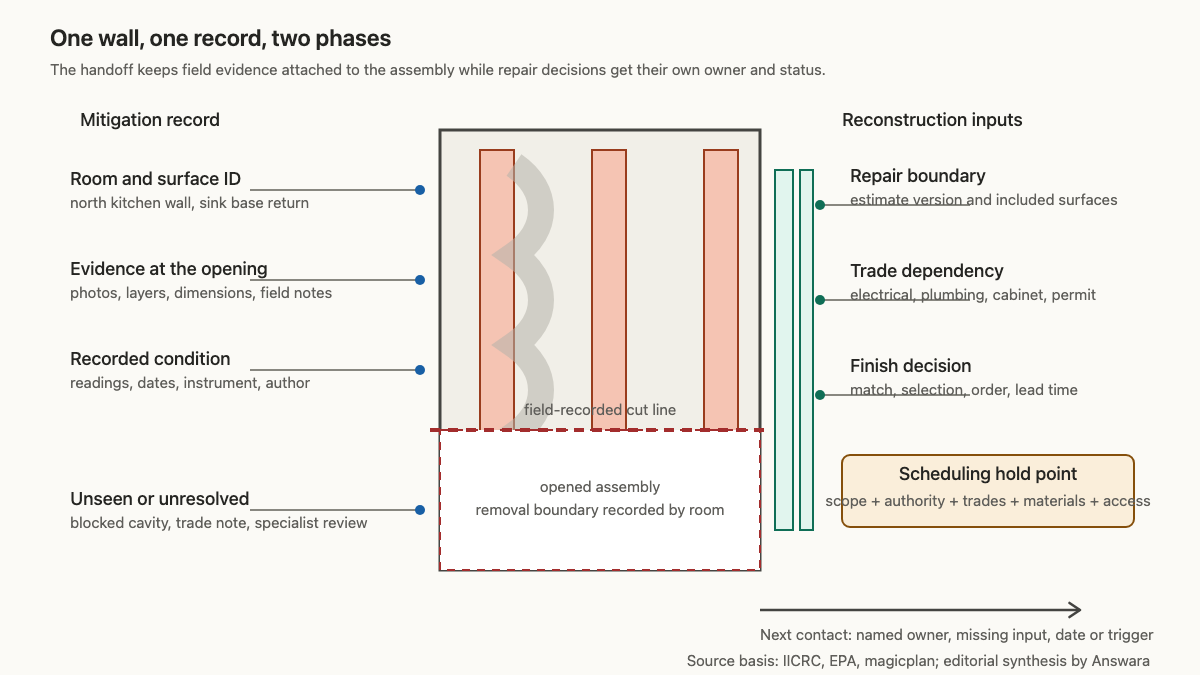
The IICRC’s public S500 summary lists project documentation, risk management, inspections, preliminary determinations, structural restoration, contents evaluation, and materials among the components of professional water damage restoration. That is a useful model for the file. A repair estimator needs more than an equipment pickup date.
Material detail matters. EPA’s water-damage cleanup table gives different response guidance for wallboard, carpet, insulation, wood, hard surfaces, and other assemblies. It also tells readers to check the subfloor below affected flooring. A handoff that says only “floor dry” may hide which finish was removed, whether the underlayment was exposed, and what subfloor condition was recorded.
Preserve uncertainty too. If a cabinet back blocked the view, say that the cavity was not observed. If staining appeared old, attribute that observation to the field note without declaring its cause. If a plumber, electrician, environmental professional, or engineer supplied a report, attach the report and identify its author. Reception should never turn a field note into a technical clearance.
Keep the timeline without turning it into a guarantee
Record the reported event date, discovery time, first site visit, material-removal dates, monitoring visits, equipment removal, and handoff review. The timeline helps the reconstruction team understand what happened and when evidence was visible.
EPA presents water-damage response strategies for the first 24 to 48 hours. Its footnote is equally important: mold growth may occur even when materials are dried within 48 hours, and the window is guidance. The office should never tell a caller, “We finished within two days, so there cannot be mold.” Record what the field team observed and what qualified people documented.
The same caution applies to moisture language. A technician’s documented readings, target, instrument, location, and date belong in the file. “Everything is dry” is too broad for a receptionist to repeat unless the responsible professional used that exact conclusion and company policy allows it. Even then, keep the statement attached to its author and date.
Calls about equipment pickup belong with the drying-equipment callback guide. That page covers noise, runtime, power, movement, and monitoring concerns while mitigation equipment remains on site.
Separate scope, approval, and schedule
Customers often hear that an estimate was written and assume work can begin. The call record should show four separate statuses: scope, price, authorization, and schedule.
For scope, identify the estimate version and the rooms or assemblies it covers. Note exclusions and open questions. Does the repair plan include drywall and paint but leave cabinet work pending? Is flooring continuous into an adjacent room? Has a trade confirmed the electrical, plumbing, HVAC, or structural work? A supplement or revised estimate should retain its own date and author.
For authorization, record who approved what and where the instruction lives. The property owner may authorize one phase while a carrier reviews another. A property manager may need an asset manager’s signature. A tenant may provide access without having authority to approve construction. Keep each role clear.
For insurance, use the documentation-call framework. Office staff can record the claim number, adjuster, estimate submission date, requested documents, and exact carrier message. They should not promise coverage, approval, payment amount, or timing. The National Association of Insurance Commissioners’ claims guidance places damage review and claim decisions with the insurer and adjuster under the applicable policy.
For schedule, list the conditions that must clear before a start date can be confirmed. Common dependencies include a signed contract, deposit under company policy, permit, trade inspection, engineering detail, cabinet decision, flooring match, material order, lead time, contents move, tenant notice, elevator reservation, or access window. “Waiting on materials” should name the material, order status, owner, and next update trigger.
Capture the repair conditions that changed during mitigation
Opening an assembly can reveal a different repair problem than the first inspection showed. The mitigation team may expose multiple finish layers, an unusual plaster base, damaged blocking, a discontinued flooring profile, hidden cabinets, prior patches, or a wet area beyond the original boundary. The handoff should distinguish newly observed conditions from approved reconstruction work.
Ask the mitigation lead to identify:
- exact removal boundaries by room, wall, floor, ceiling, or cabinet section;
- material layers visible at the edge of the opening;
- fixtures, trim, doors, counters, or contents removed and their current location;
- temporary protection that remains in place;
- trade work already completed and the supporting record;
- conditions that require an estimator, specialist, or owner decision;
- photographs that show the assembly before, during, and after mitigation.
magicplan’s restoration documentation guide recommends attaching photos, observations, measurements, affected areas, and readings to the room where they were captured. It also argues for carrying the same property record into reconstruction. The product is one implementation. The operating principle works in any system: the estimator should begin where the field record ends.
Close every handoff call with one accountable next step
A caller can tolerate an open decision better than a vague promise. End with the current phase, the missing input, the person or role who owns it, and the next confirmed contact.
A useful read-back sounds like this:
“Mitigation field work is recorded complete for the kitchen and hall. The north kitchen wall remains open behind the sink base, and temporary floor protection is still in place. The reconstruction estimate is in review; cabinet work and the flooring transition are marked pending. Jordan is the reconstruction coordinator. Jordan will review the field photos, electrician note, and estimate version three, then contact you by Thursday afternoon with either a scheduling step or the remaining decision. No repair start date or insurance approval is recorded yet.”
For a commercial site, add operating hours, occupied zones, dust or noise restrictions, loading access, escorts, badging, tenant notices, and the person who can authorize shutdowns. If the repair crosses several suites, keep each room and responsible contact attached to the shared incident record.
An AI receptionist can collect status questions after hours, read approved phase language, and route the call to the named owner. It should not interpret moisture records, approve scope, promise coverage, or create a start date from an estimator’s note.
The best handoff leaves the wall open in only one place: the building. In the job record, the room, removed layers, photographs, trade notes, repair boundary, selections, approval state, and next call all stay together.