A property manager calls from the third-floor hallway. Water is coming from Unit 3B, the ceiling in 2B has a new stain, and nobody has answered the door at 1B. Maintenance has a master key, but the regional manager may need to approve entry. Two residents have pets. One resident uses a walker.
Multi-unit water damage call intake needs a unit-by-unit record before a crew is scheduled. Identify the reported source unit, map the spaces below and beside it, name the person who can approve work, and record the access status of every unit or shared area the field team may need to inspect. Keep caller observations separate from field findings. The office should never declare a unit safe, decide which materials are affected, classify the water, promise entry rights, or predict insurance coverage.
That structure turns “three apartments have water damage” into a dispatch note a crew can use.
Build the unit stack before taking the full story
Start with the property name, street address, building number, floor, unit number, and caller’s exact location. Large apartment communities reuse unit numbers across buildings. “Unit 204” is incomplete when there are six buildings and two entrances.
Ask where water was first noticed and where it is visible now. Record the caller’s wording: “Resident in 3B reports water under the kitchen sink,” or “Manager sees dripping through the 2B bathroom ceiling.” Do not convert either statement into “source confirmed” or “pipe failed.” The arriving technician may find that the visible leak and the underlying source are in different places.
Then build the vertical and horizontal map. Which unit is directly below? What is below that one? Which units share the wet wall? Are there hallways, electrical rooms, storage rooms, laundry rooms, stairwells, elevator shafts, or utility chases nearby? Ask whether anyone has checked each space and record the checker’s name and time.
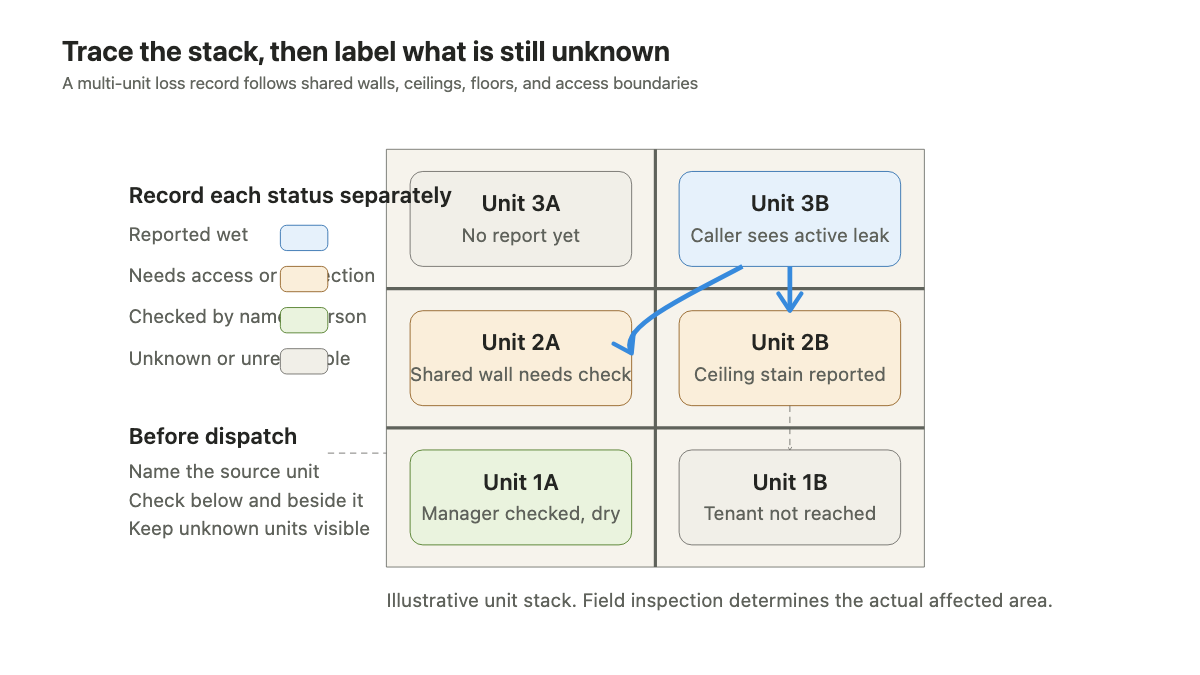
Unknown belongs in the record. An unanswered door is not a dry unit. A resident saying “I do not see water” is useful, but it does not replace a field inspection when the crew believes the space needs evaluation.
HUD’s multifamily asset-management handbook links to emergency guidance that asks managers to capture standing water, whether buildings flooded, depth and duration, access, required clearances, and damage photographs. Those questions are useful beyond HUD-assisted properties because they force a manager to separate direct observations from gaps in the report.
Record conditions without diagnosing the loss
Reception should ask what people can observe from a safe location. Useful details include active dripping, standing water, bulging ceilings, wet flooring, fallen material, water near outlets, blocked exits, unusual odors, visible sewage, and any instruction already given by the fire department, utility, electrician, plumber, or property authority.
The first safety screen should cover:
- anyone trapped, injured, unable to use a safe exit, or reporting an immediate medical concern
- standing water near electrical panels, outlets, appliances, elevators, pumps, or other powered equipment
- sagging ceilings, unstable material, broken glass, structural movement, smoke, gas odor, sewage, chemicals, or an unknown liquid
- residents who may need help moving safely, including children, older adults, and people with mobility, hearing, or vision needs
- areas already closed by management, public safety, a utility, or another authority
- pets that are loose, frightened, crated, or still inside an unchecked unit
Use the restoration company’s emergency escalation procedure when the report suggests an immediate danger. OSHA’s flood response guidance identifies electrical, structural, chemical, biological, fire, and worker hazards. CDC reentry guidance warns people never to switch power while standing in water and calls for qualified electrical review after flooding.
Do not coach a resident through a wet room to reach a breaker or shutoff. Ask whether a qualified person has acted, what that person did, and when. “Maintenance reports the unit valve closed at 8:14” is precise. “Water is handled” is not.
The broader water-damage emergency call triage guide covers hazard-first routing. When an active pipe release drives the call, use the burst-pipe intake guide for source-control questions.
Name the person who can approve work
A resident can report a leak and open a door. That does not mean the resident can authorize work on a shared plumbing line, hallway, or neighboring unit. A leasing agent may have keys but lack spending authority. A regional manager may approve the service while sitting three states away.
Capture the caller’s name, role, direct number, company, and relationship to the property. Then identify four roles, even if one person fills several:
- the person coordinating the incident
- the person with authority to approve inspection and initial work
- the on-site maintenance or facilities contact who knows the building systems
- the key holder or access contact who will meet the crew
Ask which entity receives the invoice and whether the property requires a work order, purchase order, vendor registration, certificate of insurance, or not-to-exceed authorization. Record those facts without promising a price or letting routine paperwork obscure an emergency escalation.
The public overview of the ANSI/IICRC S500 Standard describes documentation, inspection, preliminary determinations, pre-restoration evaluations, contents work, and large-loss considerations as parts of professional water-damage restoration. It also states that the property owner is responsible for determining and correcting the underlying source unless that work is separately contracted. The phone call prepares the field work. It does not perform it.
Give every door its own access status
“Management has keys” is too broad. For each unit the crew may need to reach, record whether the resident was contacted, who contacted them, when contact occurred, whether the resident will be present, who holds a key, and whether management says entry is authorized under its own procedure.
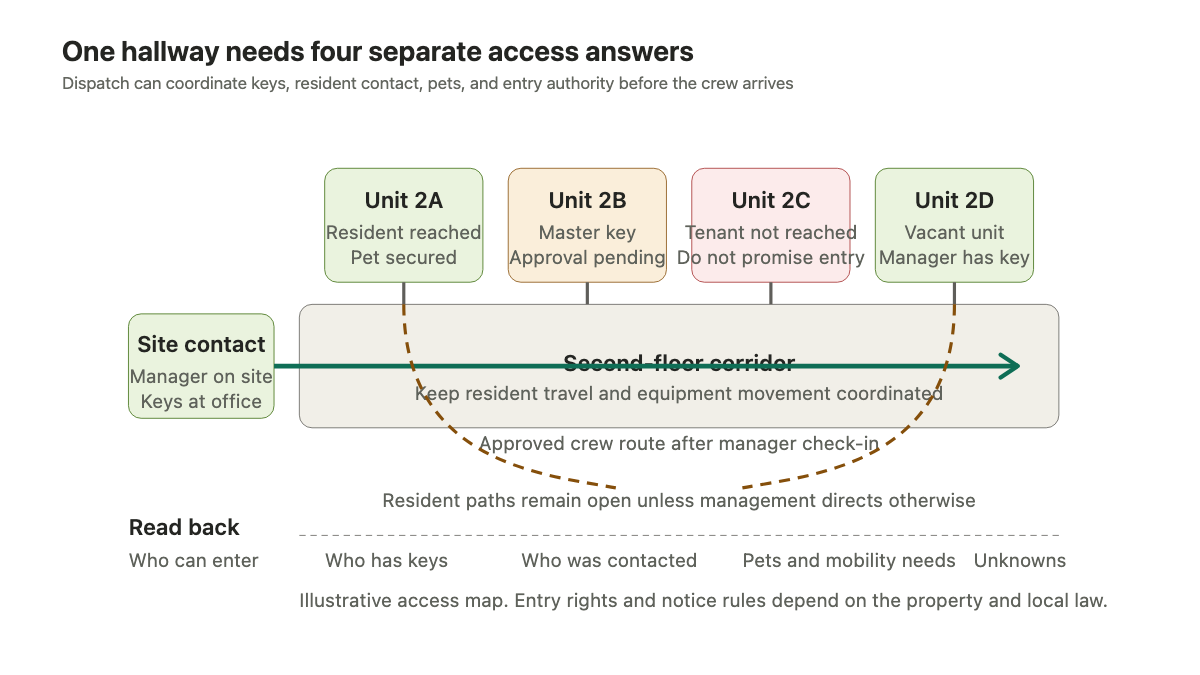
Never interpret the lease or tell a property manager that it may enter. Notice and entry rules vary by jurisdiction, lease, emergency circumstances, and property policy. Reception can ask, “Has your authorized property representative cleared entry under your procedure?” If the answer is uncertain, mark it pending and route the question back to management.
Resident coordination deserves its own fields. Ask about pets, alarms, locks changed by the resident, language needs, hearing or mobility needs, sleeping children, home health equipment, and any resident instruction supplied by management. Record only what dispatch needs. Avoid putting private medical details into a general crew note.
Confirm the crew’s entrance, parking location, gate or call-box instructions, elevator or stair access, and where equipment may be staged. A resident hallway may need to stay open. The property may have a service elevator, floor-protection rules, quiet hours, or a designated route. The office records the approved plan and its source; the field team decides whether the plan works safely.
Track changes as the call develops
Multi-unit losses change while the phone is still ringing. A resident calls back. Maintenance opens another unit. Water appears one floor lower. The fire department closes a corridor. A manager grants access to one door but not the next.
Use time-stamped status lines instead of rewriting one vague summary. A simple record might read:
“8:06, resident 3B reports water under kitchen sink. 8:12, maintenance arrives. 8:14, maintenance reports unit valve closed. 8:18, manager sees ceiling stain in 2B. 8:21, resident 2A reached and reports no visible water. 8:24, no contact with resident 1B; entry approval pending regional manager.”
That sequence preserves who said what and when. Photos need the same treatment. Label the sender, unit, room, direction, and capture time. A close-up of wet drywall with no unit number or context is weak dispatch evidence.
For a small event discovered after the visible water has stopped, the moisture-inspection call guide explains how to book an assessment without claiming hidden damage over the phone.
Hand dispatch one live status board
The final handoff should open with the exact building and unit, the incident coordinator, approving contact, on-site maintenance contact, and key holder. Follow with the reported source, current water activity, unit stack, shared spaces, observed hazards, authority instructions, resident and pet notes, access status by door, crew entrance, equipment route, parking, attached photos, and every unresolved question.
Use status labels that survive a noisy handoff: caller-reported, manager-checked, authority-directed, field-verification-needed, access-approved-by-property, and unknown. Do not let “manager checked” silently become “restorer inspected.”
Before ending the call, read back the details that could stop the crew at the curb or leave a unit untracked: “Jordan will meet the crew at Building C’s east entrance. Units 3B and 2B are open. Access to 1B is pending. The resident in 2A has secured a dog. Water near electrical equipment has not been reported, and the crew still needs to verify the affected area.”
That is the first useful map of the job. It names every known door and leaves the unknown ones visible.