“The adjuster needs your insurance paperwork by Friday. Can you send it, and will they cover the drying?”
That request contains two separate jobs. The restoration office can identify the loss, locate its own photos and field records, confirm which documents the company provides, and set a real callback. The insurer decides coverage, deductibles, deadlines, payment, and which claim forms it requires. Keep those lanes separate from the first sentence.
A useful intake record captures the property address, loss date, reported source, current safety conditions, affected rooms, customer and policyholder names, carrier, claim number, adjuster contact, documents already requested, and the exact item the caller wants from the restoration company. Record the request in the caller’s words. “Insurance paperwork” is too vague to route.
Separate the document request from the coverage question
Callers often use “insurance documentation” to mean very different things. One person needs the restoration estimate. Another wants the initial inspection notes, room photos, a drying log, an equipment list, an invoice, or proof that work was completed. A property manager may need a certificate or vendor document before granting access. An adjuster may have asked for a revised scope with a claim number in the subject line.
Ask one clean question: “Which document did your insurer or adjuster ask you to obtain from us?” If the caller has an email, ask them to forward it to the company’s approved address. Do not interpret policy language or guess what the adjuster probably meant.
The coverage question goes elsewhere. FEMA’s National Flood Insurance Program claim guidance says the insurance carrier, not the adjuster, has authority to approve an NFIP claim. Triple-I likewise tells policyholders to ask their agent or insurance company whether damage is covered, which deadlines apply, and whether estimates are needed. Those sources address different insurance settings, but the office boundary is the same: a contractor records and explains its work. It does not bind the carrier.
Use plain language. “We can confirm which job records we have and what our company provides. Your agent or carrier can answer whether the policy covers the loss.” That answer is accurate without sounding evasive.
Turn the first call into a loss timeline
Documentation gets harder when every record uses a different version of the event. The intake note says “pipe leak Monday.” The field photo says Tuesday afternoon. The customer remembers finding water after returning from a weekend trip. Reception should preserve what each person actually knows.
Start with the timeline. Ask when the caller first noticed water, whether the start time is known or estimated, when the source stopped, who stopped or repaired it, when restoration work began, and what has changed since. If the source is still active, water is near electrical equipment, a ceiling is sagging, sewage or floodwater is present, or occupants cannot avoid the affected area, return to the company’s water-damage emergency triage process. Paperwork can wait until the immediate routing is complete.
Then identify the loss parties. The caller may be a tenant, policyholder, landlord, property manager, family member, plumber, adjuster, or desk examiner. Record names and roles. Get the policyholder’s name as it appears on the claim, the service address, the carrier, claim number, assigned adjuster or examiner, and the best contact method. Do not assume the person calling can authorize work or release records.
A careful note distinguishes observation from conclusion. Write “caller reports water beneath the kitchen sink and along the cabinet toe-kick.” Avoid “covered plumbing loss” or “failed supply line caused cabinet damage” unless the appropriate person has established those facts and the company’s record supports them.
Build a photo record another person can follow
A folder with 80 close-ups and filenames such as IMG_4821 is difficult to use. Start wide, then move closer. The wide room view establishes location and direction. The source-area view shows the reported fixture, connection, roof opening, drain, or entry point in context. Material views show floor transitions, wall edges, cabinet bases, ceilings, trim, and visible changes. Contents photos isolate each affected item and its identifiers. Progress photos record what changed during extraction, removal, drying, cleaning, or repair.
FEMA tells NFIP policyholders to photograph or video structural damage, water levels, appliances, furniture, and items before moving or discarding them when safety permits. It also recommends photographing make, model, and serial numbers for appliances and organizing flood-loss images by room. That is flood-claim guidance, so do not present it as a universal rule for every homeowner policy. The room-based method is still a strong way to make a photo set understandable.
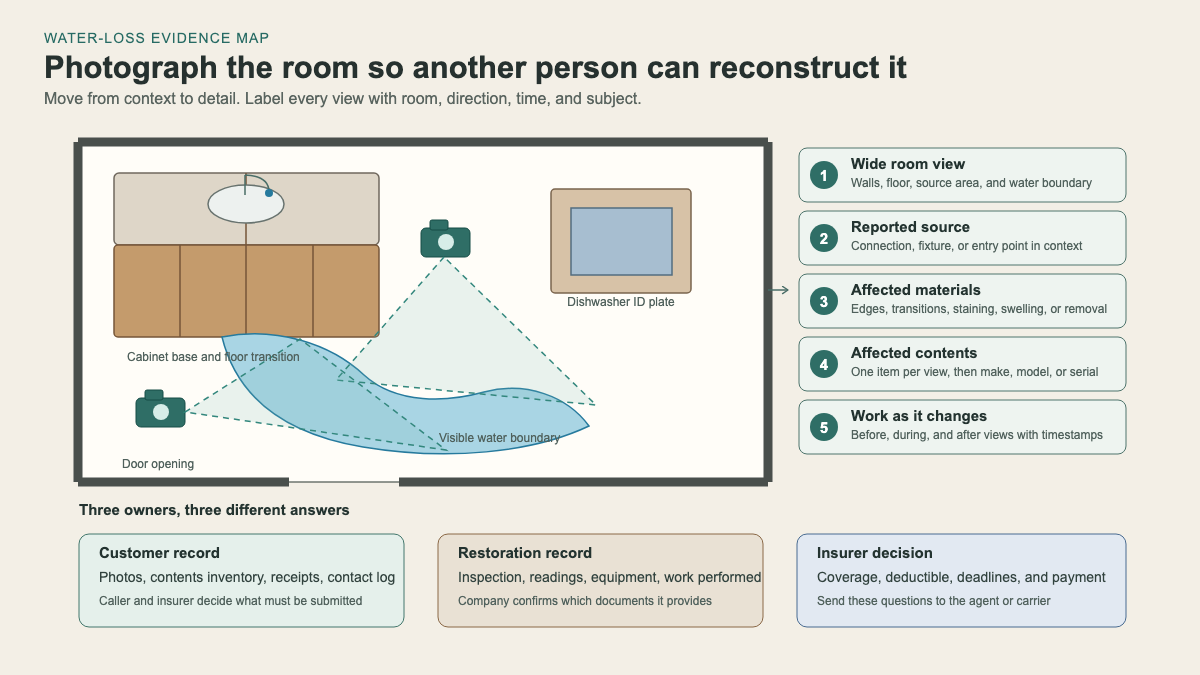
Every image needs enough context to stand on its own. A practical naming pattern might be “kitchen-north-wall-2026-09-07-0915-wide.jpg” followed by “kitchen-sink-cabinet-2026-09-07-0918-supply-area.jpg.” The exact pattern can vary. Consistency matters more than punctuation.
Keep the original file when company policy requires it. Avoid drawing directly over the only copy. If the field team adds an arrow, moisture location, room label, or removal boundary to a working image, preserve the unmarked source and identify the edited version. Do not alter an image to hide conditions, sharpen an uncertain detail into a fact, or imply a measurement that was never taken.
Reception should request customer photos only when the caller can take them safely. Never ask someone to enter standing water, approach wet electrical equipment, climb onto a roof, open a wall, move unstable materials, or cross a contained work area for a better angle.
Keep customer records and restoration records distinct
The customer’s claim file may contain personal property inventories, receipts, policy correspondence, temporary-expense records, contractor bids, and a log of conversations. Triple-I advises keeping a damaged-item inventory, copies of receipts, copies of submitted documents, paperwork received from the insurer, and the names and phone numbers of claim contacts.
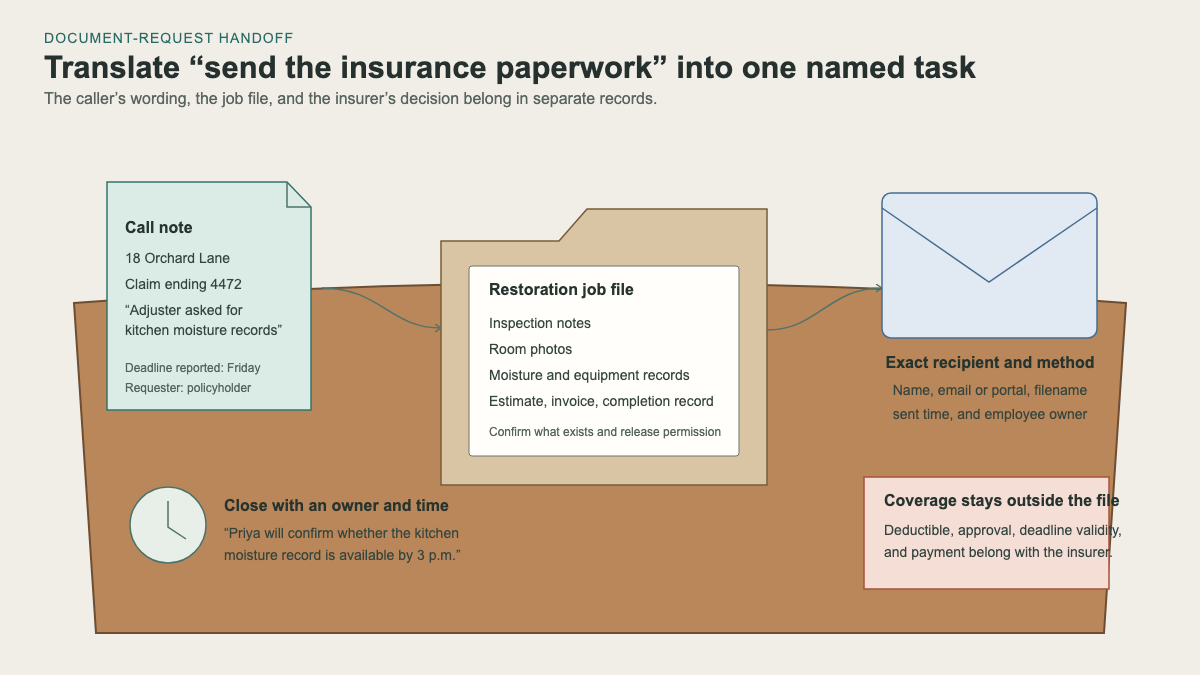
The restoration company’s job file serves a different purpose. Depending on the company and scope, it may contain intake notes, authorizations, inspection findings, moisture readings, equipment placement and monitoring records, photographs, work logs, estimates, change records, invoices, or completion documents. The public ANSI/IICRC S500 overview includes documentation, inspections, equipment, instruments, drying technology, project planning, and structural restoration within professional water-damage work. It does not say that every company produces every document on every job.
Confirm the company’s actual deliverable before making a promise. “We will send the report” fails if the shop produces field notes but no formal report. “The adjuster has everything” fails if files were sent to the homeowner or uploaded under a different claim number. Check the job record, recipient, date, delivery method, and filename.
Privacy matters here. Verify who is requesting records and whether the company has permission to release them. An adjuster’s name in the notes does not automatically answer whether photos, contracts, invoices, or occupant details may be sent. Follow the company’s release policy and escalate uncertain requests.
Name the missing item before scheduling a callback
A strong insurance-documentation call ends with one specific work item. Examples include: resend the signed authorization to the policyholder, confirm whether daily moisture records are available, add the claim number to an estimate, locate the adjuster’s written request, or ask the project manager whether a completion document has been issued.
Capture these fields in the handoff:
- Job address, loss date, caller name, role, and callback details
- Policyholder name, carrier, claim number, and claim contact when supplied
- Exact document requested and the words used by the insurer or adjuster
- Deadline stated by the requester, recorded without confirming that it is valid
- Existing delivery history: what was sent, to whom, when, and by which method
- Missing facts, authorization concerns, and the employee who owns the next action
Read it back. “You are asking for the moisture records from the kitchen loss at 18 Orchard Lane. The claim number ends in 4472. Your adjuster’s email asks for them by Friday. I have not promised that those records establish coverage. Priya is checking the job file and will call you by 3 p.m.”
That sentence protects the customer from a vague handoff and protects the office from an accidental coverage promise. If the caller also needs a new field inspection, book the service your company actually offers. The small-leak moisture inspection guide explains what to capture when the active source has stopped but hidden moisture is still a concern.
Let each party own its decision
The restoration manager owns the company’s records and explanation of work. The customer owns the information they provide and the questions they ask. The agent or carrier owns policy and claim decisions. One phone note should show those boundaries clearly.
An AI receptionist can collect the same claim identifiers, timeline, affected rooms, requested document, authorization concern, and callback deadline after hours. The company still sets its release rules and document menu. The call is complete when a named person owns a named request: “Priya will confirm whether the September 7 kitchen moisture record is available and call Jordan by 3 p.m.”
Sources
- FEMA: How Do I Start My Flood Claim?
- Insurance Information Institute: Settling Insurance Claims After a Disaster
- IICRC: ANSI/IICRC S500 Standard for Professional Water Damage Restoration