The dining room is dry enough for the adjuster to stand in, but the cabinet beside the wet wall is full of wedding china, tax records, prescription bottles, and a box of family photographs. The owner hears “contents pack-out” and pictures a moving crew carrying the whole house into an unknown warehouse.
A clear explanation starts here: a contents pack-out is a documented relocation of selected belongings so the restoration team can inspect and work on the building, while affected items receive the handling that the field team recommends. Before anything moves, the crew should identify the room, photograph condition, assign item or container records, and explain where the contents are going. The office should also ask what the household needs to keep accessible and which items require owner approval or specialist review.
Reception can explain that process. It cannot decide by phone that an item is salvageable, promise what insurance will cover, or name a return date before the scope and storage plan are known.
Explain the purpose before discussing boxes
Callers often ask, “Do you have to take everything?” The accurate answer depends on the affected rooms, the work needed inside them, the condition of the contents, and the field plan. Some items may stay in place with protection. Others may move within the property. A partial or full pack-out may be proposed when belongings block access, need separate attention, or should be moved away from continuing work.
Ask what the caller has been told so far and who said it. “The technician recommended clearing the west bedroom” is different from “my adjuster said the whole house must be emptied.” Keep those statements attached to their sources.
The public overview of the ANSI/IICRC S500 Standard includes contents evaluation, restoration, remediation, inspection, preliminary determinations, project documentation, and risk management within professional water-damage restoration. Those are field functions. The receptionist's job is to explain the next appointment, identify the decision-makers, and collect the details that keep personal property from becoming an afterthought.
Start with the loss address, affected rooms, current access restrictions, source-control status, and whether anyone has reported sewage, chemicals, structural movement, water near electrical equipment, or another immediate hazard. Use the company's emergency procedure when the report warrants it. The broader water-damage emergency call triage guide covers that first safety screen.
Build the inventory before anything moves
A useful inventory begins with the room, not a pile of boxes in the truck. Ask how the company documents a room before packing. The record should let another person connect a belonging to where it started, what condition was visible, which container holds it, its current handling status, and its storage location.
FEMA's flood claim guidance tells policyholders to photograph damaged property and possessions before moving, removing, or discarding anything. It recommends room-based organization and photographs of the make, model, and serial number for appliances, televisions, computers, and similar equipment. Although that page addresses National Flood Insurance Program claims, the documentation method is useful on other water losses too. The caller must still ask the actual insurer what its policy requires.
Wide room photographs establish location. Closer photographs capture an item's condition and identifying marks. A useful description says “brass table lamp, north living-room shelf, tag LR-017, scratch on base visible before handling.” “Lamp, packed” will not help when the owner asks for it six weeks later.
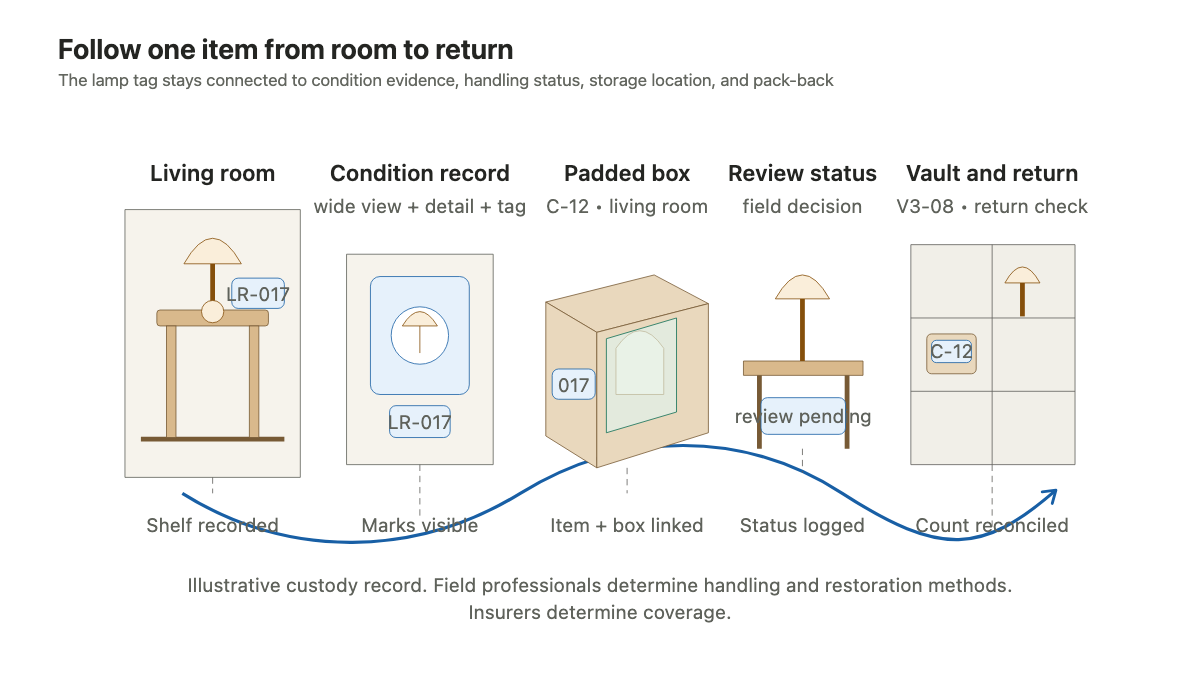
The container needs its own traceable label. Record the room, box or crate number, general contents, special handling note, and destination. If the box later moves to a cleaning area or another vault, update the location. Do not create a disconnected note that leaves the office searching two systems.
Before the crew leaves a room, reconcile item and container counts under the company's process. Open questions should remain open: owner review pending, specialist opinion needed, insurer question referred, or disposition undecided. A blank status looks like a forgotten item.
Set aside what the household still needs
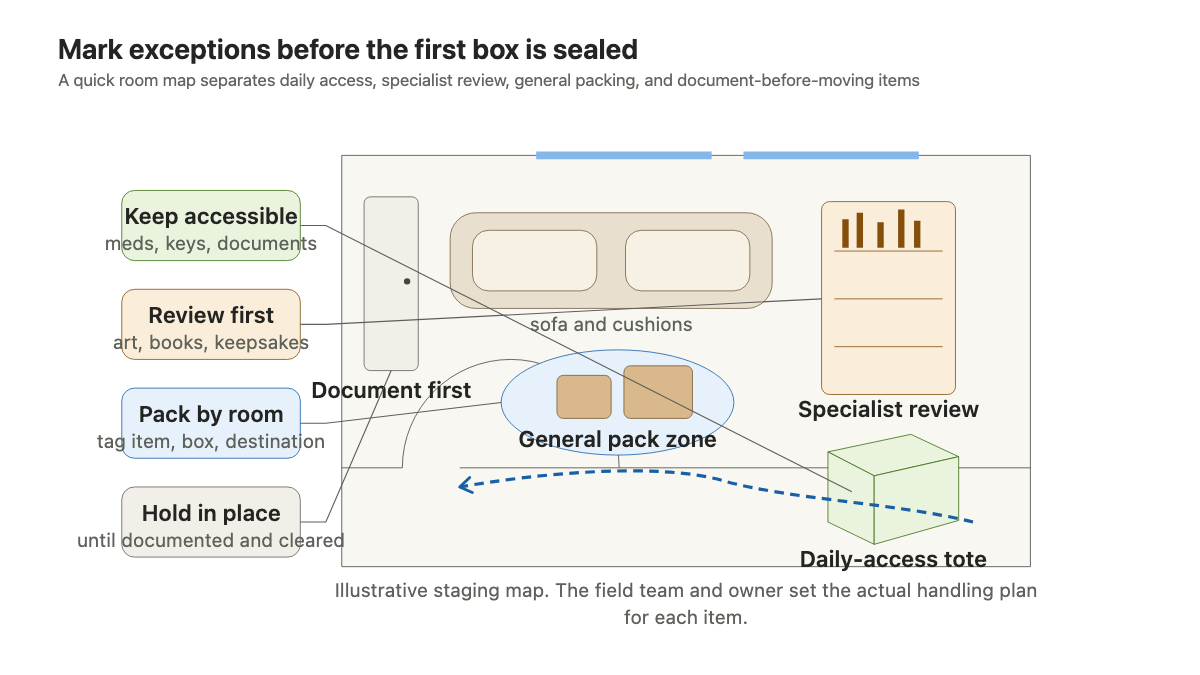
The best time to ask about essential property is before the tape gun starts. A displaced family may need medication, identification, school materials, work equipment, keys, chargers, pet supplies, clothing, insurance papers, and a child's comfort item. A business may need payroll records, current orders, access cards, or a particular computer.
Do not ask the caller to make a perfect list during a stressful first call. Start a short access list, name the person who can update it, and confirm when the field lead will review it. If an owner will remain in part of the home, ask which rooms and paths must stay usable.
Valuable and sensitive contents need a separate conversation. Record art, antiques, firearms, jewelry, legal papers, refrigerated medication, musical instruments, collections, irreplaceable photographs, and fragile keepsakes in the terms the owner uses. Ask who may authorize movement and whether a specialist already cares for the item. Do not estimate value or choose a cleaning method from the desk.
EPA's guide to mold and moisture advises prompt drying of water-damaged areas and items. It also notes that porous materials can be difficult or impossible to clean completely once mold grows in them, and suggests consulting an appropriate specialist when an item is expensive, sentimental, or hard to evaluate. That guidance supports quick professional review. It does not let reception pronounce a family album restored or a sofa ruined.
Explain cleaning, storage, and access as separate steps
“Where will my things go?” deserves a specific answer. Name the destination the company actually uses, whether it is an on-site container, company facility, specialist facility, or third-party storage location. Explain who transports the contents, how the owner receives the inventory, who controls access, and which contact handles questions after pickup.
Then separate four stages that callers tend to blend together:
- Pack-out: documentation, packing, labeling, and transport under the approved scope.
- Handling review: the field team or appropriate specialist assigns the next action for each item or group.
- Storage: the record identifies the current container and location while building work continues.
- Pack-back: returned items are checked against the inventory and placed according to the agreed plan.
Avoid saying every item will be “cleaned and restored.” Some contents may need no treatment. Some may wait for owner, specialist, or insurer input. Some may not be suitable for the same method as their neighbors in the box.
Ask how an owner can request an item during storage. The process may require advance notice because staff must locate the vault, retrieve the container, update custody, and arrange pickup or delivery. Record which items are likely to be needed early. Never promise unrestricted warehouse access or same-day retrieval unless that is the company's real policy for this job.
Return planning starts before removal. Room tags, shelf or cabinet locations, photographs, and owner notes make pack-back more orderly. “Kitchen, upper cabinet left of sink” carries more information than “box 34.” At return, unresolved shortages, changed-condition questions, or items routed elsewhere need a documented exception, not a quiet adjustment to the count.
Keep insurance promises out of the explanation
A caller may ask whether the pack-out is covered, whether storage has a time limit, or whether the insurer will pay to restore a particular item. The restoration office can explain its proposal, authorization forms, rates, documentation, and billing process. Coverage belongs with the carrier, policyholder, and adjuster.
FEMA's NFIP guidance states that the insurance carrier has authority to approve the claim and tells policyholders to discuss coverage with their agent and adjuster. Other policies and losses have their own terms. A useful response is, “We can send you the proposed scope and inventory process. Please confirm coverage and approval requirements with your insurer.” Keep the adjuster's name, claim number, direct contact, and any written instruction in the job record without translating that instruction into a guarantee.
Disposition calls need the same discipline. FEMA cleanup guidance advises photographing damaged personal property by room and separating damaged from undamaged items when an adjuster may need to document them. It also recognizes that some flood-contact items can pose health concerns. Field professionals should apply the conditions of the actual loss. Reception should never tell a caller to rummage through a hazardous room or discard a disputed item solely to simplify the pack-out.
Give the caller one record and one next contact
Before ending the call, read back the affected rooms, who owns or controls the contents, who can authorize work, where the field review will begin, the essential-access list, special items, current documentation status, expected storage destination, insurer contact, and every unanswered question.
A concise handoff might say: “The field lead will review the living room and west bedroom before any contents move. Dana approves the work. Medication, passports, two laptops, and the child's blue blanket stay accessible. The piano and framed photographs need owner and specialist review. The insurer has received notice, but coverage approval is still pending. Morgan is the contents contact after inventory.”
That call gives the owner something firmer than “we take care of everything.” It gives one named person, one documented inventory, and a visible path for each box to come home.