The caller says, “The big machine in the hallway stopped making noise.” There are four air movers in two rooms, a dehumidifier beside the stairs, a drain hose running to a utility sink, and an extension of the drying area behind a closed door. “The big machine” is not enough for a technician to act on.
A useful drying-equipment callback captures the address, room, machine label, current operating state, display or alert, drain condition, nearby water, power observations, anything that was moved or opened, and the caller's safe access window. Keep the caller away from electrical troubleshooting. Do not tell them the building is dry because a wall feels dry or a screen shows a lower humidity number. The field lead decides whether the report needs urgent action, phone guidance under company policy, or attention at the next monitoring visit.
Start with the exact machine and room
Restoration drying setups often combine air movement and dehumidification. The equipment manufacturer XPOWER describes the relationship in plain terms: air movers help move moisture from wet surfaces into the air, while an LGR dehumidifier removes water vapor from that air. A stopped air mover in the den and a stopped dehumidifier serving the whole contained area are different reports.
Ask the caller to stay in a safe, dry location and read the label that your crew placed on the machine. A practical label might say “D-3, upstairs hall” or “AM-4, east bedroom.” If the company records manufacturer and model, confirm those too. Then ask what the caller observes without touching or opening the unit: running, silent, cycling, showing an alert, leaking, unusually loud, or blocked by something that changed in the room.
The public overview of the ANSI/IICRC S500 Standard includes psychrometry, drying technology, equipment, instruments, safety, inspections, project documentation, and structural restoration. That is why the callback should join the machine to the room and drying record. A detached note such as “fan broken” forces the field team to reconstruct the job while the customer waits.
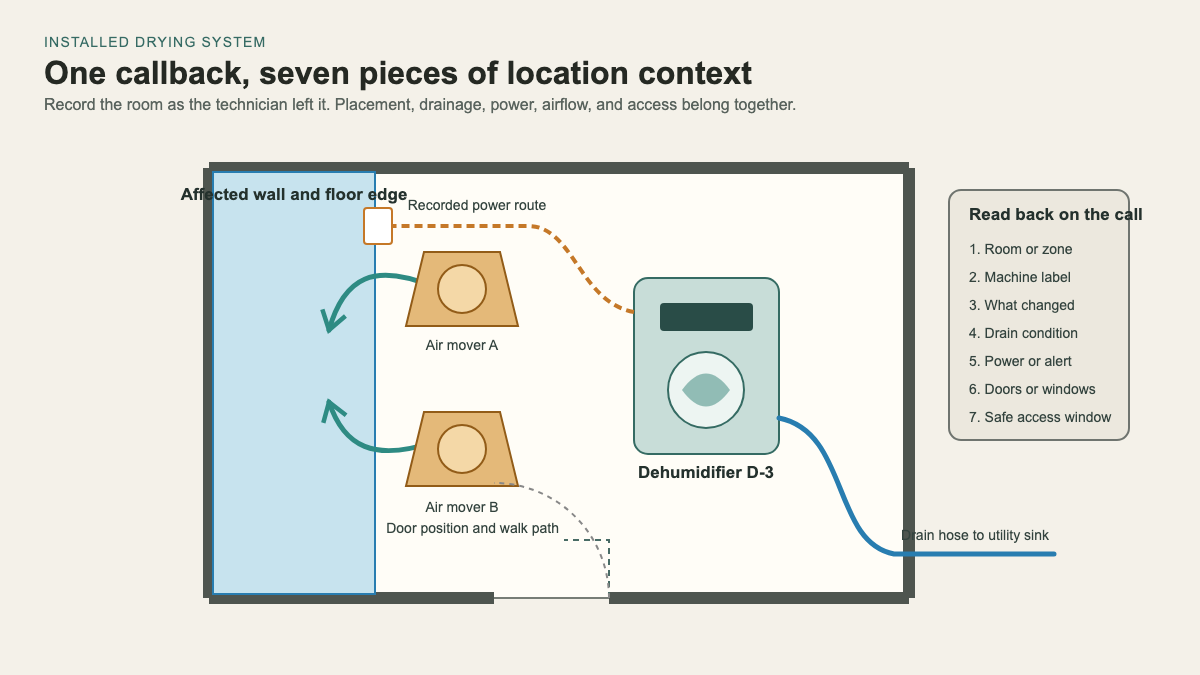
Use the placement record if your crew made one. Ask whether the machine is still where the technician left it, whether a door or window changed position, whether furniture or laundry now blocks airflow, and whether anyone unplugged or moved anything. Reception should document the change, not coach the caller through rebuilding the setup.
Separate inconvenience from a safety escalation
Drying equipment can be loud, warm, and awkward in an occupied home. Those concerns deserve a real answer and a clear callback time. They are still different from smoke, sparking, a burning odor, a visibly damaged or hot cord, water around electrical equipment, or new standing water.
Use the company's urgent safety procedure for electrical warning signs or a changed water condition. Keep the caller out of the affected area when the company's protocol calls for it. Do not ask someone to reset a breaker, open an equipment housing, handle a wet plug, test a damaged receptacle, or step through water to read a display. The office collects observations and location. A trained field person chooses the response.
A drain report needs similar precision. Ask where the water appears in relation to the machine and hose. Is it a few drops at a hose connection, a wet area beneath the unit, an overflowing sink, or fresh water entering from another source? When was it first seen? Is the amount changing? Get a photograph only if the caller can take it from a safe place without moving equipment or crossing the work zone.
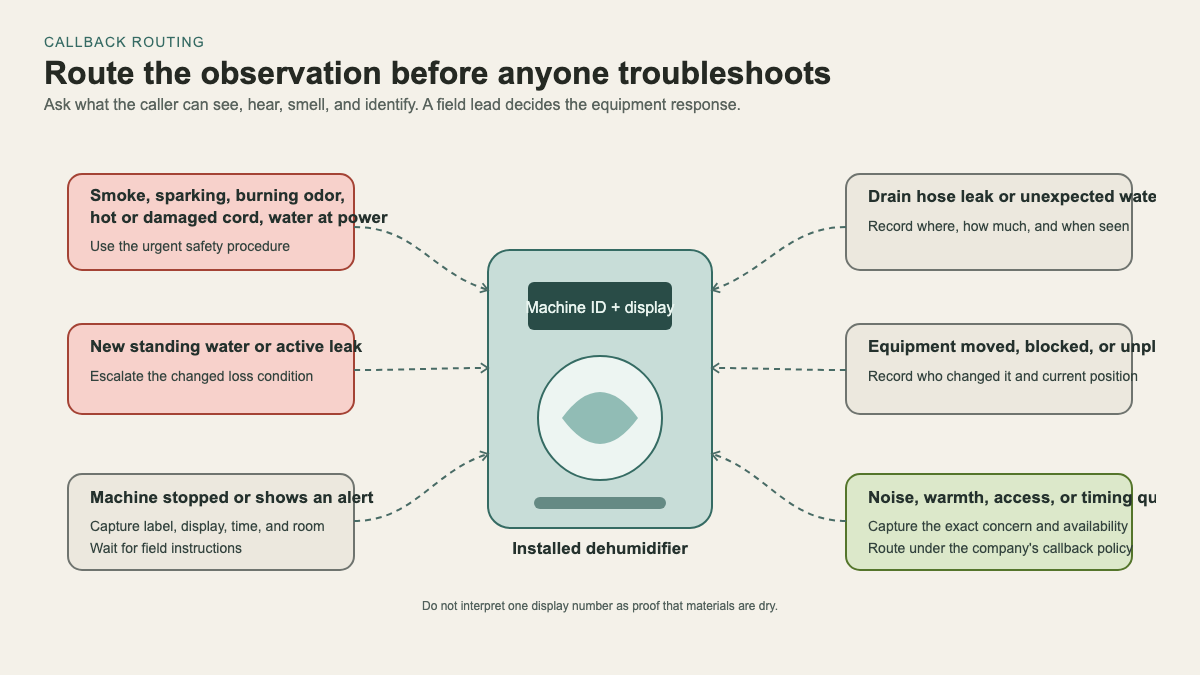
This routing map has a deliberate gap: it contains no repair steps. Equipment models, power arrangements, containment, water category, and site conditions vary. A script that tells every caller to unplug, reset, reposition, or restart a machine can make a manageable callback unsafe.
Protect the drying setup while the field lead reviews it
A caller may want to turn everything off for a meeting, bedtime, a child's nap, or a remote-work call. XPOWER's published guidance for its drying system says the equipment should continue operating overnight and the space should stay contained until the drying goal is reached. That supports a simple office rule: follow the restorer's job-specific instructions and call before changing the setup when circumstances allow.
Do not turn that rule into a promise that every machine on every job must run for a fixed number of days. Drying time depends on affected materials, the amount and path of water, what was removed, indoor and outdoor conditions, equipment performance, and the readings collected during monitoring. The R&R monitoring guide tells restorers to record moisture in affected structural materials and conditions in the air. It also describes adjustments as the site changes.
A room can feel dry before concealed or dense materials meet the field team's drying criteria. The reverse can happen too: a caller may feel uncomfortable in dry, warm moving air even while the equipment operates as intended. Reception should acknowledge the concern and send the exact observation to the field lead. Avoid interpreting a touch test, odor, display reading, or run time as the finish line.
EPA advises drying water-damaged areas and items within 24 to 48 hours when feasible. That figure is a prompt-action target. It is not a guaranteed completion time for every structure, and it does not tell office staff when to remove equipment.
Capture the display, drain, power, and site changes
Some commercial dehumidifiers display temperature, relative humidity, operating hours, alerts, or drying trends. Legend Brands lists those features for its Revolution LGR dehumidifier, but models vary. Ask the caller to read visible text exactly or send a clear photograph if that can be done safely. Do not translate a code from memory when the job record or manufacturer documentation can preserve the exact model context.
A strong callback note answers these questions:
- What is the job address, caller name, and best callback number?
- Which room or contained zone is involved, and what machine label is visible?
- What is the machine doing now, and when did the caller first notice the change?
- What exact text, code, light, or reading appears on the display?
- Is water visible near the unit, hose, drain destination, cord, plug, or receptacle?
- Did power fail elsewhere in the property? Did anyone move, unplug, cover, or block equipment?
- Have doors, windows, HVAC settings, occupancy, or access conditions changed since the last visit?
- Can the caller send a safe wide photo of the machine in the room and a closer photo of the label or display?
- Who can provide access, and during which window?
Read the note back. “D-3 stopped” becomes: “Dehumidifier D-3 in the upstairs hall became silent at about 9:20 p.m. The display reads E4. The drain hose still reaches the utility sink, and no water is visible around the unit. A bedroom door that was open at the last visit is now closed. Nobody reports smoke, sparking, heat at the cord, or new standing water. Jamie can provide access until 11 p.m.”
That handoff gives the field lead enough context to decide what comes next without asking the caller to diagnose the machine.
Set one callback owner and a concrete expectation
Tell the caller who owns the response. If the on-call technician is reviewing it, say so. If the report will be handled during the scheduled monitoring visit, give the real appointment window. If your policy requires an urgent return, confirm who is dispatching and what access is needed. Do not promise an arrival time that the field team has not accepted.
Keep equipment concerns linked to the drying log. The machine ID, room, report time, caller's observations, photographs, field decision, and follow-up belong in one record. If a technician changes placement or removes a unit, update the record so the next receptionist does not read yesterday's setup back to the customer.
For a fresh leak or new standing water, return to the company's emergency workflow and the broader water-damage call triage guide. For questions about readings after a small leak, use the moisture inspection intake guide. Commercial sites may also need the access and operations details in the commercial water-loss call guide.
The best closing line is specific: “Morgan has the D-3 report, the E4 display photo, and Jamie's access window. Morgan will call Jamie by 10 p.m. with the field decision.” The caller knows who has the problem. The technician gets the room as it actually stands.