A warehouse manager calls at 7:10 a.m. Water is dripping above aisle four, receiving starts in fifty minutes, and the maintenance supervisor is still driving in. The service address alone will not get a restoration crew through the gate or tell them whether the stock room is the only affected area.
Commercial water damage restoration call intake should establish four things early: who controls the incident, which operations remain active, what hazards have been reported, and how the crew will enter with its equipment. Capture observations without declaring the property safe, diagnosing contamination, setting the restoration scope, or promising insurance coverage.
That distinction gives dispatch a usable record. It also keeps the office from burying the most important detail, such as “security requires a vendor escort,” under ten minutes of water-loss history.
Establish authority before collecting the whole story
Start with the caller’s name, role, direct mobile number, company, and exact property address. Then ask a harder question: “Who has authority to approve emergency inspection and initial work today?” The caller may be a tenant manager who can open a suite but cannot approve work in a mechanical room. A regional facilities director may control the budget from another state. Security may control physical entry while a building engineer controls utilities.
Name each role. “Manager is aware” is weak dispatch information.
For a complicated property, the office usually needs an incident contact and a facilities contact. The incident contact coordinates the loss, approvals, and updates. The facilities contact knows the water, electrical, HVAC, fire-protection, alarm, elevator, and access systems. One person may fill both roles, but the record should say so.
Ask who owns the building, who occupies the affected space, and who will pay for the initial visit. Record purchase-order or vendor-registration requirements without letting paperwork delay a life-safety escalation. If the caller mentions an insurer, broker, or adjuster, capture that contact as a separate stakeholder. Do not tell the caller whether a service, material, or interruption will be covered.
Ready.gov’s business emergency planning guidance tells businesses to document internal and external incident resources and determine what information outside responders need. A restoration company can apply the same principle on the call: identify the people who can make decisions, provide building information, and open the right doors.
Map the loss around operations that are still active
A commercial loss is rarely described well by one room name. “Back warehouse” could mean a locked stock cage, an active forklift aisle, a food-storage area, or a tenant space below a leaking roof. Ask the caller to walk through locations in plain language. Where is water first visible? What is directly above, below, and beside it? Which rooms, floors, suites, aisles, or departments show an effect?
Then ask what remains open. A hotel may still have guests above the affected floor. A clinic may have patients arriving through the same corridor a crew would use. A restaurant may have water near dry storage while the kitchen is preparing to open. The intake note should distinguish reported affected areas, active operating areas, restricted rooms, and conditions nobody has checked yet.
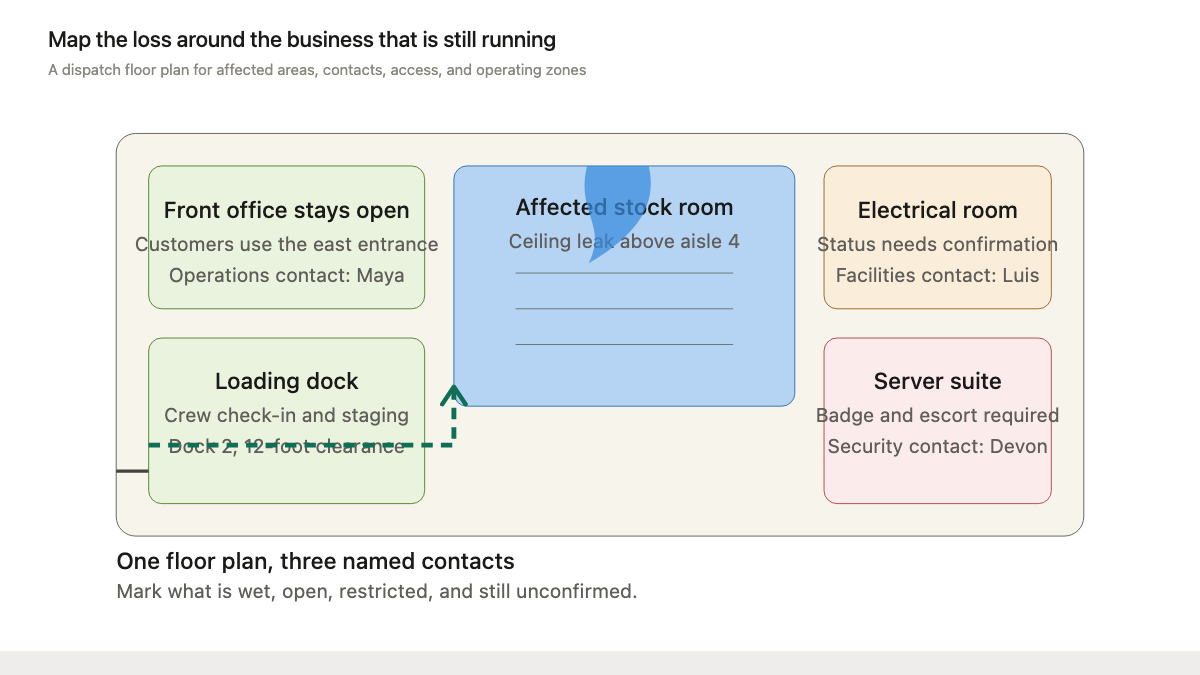
Ask whether employees, customers, residents, students, patients, contractors, or delivery drivers are present. Record the property’s own closures, barriers, and protective actions. Reception should not invent a reopening plan. The EPA’s guidance for mold remediation in schools and commercial buildings treats occupants and remediators as part of the response context, which is why building use belongs in the first dispatch record.
Get the operating schedule for the next several hours. Ask about shift change, opening time, deliveries, appointments, production runs, housekeeping, and security lockup. A crew arriving at a quiet loading dock at 7:30 may find the same path blocked by pallets and trucks at 8:00.
This article focuses on commercial coordination. Use the broader water-damage emergency call triage guide when the immediate question is whether the event needs emergency escalation. For an active pipe release, the burst-pipe intake guide covers source status and spread in more detail.
Screen hazards without making a site declaration
Ask what the caller can observe from a safe location. Keep the wording factual. “Water is touching the bottom of the electrical panel” belongs in the record. “Electrical room is safe” does not, unless the appropriate on-site authority has made and documented that determination under its own procedure.
The first safety screen should cover:
- standing or moving water, sagging ceilings, falling material, unstable shelving, damaged glass, or blocked exits
- water near electrical panels, outlets, machinery, elevators, IT equipment, fire-protection equipment, fuel systems, or other utilities
- sewage, chemicals, process liquids, medical waste, spoiled food, strong odors, visible smoke, or any unknown substance in the water
- people who are trapped, injured, unable to use a safe exit, or reporting an immediate medical concern
- areas already closed by security, facilities staff, the fire department, a utility, or another authority
- special operations such as food preparation, patient care, laboratories, child care, manufacturing, or occupied lodging
If the report points to an immediate emergency, follow the restoration company’s escalation procedure and direct the caller to the appropriate emergency authority when required. Keep people away from reported hazards. OSHA’s flood response guidance lists electrical, structural, chemical, biological, fire, and worker-safety hazards that can appear during water cleanup. It also warns against entering wet areas near electrical equipment.
Do not coach an untrained caller through electrical shutdown, roof access, machinery isolation, sewage cleanup, or entry into a restricted area. Ask whether the site’s qualified facilities or utility contact has acted, what they did, when they did it, and how that status was communicated. Reported shutoff and verified isolation are different fields.
Build an arrival route the crew can actually use
“Park in back” is where many commercial dispatch notes fail. Ask for the gate, street, driveway, dock, or service entrance the crew should use. Capture a named check-in contact with a direct number. Record gate hours, call-box instructions, badge rules, vendor screening, photo-identification requirements, alarm procedures, and whether an escort must remain with the crew.
Equipment changes the route. Ask about vehicle-height limits, loading-dock clearance, reserved staging space, freight-elevator dimensions or restrictions, stairs, long hose or cord runs, floor protection, and areas where carts cannot travel. Reception does not need to design the drying setup. It needs to reveal the constraints before the wrong vehicle is sent to the wrong door.
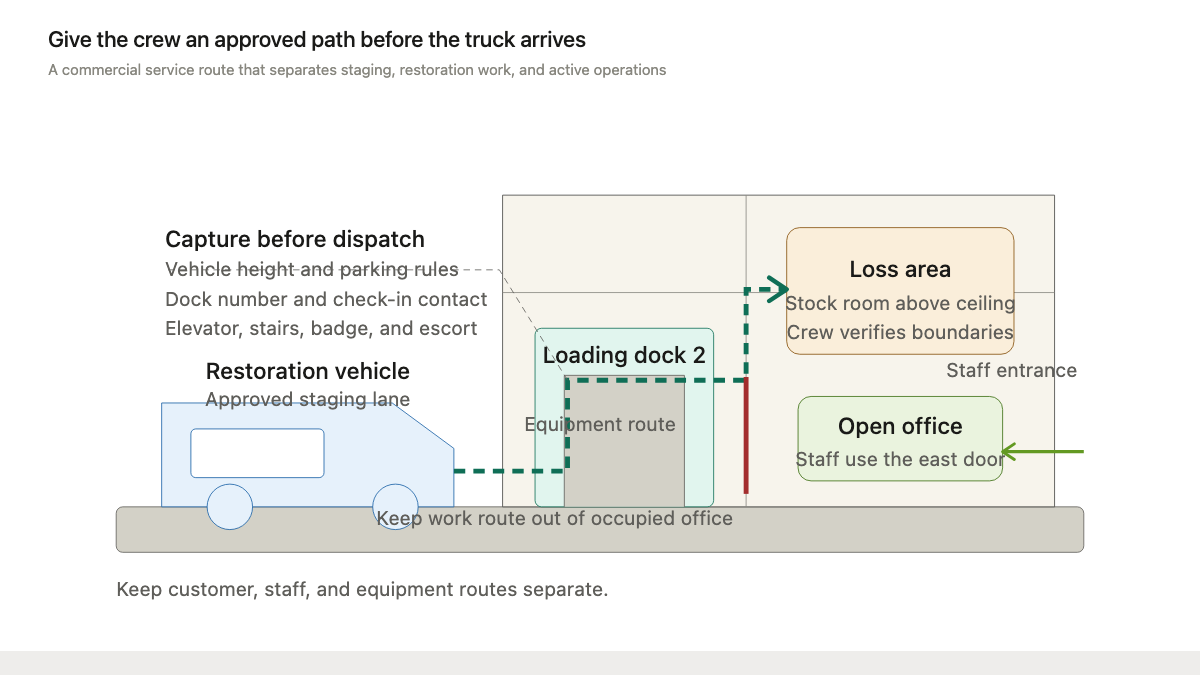
Separate the crew route from public traffic when the property has already established one. Ask where customers and employees are entering, where deliveries are moving, and which corridor the site contact has approved for equipment. Note any quiet hours, infection-control process, food-area restrictions, clean-room controls, or tenant rules supplied by the property. Those details may require a manager callback before dispatch.
Request useful files while someone is available to send them: a floor plan, marked phone photo, dock instructions, vendor packet, incident log, roof or plumbing report, and photos showing the affected area from a safe position. Label every file with its source and time. A photo from yesterday afternoon should not silently become the current site condition.
Ask what happened to building services
Commercial buildings have linked systems. A closed water main may affect toilets, production, tenant service, or fire protection. An elevator taken out of service may remove the only practical equipment route. An HVAC shutdown can affect occupied areas beyond the visible loss.
Ask which building services are operating, limited, shut down, or unknown. Capture who reported each status. Do not tell facilities staff when to restart water, power, HVAC, elevators, alarms, machinery, or fire-protection systems. The field team and the property’s qualified personnel need to coordinate those decisions.
The same discipline applies to the source. Record “facilities reports the domestic-water valve closed at 6:52 a.m.” That is better than “source fixed.” A closed valve may stop flow without repairing the failed component, and the caller may be describing a different line.
Hand the crew one coordinated record
A good dispatch note reads like a site handoff, not a transcript. Put the exact address, business name, incident contact, facilities contact, approving party, billing contact, and check-in contact at the top. Then summarize the reported source and time, visible spread by floor or zone, current water activity, hazards, protective actions, active operations, affected occupants, building-service status, access route, staging location, security rules, equipment constraints, and attached files.
Mark each important statement as caller-reported, property-confirmed, authority-directed, or unknown. That language protects the quality of the handoff because the arriving crew can see what still needs field verification.
The public overview of the ANSI/IICRC S500 Standard for Professional Water Damage Restoration describes inspection, documentation, drying, and evaluation of affected materials as parts of professional restoration work. The phone call prepares those activities. It cannot replace them.
Before ending, read back the few details that could derail arrival: “Maya will meet the crew at dock two. Security needs photo ID. Luis is the facilities contact. The office remains open through the east entrance, and the electrical-room status is still unconfirmed.” Then give the caller the company’s real callback process and ask them to report any change in water flow, occupancy, access, or observed hazards before the crew arrives.
That final readback gives everyone the same first map of the incident, down to the door the truck should use.