A caller says, “There is dirty water coming up through the basement drain.” Behind that sentence could be a damp patch around one opening, sewage across a finished room, or standing liquid at the electrical panel. The first call should establish whether everyone has a dry way out, which fixtures are affected, whether the backup is active, and how far contamination has spread. Then the office can route the plumber, restoration crew, municipal utility, or septic provider without asking the caller to investigate in a hazardous area.
Treat visible sewage as a contamination call from the first minute. The U.S. Environmental Protection Agency says sanitary sewer overflows contain untreated or partly treated sewage and may expose people through direct contact. Reception should keep people and pets away, screen electrical and structural hazards, record observations, and escalate under the company’s emergency policy.
Put a safety boundary around the area
The caller may be standing at the basement door, trying to decide whether to cross the room and save boxes. Give a simple boundary: stay out of the affected area and keep children, visitors, and animals out. Do not ask anyone to walk through sewage, pick up soaked belongings, open a floor drain, or test an appliance.
Electricity changes the call immediately. Ask whether liquid has reached outlets, extension cords, appliances, a furnace, a water heater, or the electrical panel. Also ask whether lights are flickering, breakers have tripped, or the caller sees sparks. The Centers for Disease Control and Prevention says a person should never turn power on or off while standing in water. If the main switch cannot be reached from a dry location, an electrician should handle it.
Gas odor, hissing, smoke, fire, a possible structural collapse, or a person who cannot leave safely belongs in the company’s emergency-services route. Reception should use approved language and avoid improvising technical instructions. The property can wait.
Capture the caller’s position too. “Standing on the dry basement stairs” is useful. So is “calling from upstairs because the basement floor is covered.” The responding manager now knows whether a safe entry route has been reported or must be found on arrival.
Separate an active backup from a completed overflow
Ask what the caller can see without reentering the area. Is liquid rising now, draining slowly, or sitting at a stable level? Which opening did it come through: a toilet, shower, tub, sink, cleanout, or floor drain? Has the caller seen another fixture overflow?
Next, ask about water use. Did the backup appear while a toilet flushed, a washing machine drained, or several fixtures were used? Have occupants stopped using toilets, sinks, showers, dishwashers, and laundry equipment? The answer does not diagnose the blockage. It tells the dispatcher whether continued discharge may still be feeding the event.
The office should never promise that stopping water use has solved the problem. A municipal main, private building sewer, septic problem, or obstruction elsewhere may be involved. Ask whether the property uses a public sewer or septic system, whether neighbors report trouble, whether heavy rain occurred recently, and whether a plumber, utility, property manager, or septic company has already been contacted. Record each answer as reported.
This distinction matters for dispatch ownership. The IICRC’s public overview of the ANSI/IICRC S500 standard says correction of the underlying source is generally the property owner’s responsibility unless the restorer or another specialist is hired for that work. A restoration company can assess contamination and material damage, but its office should confirm whether source correction is within its own scope.
Keep this page beside the broader water-damage emergency call triage guide. If the property has a private system and the call concerns pumping or a septic source visit, use the septic pumping and backup intake guide for that trade’s questions.
Build a contamination map in plain language
“Basement affected” is too vague for a crew assignment. Ask the caller to name rooms and surfaces from a safe location. A useful record identifies the apparent opening, the farthest visible edge, any lower level, and anything important in the path.
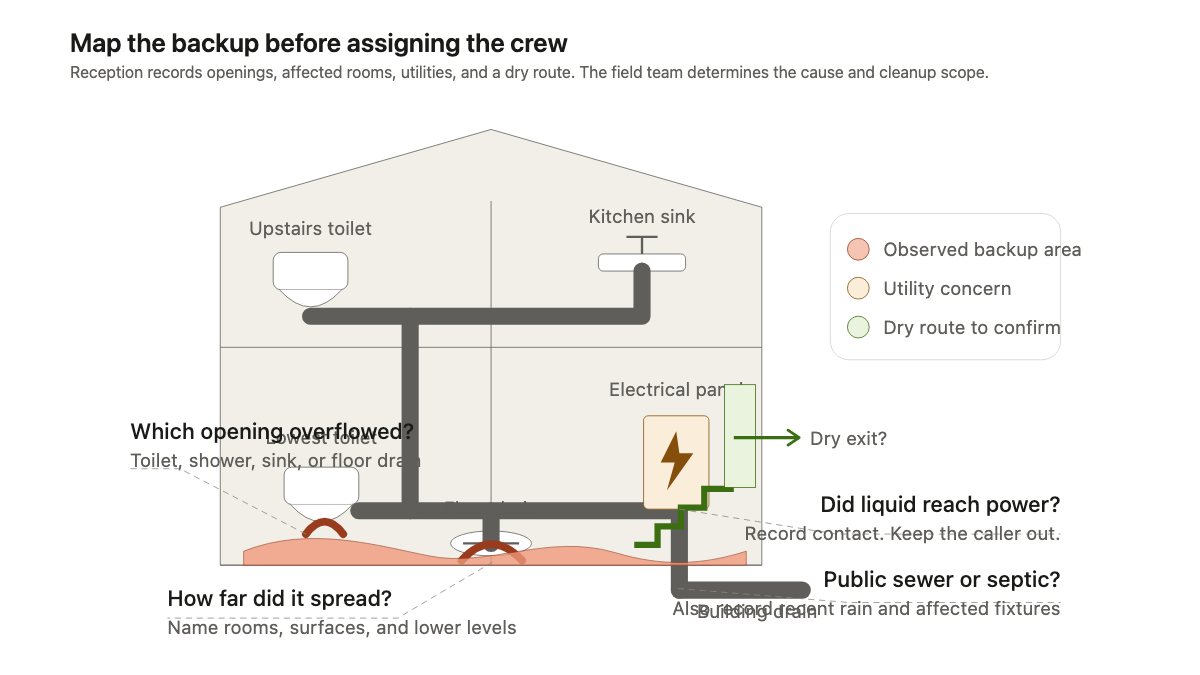
Use one sequence for the scope questions:
- Which room contains the first visible backup, and which opening appears involved?
- What other rooms, closets, hallways, or stair landings have visible liquid or splashing?
- Is the surface concrete, tile, carpet, wood, or another material?
- Did sewage touch drywall, cabinets, upholstered furniture, stored boxes, food, toys, or HVAC equipment?
- Is there standing liquid, and can its depth be estimated from a dry location against a step, baseboard, or fixed object?
- Has anything reached an outlet, appliance, panel, furnace, water heater, or extension cord?
- Is there a dry entrance for the crew, and are gates, elevators, loading areas, pets, or parked vehicles in the way?
Boston Water and Sewer Commission advises treating everything touched by sewage as contaminated. It also recommends photographs that record the date, time, affected area, and opening involved. The office can ask whether the caller already has safe photos. It should never send the caller back into the area to create documentation.
Avoid classifying materials over the phone. A caller can report “carpet is wet to the doorway” or “liquid touched the bottom of the drywall.” The technician decides what can be cleaned, dried, or removed after inspecting the site. EPA notes that rugs, flooring, wallboard, curtains, and upholstered furniture that contact sewage usually require replacement, but a receptionist should not turn that general guidance into a site-specific verdict.
Assign the right responders and handoffs
The dispatch note should show who is handling the source and who is handling contamination. In a single-company operation, those may be two crews under one roof. In other cases, the restoration manager needs a plumber, septic provider, municipal sewer department, electrician, HVAC specialist, or building manager involved before or during mitigation.
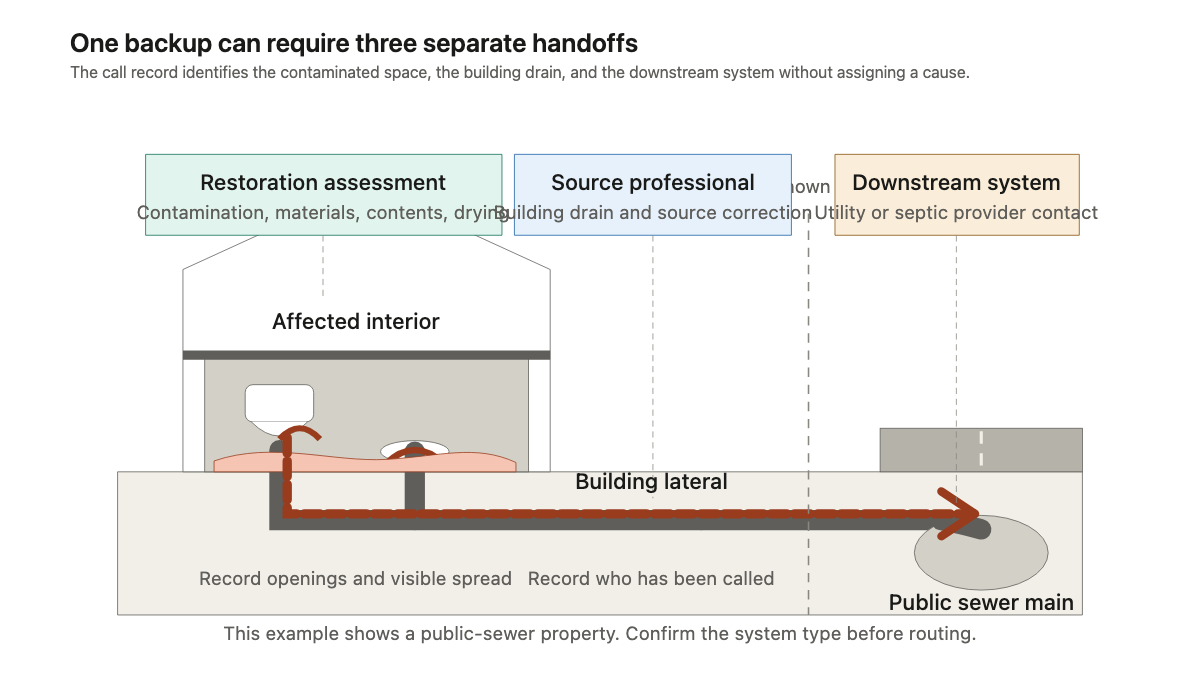
For a public-sewer property, ask whether the utility has issued an incident number or said other addresses are affected. For a septic property, record alarms, recent pumping or service, visible wastewater outdoors, and the service provider if known. For a rental or multi-unit building, capture the on-site contact, owner or management authorization, affected unit numbers, shared spaces, and access instructions. Do not promise who is financially responsible or whether insurance will cover the work.
A clean handoff can read:
“Caller is upstairs at 44 Hawthorne Place. Basement floor drain and lowest toilet overflowed at about 8:10 p.m. Liquid is no longer rising after occupants stopped water use. Visible spread covers the laundry room and reaches the doorway to the finished room. Water is near the furnace, but electrical contact is unknown. Caller will not reenter. Public sewer property; next-door neighbor reports no issue. Plumber has not been called. Dry exterior basement stair and side gate available. Two dogs will be secured. Restoration manager callback requested.”
That note leaves the cause open. It also gives the manager enough to decide which conversations and resources must happen next.
Set expectations without making promises
Tell the caller exactly what will happen after the call. State whether an on-call manager will return the call, whether a crew is being considered for dispatch, and what information still needs confirmation. Give a callback window only when the schedule supports it. Never guarantee an arrival time that the dispatcher has not approved.
The caller should know to leave the boundary in place and avoid using plumbing until the source professional or company protocol says otherwise. Do not recommend bleach mixtures, pumps, shop vacuums, fans, or do-it-yourself removal during intake. Cleanup methods depend on contamination, electricity, ventilation, materials, local disposal rules, and the worker’s protective equipment. The office does not have that field picture yet.
An AI receptionist can run the same safety screen after hours and send a structured record to the on-call manager. The routing rules still belong to the restoration company. Each service area needs named escalation contacts, clear source-work boundaries, and approved emergency language.
Close the call with a read-back
Read back the facts that determine urgency: the caller’s safe location, active or stopped flow, openings involved, affected rooms, utility concerns, source professional status, and crew access. Correct errors while the caller is present. Confirm the best callback number and the name of the person who can authorize entry.
Then leave one clear next step. The caller at 44 Hawthorne Place should hang up knowing who will call next, what area must remain closed, and which side gate the crew will use. The restoration manager should receive the same picture before putting a truck in motion.
Sources
- U.S. EPA: Sanitary Sewer Overflow Frequent Questions
- CDC: Safety Guidelines for Reentering a Flooded Home
- IICRC: ANSI/IICRC S500 Standard for Professional Water Damage Restoration
- Boston Water and Sewer Commission: Cleanup Procedures After a Sewer Backup