A homeowner calls about a crack across the patio and asks for a replacement price. The photo shows six inches of concrete, a chair leg, and nothing else. It does not show that the slab slopes toward the sliding door, the downspout empties beside it, or a pool contractor will need the same side gate next month.
For a concrete patio repair or replacement estimate, capture the patio dimensions, panel and joint layout, crack pattern, vertical movement, surface condition, water behavior, house interfaces, previous work, desired use, finish expectations, and crew access. Schedule an on-site assessment before promising patching, resurfacing, lifting, partial replacement, or a full tear-out.
Start with the patio footprint and the caller's goal
First locate the patio. Ask whether it is attached to the house, set in the yard, under a roof, beside a pool, or connected to steps and walkways. Record the service address and the caller's relationship to the property. A tenant, owner, property manager, and buyer under contract may have different authority and deadlines.
Get approximate length and width. If the slab has visible control joints, ask how many sections or panels there are and which ones look affected. A patio described as “twenty feet wide” may include an older slab, a later addition, and a narrow walkway poured at different times.
Then ask what the caller wants to change. They may want to stop water at the door, remove a trip edge, improve a flaking surface, make room for an outdoor kitchen, or replace a stained finish before a home sale. Those goals do not choose the method, but they tell the estimator what a successful scope must accomplish.
Describe damage as a pattern, not a diagnosis
A single crack width is a poor substitute for the whole pattern. Ask where each crack begins and ends, whether it follows a joint, and whether the two sides remain level. Note branching cracks, broken corners, loose pieces, flaking, exposed aggregate, rust-colored staining, and areas that sound or feel different under ordinary foot traffic. Do not ask the caller to hammer, pry, drill, or load the slab.
The National Ready Mixed Concrete Association's guidance on cracking identifies several crack forms and a range of contributing conditions, including jointing, subgrade preparation, finishing, curing, moisture, temperature, settlement, and support. That is why reception should record the visible condition without announcing that soil, roots, frost, or bad concrete caused it.
Ask about change over time. Did the crack appear recently? Does it open and close with the seasons? Has one side become higher? Is the surface crumbling across the patio or only near one edge? A date-stamped photo from last year can be more useful than a confident guess today.
Previous work matters too. Record flexible sealant, rigid patches, overlays, grinding marks, injection holes, saw cuts, lifted panels, or a replaced section. Ask when the work was done and whether the same symptom returned. Attach old proposals or invoices when the caller has them.
The assessment comes first. The American Concrete Institute's ACI 562 overview describes evaluation as the opening step in assessment and repair. A residential patio is simpler than the structures covered by that code, but the operating principle holds: inspect the existing condition before selecting a strategy.
Map water from the roofline to the yard
Ask what happens during and after rain. Where does roof water land? Which way does water cross the patio? Does it collect against the wall, at the door threshold, along a joint, or in the middle of a panel? How long does the caller observe standing water after the rain stops?
Downspouts, irrigation, a pool splash zone, an uphill yard, and recent landscaping all belong in the call record. So do drains, channels, swales, and buried discharge lines. Reception does not need to decide whether any of them are adequate.
The Building America Solution Center's patio and walkway guidance explains that impervious surfaces near a home should direct stormwater away from the foundation. Its examples also show why drains or other water-management measures may be needed where site constraints limit grading. Local requirements and the actual property still control the project.
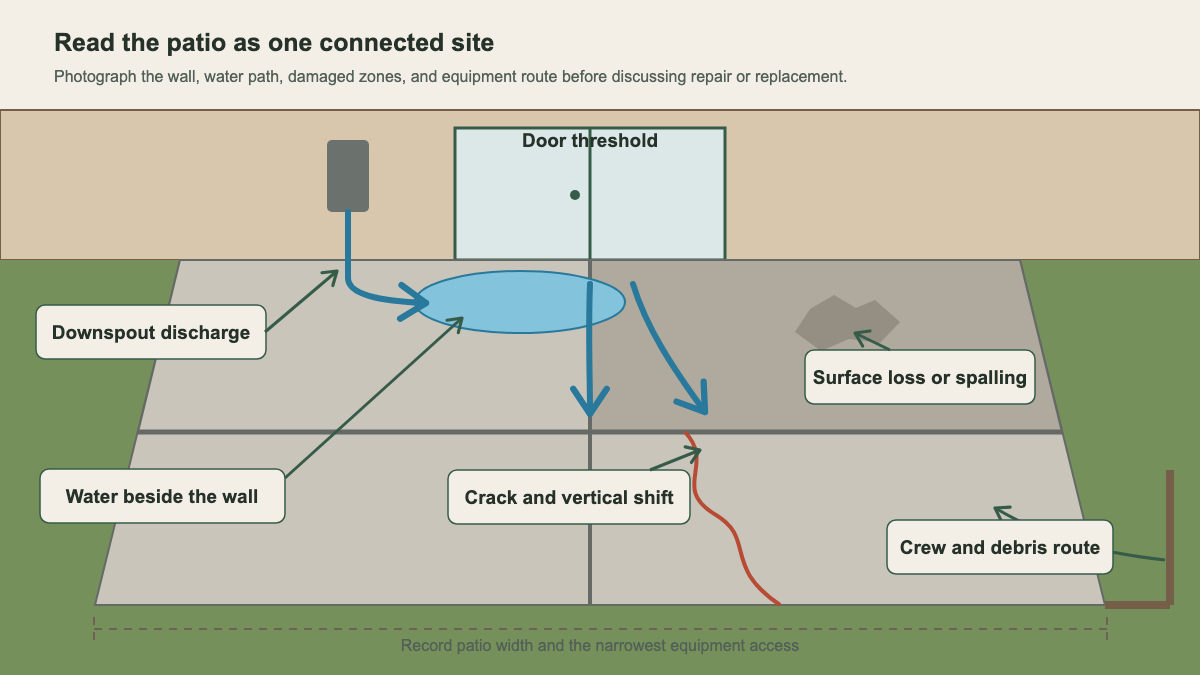
A useful photo set follows the water. Request one wide view from the yard toward the house, one from the house toward the yard, and one along the wall. Add close views of each damaged area, but keep a door, wall corner, joint, or patio edge in frame as a landmark. After a rain, photos of ponding can help if they can be taken without stepping onto an unstable or slippery surface.
Capture the house edge and attached features
The patio rarely stands alone. Ask what touches it: sliding-door thresholds, masonry veneer, siding, steps, porch posts, railings, screen enclosures, pergola columns, pool coping, outdoor kitchens, drains, and utility lines. A crack through open slab area is a different estimating problem from movement at a column base or door.
Record any interior symptom near the patio. The caller may mention damp flooring, staining at the baseboard, a wet basement wall, or water beneath a door. The concrete office should document the report and avoid promising that patio work will solve an interior leak before the source is assessed.
Buried and private services can affect demolition and redesign. Ask about irrigation, landscape lighting, pool lines, gas to a grill, electrical feeds, dog fencing, and downspout piping. The caller may not know the route. Mark each item as reported or unknown instead of treating a rough memory as a locate.
When movement near the house sounds broader than a patio problem, route the call for the right review. The intake principles in concrete slab settlement versus foundation repair inquiries can help the office separate observable locations from an unsupported structural conclusion.
Set appearance and future-use expectations
Repair can be technically acceptable and still disappoint a caller who expects invisible work. Ask whether color and texture matching matter, whether the patio is stained or stamped, and whether previous repairs are visible. Record the existing finish as broomed, smooth, exposed aggregate, stamped, coated, or unknown.
The contractor should inspect it before discussing match quality. New concrete, patch materials, sealers, and cleaned areas can differ from weathered surroundings. A caller planning to cover the patio with tile may care about different conditions than someone preserving a decorative border.
Future use can change the scope. Ask about a hot tub, masonry fireplace, outdoor kitchen, screen enclosure, accessibility change, widened door, drainage project, or pool renovation. Do not imply that the existing slab can carry new loads. Give the estimator the planned equipment and, when available, the manufacturer's installation requirements.
Industry guidance on repairing versus replacing concrete commonly weighs the extent of damage, condition of the remaining slab, repeated failed repairs, desired function, and the owner's expected result. Those are useful intake categories. They are not a remote verdict.
Prove that a crew can reach the patio
Backyard access can decide which options are practical. Ask for the narrowest gate width and height, turns between the street and patio, steps, slopes, soft ground, low branches, overhead wires, septic areas, and surfaces that must be protected. Note whether equipment would cross a neighbor's property or an HOA common area.
Confirm parking and staging. Where could a truck stand? How far is the patio from the street? Is there room for removed concrete, forms, base material, and fresh-concrete delivery? A photo looking from the patio back to the gate often answers more than the phrase “normal side access.”
Record occupancy constraints as well. Pets, locked gates, school pickup, tenant notice, pool barriers, quiet hours, and a home-based business can affect the visit. If the estimator needs access through the house, say so before the appointment.
The same access discipline improves a foundation crack inspection call, though patios add confined-yard routes and more contact with walls, doors, and outdoor living features.
Close without choosing the method
Read the intake back in concrete terms. For example: the patio is approximately twelve by eighteen feet, attached to the rear wall, with four visible panels. A diagonal crack crosses two panels, one side appears higher near the yard edge, water collects by the sliding door, the downspout discharges at the left corner, and the only access is a thirty-eight-inch side gate. The caller wants a level surface for a dining table and understands that the estimator must inspect before recommending a scope.
Confirm the appointment window, site contact, pets, gate status, and where the photos are attached. If there is active water entry, loose concrete at a frequently used step, or a rapidly changing vertical edge, flag the record for prompt human review. Do not promise code compliance, structural adequacy, drainage performance, or an exact method over the phone.
An AI receptionist can collect the same fields after hours and route urgent conditions to a person. The script should preserve the line between intake and diagnosis.
A useful patio estimate begins with the whole site. The estimator should arrive knowing where water travels, what changed, what the owner wants, and whether the crew can reach the work.