A homeowner calls two days before an alarm installation and asks, “Do I need a permit?” The tempting answer is a quick yes or no. That answer can be wrong before the office even knows the address.
Start with the exact service address, the kind of alarm, whether it will be monitored, and why the question came up. Then find the current official program for that jurisdiction. Give the customer the agency link, the contact, the stated next action, and a clear record of who will handle it. Do not interpret the ordinance or promise that an application will be accepted.
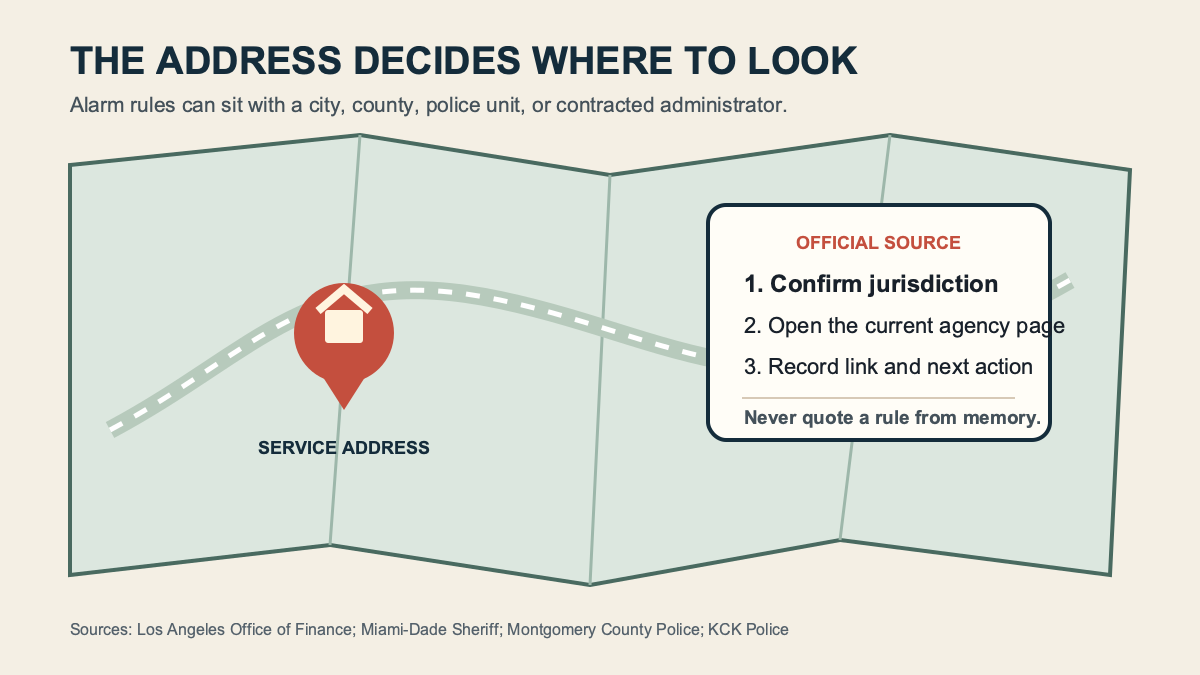
Alarm registration is local. The agency, covered systems, customer duties, installer duties, renewal terms, and response rules can change across a city line. A useful call turns “Do I need a permit?” into an address-specific handoff.
The service address comes before the permit answer
Ask for the complete address, including city, state, ZIP code, and unit or suite. Confirm whether it sits inside city limits or in an unincorporated part of the county if the caller knows. Do not rely on the city printed in a mailing address. Postal names and government boundaries do not always match.
Next, identify the likely program owner. It may be a city finance office, police department, sheriff, county false-alarm unit, or an outside administrator working under a local contract. Search the official city, county, police, or sheriff site for the address and “alarm registration” or “alarm permit.” A monitoring portal can be useful after the official agency page links to it. A search-result snippet alone is a poor source because old fees and old forms stay in search indexes.
The differences are easy to see in current official pages. The Los Angeles Office of Finance publishes an alarm user permit process and tells users to give their permit number and current emergency contacts to the alarm company. Kansas City, Kansas Police runs its own registration program with local application timing and annual renewal instructions. Those pages answer different addresses.
Record the official page URL and the date it was checked. If the agency page links to a form or portal, keep the agency page too. It gives the customer a durable place to check when a form moves.
Classify what changed at the property
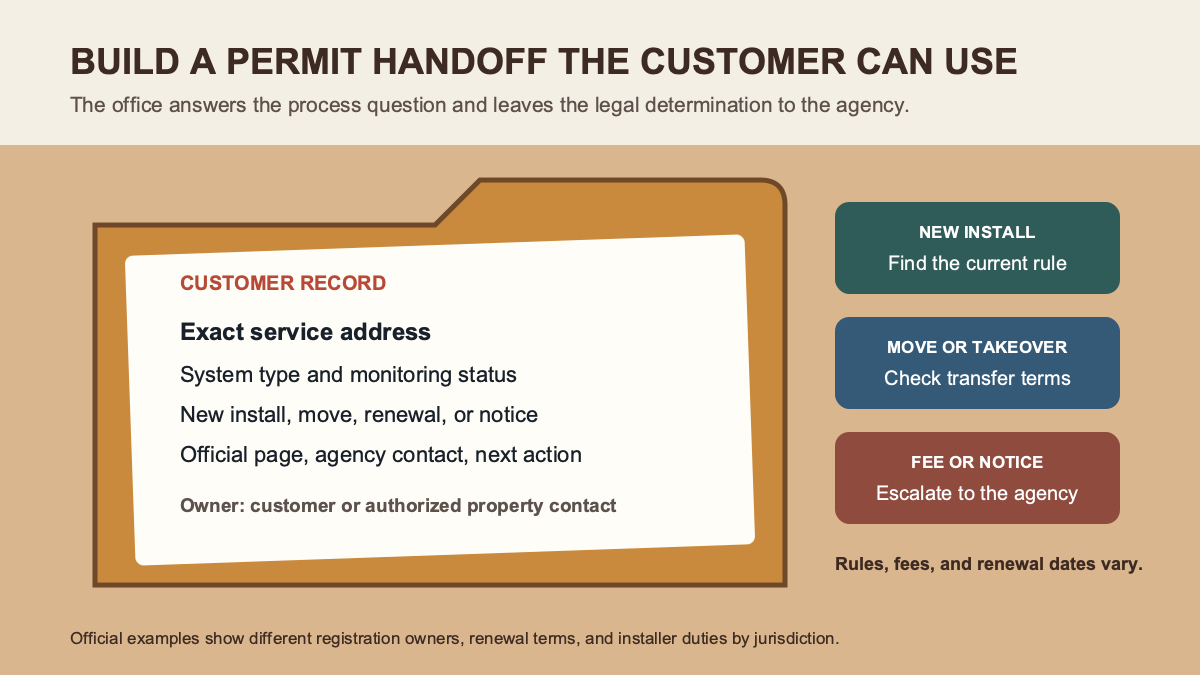
“Permit question” hides several different events. Ask what prompted the call. A new monitored burglar alarm may follow one path. A move, account takeover, ownership change, renewal letter, false-alarm notice, or switch in monitoring companies may follow another.
Capture these facts before routing:
- Exact service address and the caller's relationship to the property
- Residential or commercial use, plus the alarm type the caller describes
- Monitored or local-only operation, if known
- New installation, existing-system takeover, move, ownership change, renewal, agency notice, or another event
- Installation date or planned date, monitoring company, and any permit number already on file
- A photo or copy of the letter when the question began with an agency notice
- The official source checked, agency contact, next action, owner, and follow-up date
Do not combine fire, medical, panic, burglar, and access-control questions under one remembered policy. Local pages can define covered systems and exceptions differently. If the caller cannot identify the alarm type, record the equipment and intended response in plain language, then ask the project lead or monitoring partner to classify it.
Moves deserve their own question. Montgomery County's burglary alarm customer guidance distinguishes relocation or ownership changes from a change in alarm company or contact information. That does not establish a national rule. It shows why “We already had a permit at the old house” needs an address-specific review.
For an existing equipment transfer, pair this record with the alarm system takeover call guide. The permit question and the equipment question affect the same project, but each has a different owner.
Explain the boundary in plain language
The office can describe what the current official page says. It can send the link, identify the named agency, explain which fields the form requests, and note whether the agency assigns the action to the user, alarm company, or installer. It should avoid deciding whether a caller is legally exempt, interpreting a disputed notice, or predicting an agency response.
A safe answer sounds like this: “For this address, the city's current alarm page directs users to its registration process. I will send you that page and note the registration item on your installation record. The city makes the permit determination, so please use its instructions or contact the office listed there if the system type is unclear.”
That wording does useful work. It identifies the source and the next step. It also leaves an uncertain classification with the agency that owns it.
Avoid reading a fee, deadline, or false-alarm penalty from an old office script. If the customer asks for a number, open the official page during the call and name the jurisdiction and retrieval date. Better yet, send the link. A fee printed by one city has no authority across the county line, and a renewal term can change after the script was written.
The same boundary applies to enforcement letters. Verify the sender and contact through the official government site, not through the phone number or link printed in an unexpected message. Place a copy of the notice in the customer record. Do not tell the customer to ignore it, pay it, or appeal it before the named agency confirms the notice and explains its process.
Customer duties and company duties belong in separate fields
A registration program may assign work to more than one party. The customer might submit a registration. The installer may need to provide a form or certificate. The monitoring company may need the permit number, emergency contacts, or dispatch information. Treat those as separate tasks with separate owners.
Miami-Dade County's burglar alarm registration page illustrates the split. It gives registration and renewal instructions to alarm users, then lists distinct obligations for alarm companies and installers. Montgomery County says alarm or monitoring companies must provide customers with registration information at sale or installation. Los Angeles tells alarm users to share their permit number and updated emergency contacts with the alarm company.
The office should copy the local division of responsibility into the job record without rewriting it into a company-wide national rule. Use fields such as “customer action,” “installer action,” “monitoring action,” and “agency decision.” Assign a person and date to each open item.
If the installer normally helps customers complete a form, set a firm scope for that help. Staff can point to fields already present in the contract, such as the service address, equipment description, or monitoring company. The customer confirms personal declarations and signs their own application unless the local program clearly authorizes another process.
Keep installation and false-alarm service records connected
Permit questions often return after installation. The customer may receive a renewal reminder, move to another property, change monitoring providers, or call after an alarm dispatch. The original lookup should remain attached to the property record, with the permit number only where company policy and data controls allow it.
When a caller reports repeated unwanted activations, use the false-alarm service call intake for the technical and safety record. Keep the agency notice as a separate administrative item. A service coordinator can schedule a sensor or panel assessment without deciding whether an agency event qualifies as a false alarm.
The installation consultation should capture this handoff early. Add a permit checkpoint to the home security installation consultation workflow once the address, monitoring plan, and proposed system are known. “Permit checked” should mean the current official source was found and responsibility was assigned. It should not mean the office guaranteed compliance.
Review saved links periodically. A dead portal, changed agency name, or new administrator deserves an update before the next customer receives it. Preserve the old source and the check date in the record so staff can see what changed.
Read back the handoff before ending the call
A permit call should close with the address, event, source, owner, and next action stated aloud. For example: “I have the monitored burglar alarm planned for 18 Oak Street inside the city. I found the city's current alarm registration page and will send it to you. The page assigns the application to the alarm user. I have added a customer follow-up for Friday and an installer check for the permit number before monitoring setup. The agency will answer any exemption or form question.”
That readback exposes missing pieces while the customer is still on the line. It also gives the sales coordinator, installer, and monitoring contact the same version of the job.
The best office answer begins with a street address and ends with a named owner. Everything between those points should be traceable to the current official page.