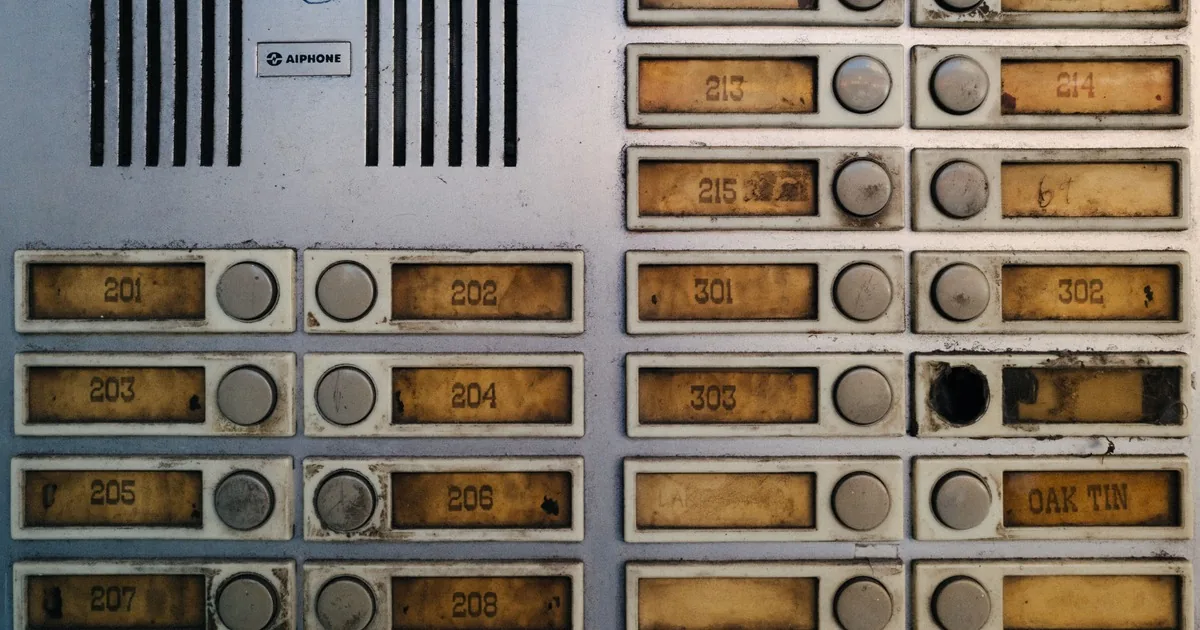
A homeowner calls about “the old intercom in the kitchen.” Then a photo arrives. The kitchen unit is the master, six bedrooms have room stations, the patio has another speaker, and the front-door button is tied into the same system. Two walls have wallpaper around openings that may be larger than any current device.
That is a small retrofit project, not one broken box.
Start a home intercom replacement call with the brand and model of the master unit. Then inventory every room, patio, and door station. Ask what the household still uses, what has failed, which openings must be preserved, and whether the caller has old manuals or installation records. Existing cable and wall openings may be reusable, but the office should treat compatibility as a field finding.
The goal of the call is a complete site record. Product selection comes later.
Identify the master before discussing replacements
Ask the caller for a straight-on photo of the master station while it remains installed. The photo should include the faceplate, buttons, labels, and the wall around it. A second photo from several feet back helps the installer see cabinets, trim, outlets, switches, and nearby finishes.
Get the manufacturer and exact model from a visible label, old manual, invoice, or safe exterior marking. Do not ask the caller to pull the master out of the wall. Behind that faceplate may be a power supply, concealed connections, brittle cable, or a larger rough opening than the front suggests.
The model matters because “NuTone intercom” describes decades of equipment. Broan-NuTone’s intercom FAQ says the company stopped offering intercoms on February 1, 2018. The same FAQ describes one older three-wire update path that retained the wire while changing the other equipment. That is useful evidence for a consultation, but it is not approval to reuse any three conductors with any current product.
Record the complaint in observable terms. Does the master have power? Can one room hear another? Does the front-door call sound inside? Is the failure limited to one station? Is there buzzing all the time, only during a call, or only when music is selected? “Old” describes the system’s age. It does not identify the fault or the replacement scope.
Build a station map room by room
Count every installed point. Homeowners often remember the kitchen master and front door while forgetting a patio speaker, garage station, or bedroom unit hidden behind furniture. Those forgotten points can change the equipment count, cable plan, wall work, and time needed on site.
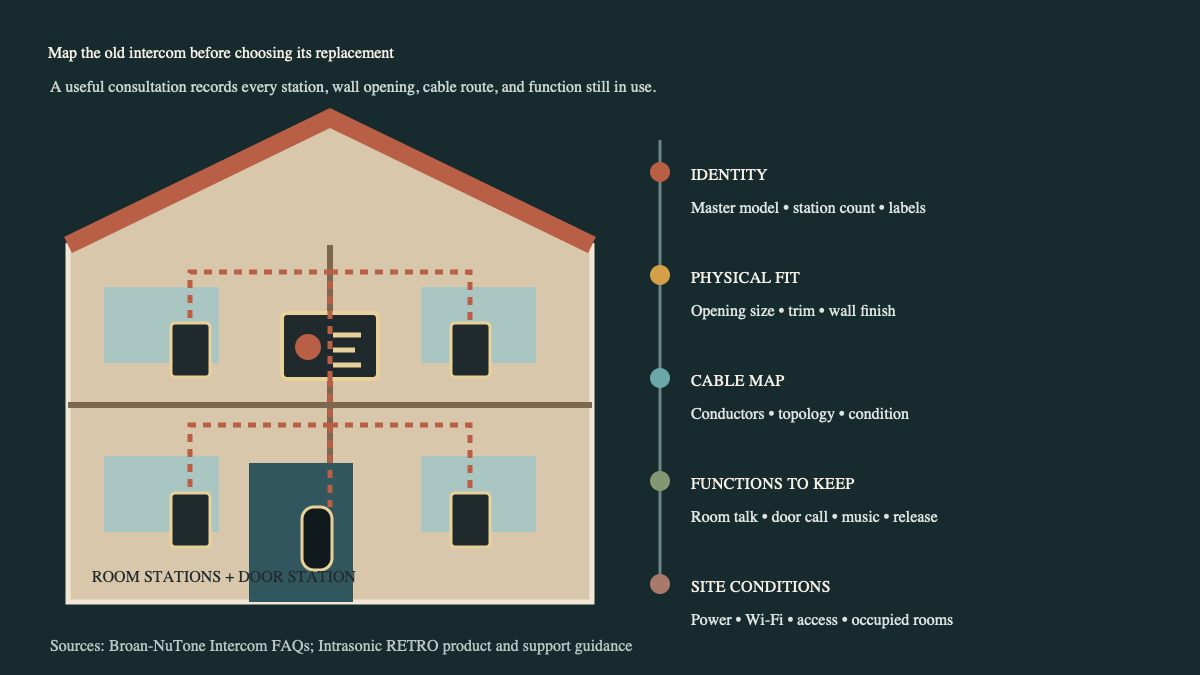
Have the caller walk through the property and name each location. Use a simple convention in the job note: “Kitchen master, upstairs hall station, bedroom 1 station, bedroom 2 blank plate, rear patio speaker, front-door station.” Mark whether each point works, is dead, has been covered, or is unknown.
For each distinct station style, request one installed photo and an approximate faceplate measurement. If the caller can measure without loosening anything, ask for the visible width and height. Write “faceplate measurement” in the note. The hidden opening may differ and must be checked in person.
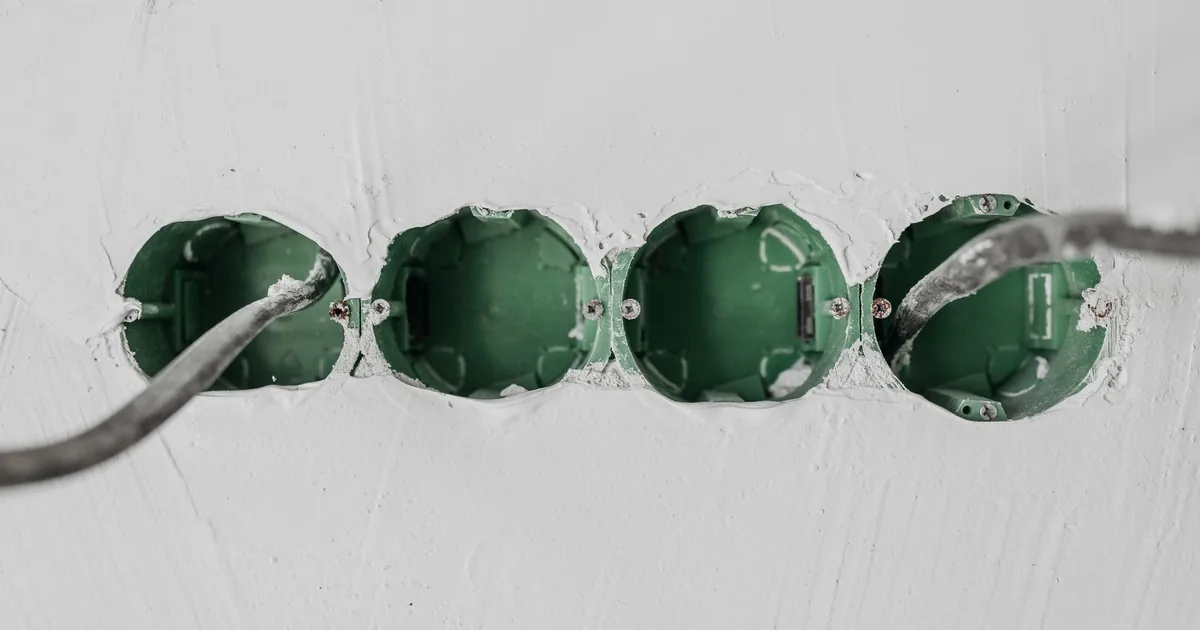
The room finish belongs in the record too. Drywall can usually be patched as part of a defined finish scope. Tile, stone, wood paneling, custom millwork, and wallpaper deserve separate attention. A smaller replacement station can expose an unfinished rectangle that has been hidden for twenty years. The low-voltage work and the finish repair may need different trades.
A useful station inventory includes:
- room or exterior location, station type, visible brand or model, and working status;
- a straight-on photo plus a wider photo showing nearby trim and finishes;
- visible faceplate width and height when it can be measured safely;
- functions at that point, such as room talk, door call, music, monitor, or door release;
- any covered opening, blank plate, painted-over station, water exposure, damage, or previous alteration;
- access details for locked rooms, occupied bedrooms, pets, gates, parking, and the authorized decision-maker.
Read the count back. “I have one master, five room stations, one patio station, and one front-door station.” That single sentence catches omissions before the truck rolls.
Keep wire reuse behind a field check
Existing wire can be valuable. It can also be the wrong type, damaged, spliced, inaccessible, or arranged in a topology the proposed system does not support.
Purpose-built retrofit products do exist. Intrasonic’s RETRO system page describes reuse of existing intercom wiring and openings under product-specific conditions. Its support FAQ directs this work to an electrician or certified installation professional. That supports a careful intake question: “Do you have any record of the cable or the original installation?” It does not support a promise that the old wire will work.
Current equipment has its own requirements. For example, Aiphone publishes model-specific wiring guidance for conductor type, power, and distance. The right specification is the one for the exact proposed system. A caller’s statement that the cable “looks like phone wire” cannot replace that documentation or a field test.
Ask whether anyone has remodeled around the system, removed a station, joined wires, relocated the master, or converted an old opening to a speaker, thermostat, or tablet mount. Record the answer as history, not proof. Concealed routes and cable condition remain unknown until inspected.
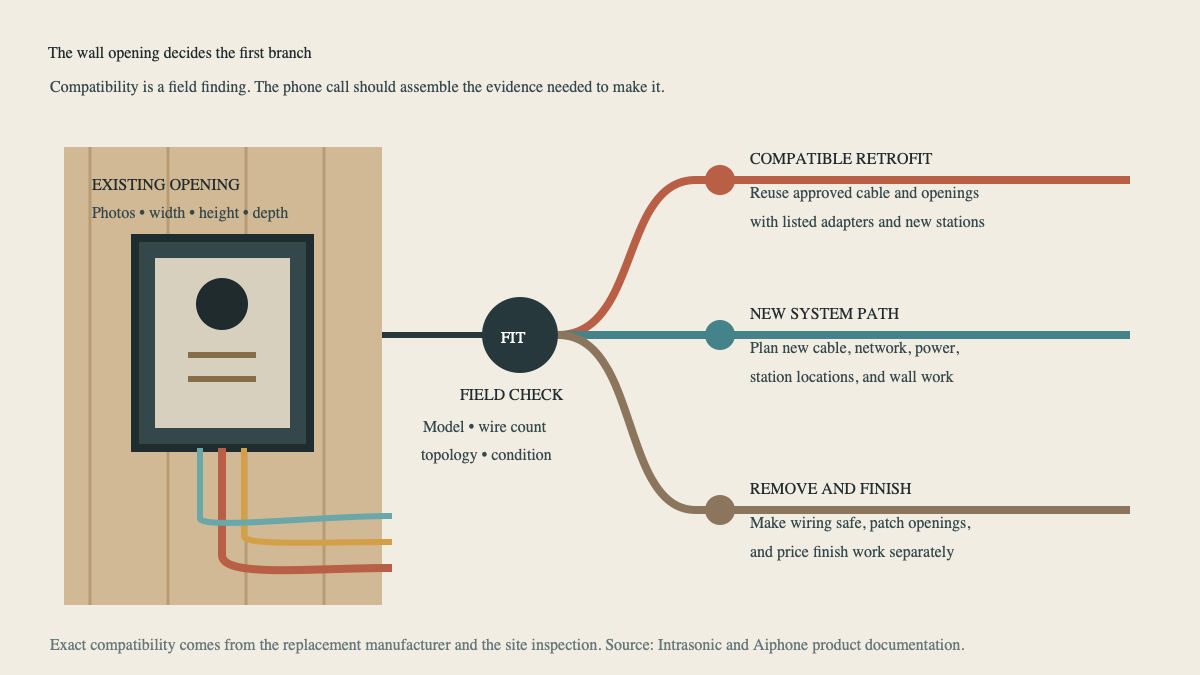
Three project routes usually deserve separate estimates. A compatible retrofit may reuse approved cable and cover the existing openings with listed stations or trim plates. A new-system route may require new cable, network planning, power, changed station locations, and wall work. A removal route makes the old wiring safe, closes or covers openings, and may add a separate doorbell or communication device.
The site visit chooses the route.
Ask which functions still matter
Some households want room-to-room voice. Others used the system only for the door call or whole-house radio. One owner may want every old station replaced. Another would prefer the bedroom openings patched and a single modern entry station near the kitchen.
Ask people to describe the action they want, not a product feature they saw online. Useful answers sound like this: “I need to hear the front-door call upstairs,” “I want to talk between the kitchen and detached garage,” or “I only want the wall holes gone.” Those statements can be checked against the property and the proposed equipment.
If the request includes video, mobile notifications, remote answering, door release, gate control, cameras, or smart-home integration, capture the associated conditions. Which entrance is involved? Is there usable network coverage there? Who owns the home network and app account? Is a door strike already installed? Does the company handle that access-control work? Never request a Wi-Fi password, account password, recovery code, or one-time verification code in an ordinary job note.
Keep a first-time installation on its own route. A property adding a new alarm, camera, access, and communication system belongs in the home security installation consultation guide. A caller focused on a new video doorbell needs the camera and doorbell quote intake. The legacy intercom call is different because old openings, cable, abandoned stations, and finish damage already exist.
Hand the field technician a usable record
Before booking, confirm the address, property type, number of floors, station count, master model, desired functions, visible damage, remodeling history, and access constraints. Attach the photos in location order. Put unknowns in the note plainly.
Do not quote a final replacement package from one picture. The visit may uncover an unsupported cable arrangement, a larger wall opening, water damage at an exterior station, discontinued equipment, or finish work outside the installer’s scope. Explain what the consultation will establish: cable and opening condition, compatible equipment paths, new-work requirements, stations to keep or remove, and responsibility for patching or refinishing.
An AI receptionist can collect the model, station inventory, photos, desired functions, and access details after hours. Compatibility and electrical decisions stay with the field professional. When that person arrives, the record should already show the whole system, not one beige box in the kitchen.
Sources
- Broan-NuTone: Intercom FAQs
- Intrasonic Technology: RETRO Home Intercom System
- Intrasonic Technology: Support FAQ
- Aiphone: JO Series Wiring Guide