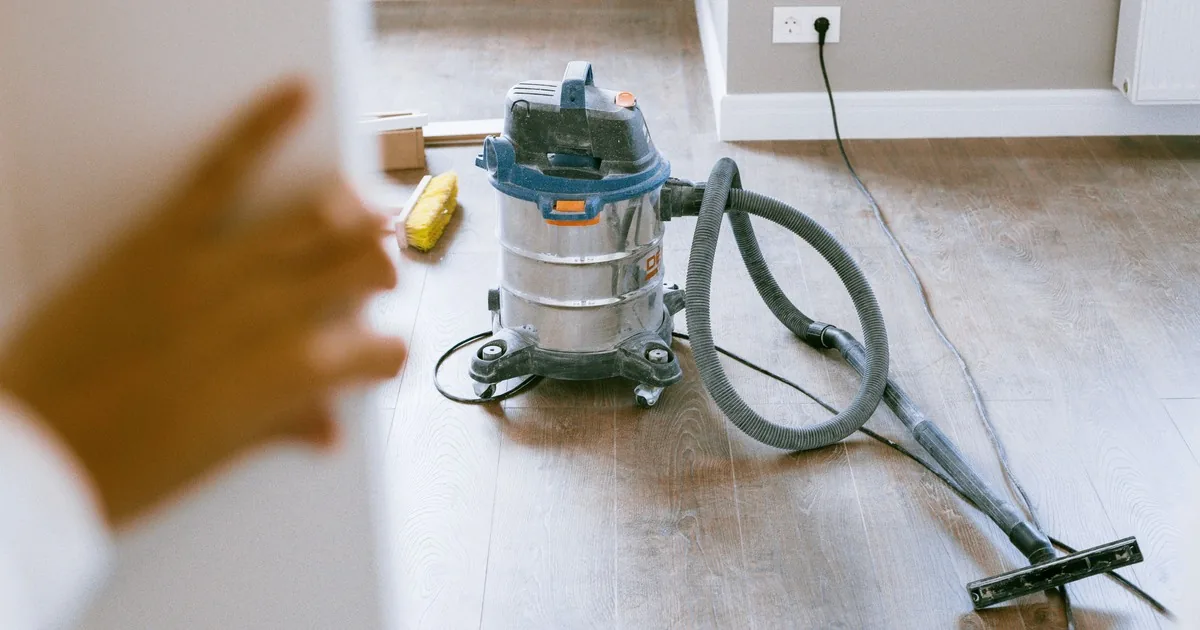
A customer asks for a move-in clean on Friday afternoon because the moving truck arrives Saturday morning. The painter says he will be done Thursday. The electricity account changes hands Friday. Nobody knows whether the lockbox still works, and the new refrigerator may arrive during the cleaning window.
That appointment is not ready to book.
A move-in cleaning call should confirm six things before the crew is reserved: the property will be empty enough to clean, other trades will be finished, water and electricity will be on, the entry method is verified, the service scope is written down, and one person owns the handoff at completion. Work backward from the move-in time, not forward from the first open calendar slot.
Protect the cleaning window
Start with the hard deadline. Ask when furniture, boxes, appliance installers, internet technicians, or the first occupants will enter. Then ask which contractor is scheduled to leave last. The cleaning window sits between those two events.
“Friday” is too vague. A usable record says the painter is scheduled to finish by Thursday at 3 p.m., the customer will inspect Thursday evening, and the cleaners have sole access Friday from 8 a.m. until completion. If another trade may return, record who can confirm that the work is done.
A local cleaning provider's guide to scheduling cleaning around a move identifies property access, utility status, an empty home, and coordination with the move as practical dependencies. Those categories apply to move-in work too. The office still needs its own cancellation, rescheduling, and overlap policies.
Do not squeeze cleaning into an unverified gap. Wet paint, construction dust, unpacked fixtures, and workers crossing freshly cleaned floors can undo the service before the customer sees it. An appliance installer who blocks the kitchen for two hours can also turn a whole-home appointment into a partial job.
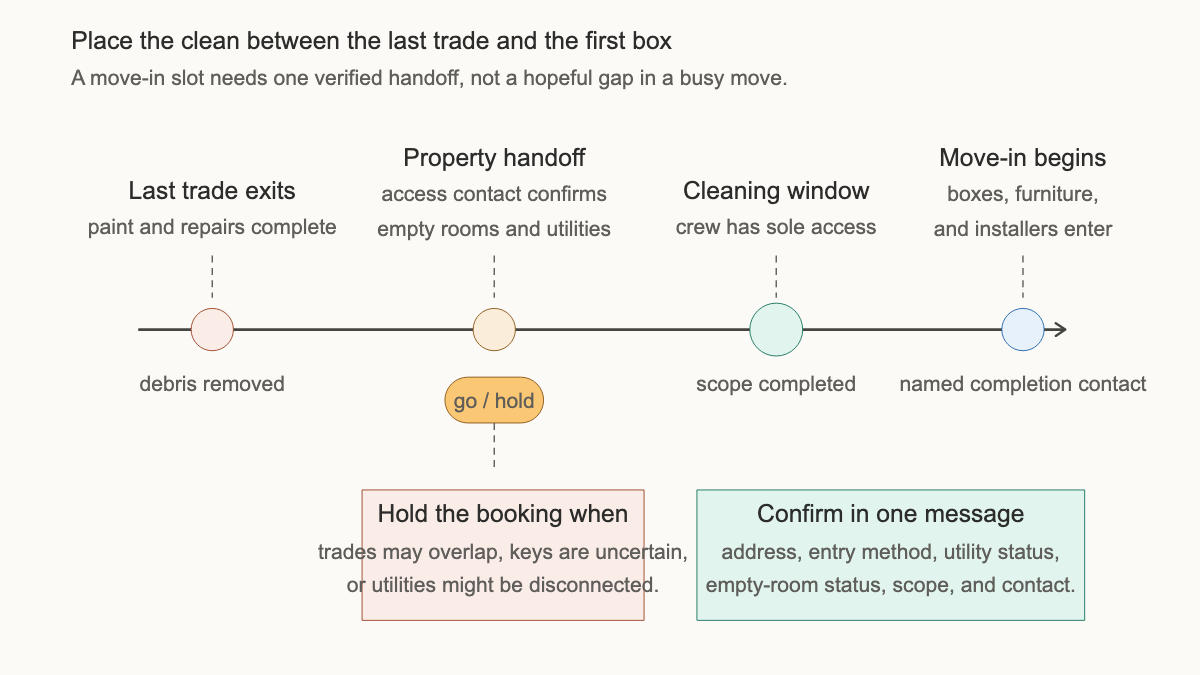
Ask one direct question: “Who can tell us the property is ready before we dispatch?” That person may be the buyer, seller, property manager, real estate agent, builder, or general contractor. Capture a name and reachable number according to company policy. A chain of five people who each assume someone else checked the house is not a handoff.
Confirm that empty means cleanable
Customers use “empty” loosely. It may mean no furniture, while every cabinet contains shelf liner and forgotten dishes. It may mean the movers left but packing paper, wall anchors, paint cans, and contractor debris remain. Ask what will still be inside each room when the crew arrives.
Useful booking questions include:
- Will all furniture, boxes, trash, construction debris, and personal belongings be removed from the rooms in scope?
- Are closets, cabinets, drawers, and appliance interiors supposed to be cleaned, and will they be empty?
- Are painters, flooring crews, appliance installers, or repair workers fully finished?
- Which items must remain, and who will move them if access is needed behind or underneath?
- Is the property a standard residential clean, a post-construction job, or a home with heavy residue that needs separate review?
- Are there sharp materials, pests, animal waste, mold concerns, strong odors, or other conditions that require manager review before booking?
Do not let “move-in clean” become a universal package name. One company may include cabinet interiors and the refrigerator. Another may price those separately or decline an appliance interior until shelves are removed. Write the agreed surfaces into the job record.
The first-time deep-cleaning intake guide covers current condition, room priorities, buildup, belongings, and access when scope is the main question. Use that path when the caller cannot describe the property's condition well enough to quote or schedule safely.
Verify water, power, and workable conditions
A vacant house can look ready in photos and still be impossible to clean. Confirm that running water will be available at sinks and toilets. Confirm that electricity will serve lights and any outlets the crew is expected to use. Ask whether heating or cooling will keep indoor conditions workable for the season.
Do not accept “the utilities should still be on” as verification when service changes hands near the appointment. Ask who controls each account on the cleaning date and when that person will confirm service. If the company has a day-before checklist, utility status belongs on it.
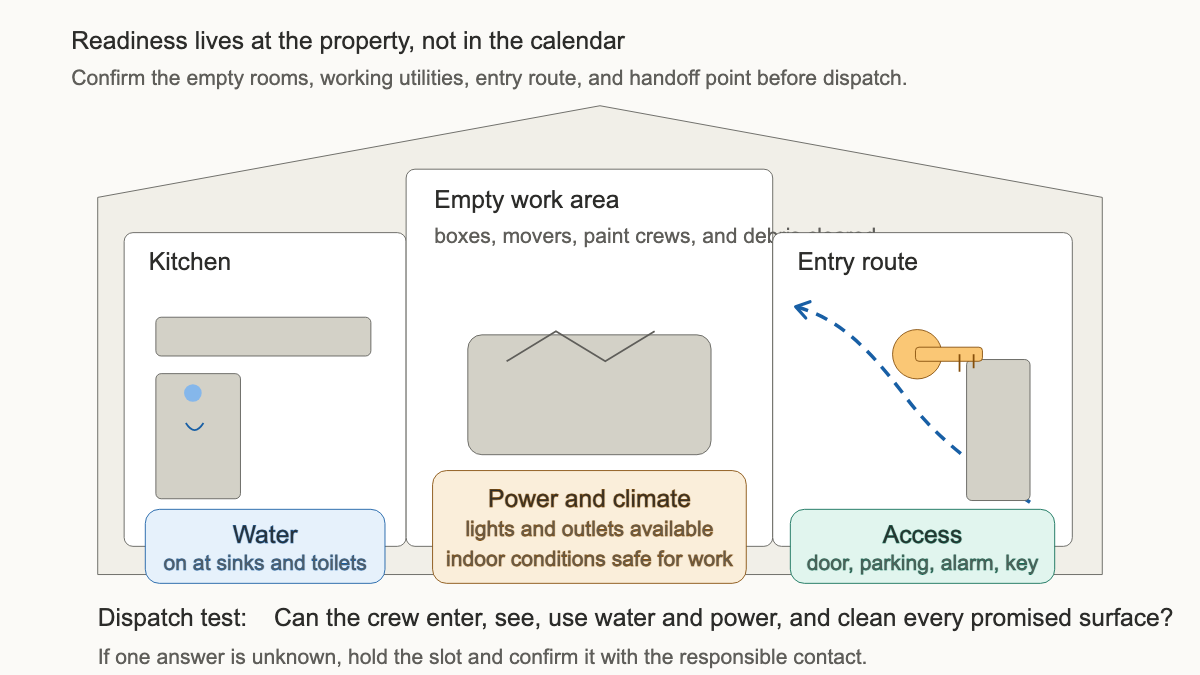
The map gives the dispatcher a simple test: can the crew enter, see, use water and power, and reach every promised surface? One unknown can strand a team outside or leave the work incomplete.
OSHA's cleaning-industry hazards and solutions page groups chemical exposure, slips, trips, and physical hazards among the risks cleaning employers must address. A booking agent does not perform a safety inspection by phone, but reports of active construction, standing water, exposed sharp debris, failed lighting, or unsafe indoor conditions should follow the company's escalation policy.
Make access specific and secure
“There's a key under the mat” is not a complete access plan. Confirm the street address, unit, parking instructions, building entry, gate, lockbox or key procedure, alarm status, elevator rules, and who can answer if entry fails. Store codes and key details only in the company's approved secure system.
Ask whether the customer must be present. If nobody will be there, name the authorized access contact and the completion contact. They may be different people. A real estate agent might open the property, while the buyer approves an added task.
For apartments or managed buildings, ask about loading access, service elevators, parking permits, concierge hours, and proof-of-insurance requirements. Do not promise that the crew can meet a building rule until the office has confirmed it.
Pets should be covered even in a supposedly vacant property. Ask whether any animal will be present, where it will be secured, and whether anyone else has permission to enter. A contractor's loose dog or a cat left in one room changes access immediately.
Write the scope room by room
Move-in work often involves surfaces that recurring cleaning does not touch every visit: cabinet interiors, drawers, closet shelving, baseboards, doors, trim, empty refrigerator compartments, oven interiors, or adhesive residue. Ask about each requested area. Record exclusions too.
Separate cleaning from repair and specialty remediation. Paint overspray, cured adhesive, construction dust, pest residue, mold, biohazards, smoke residue, and damaged finishes may require different tools, training, pricing, or providers. A receptionist should capture what the caller sees and route the request. Do not diagnose the material or promise removal.
Product preferences need exact wording. If a caller asks for products carrying the EPA Safer Choice label, record that request and let the company confirm which approved product fits its process and the surface. The label means the product's ingredients meet EPA program criteria. It does not make every labeled product suitable for every finish, person, or pet.
Keep cleaning and disinfection separate. The CDC's home cleaning and disinfection guidance explains that routine cleaning and disinfection serve different purposes and that label directions matter. If the customer asks for disinfection, infection-control work, or a health guarantee, route the request through company policy. Do not promise an outcome on the booking call.
Close with a single readiness confirmation
Send or read back one concise summary before the appointment is final:
“Move-in clean requested for 18 Cedar Lane on Friday. Painters finish Thursday and the buyer will confirm the property is empty and contractor debris is removed by 6 p.m. Thursday. Water, electricity, lights, and climate control will be on Friday. Crew entry is through the agent's lockbox, with code stored in the approved secure field. No movers or appliance installers enter before Saturday morning. Scope includes two bathrooms, kitchen surfaces, empty cabinet and drawer interiors, empty refrigerator interior, floors, baseboards, doors, and reachable trim. Oven interior is excluded. Buyer approves scope changes; agent handles entry problems. Hold dispatch if the Thursday readiness confirmation is missing.”
That note gives the scheduler an actual property, a protected interval, and named owners for access and decisions. It also makes later recurring service easier to discuss. Once the move is complete, the recurring cleaning frequency guide helps the office choose a maintenance interval based on how the occupied rooms are used.
An AI receptionist can collect the same details after hours and flag missing confirmations. The cleaning company still decides whether the site is safe, which products and tasks fit the job, and when the crew can be assigned. The appointment becomes real when the house is ready, the key works, and the first moving box is still outside.