A recurring customer calls on Wednesday and says, “Could your team get the fridge and oven this time too?” The appointment is Friday morning. The refrigerator is full, the oven was used last night, and the customer assumes “get” means shelves, drawers, racks, door seals, glass, and the floor under both appliances.
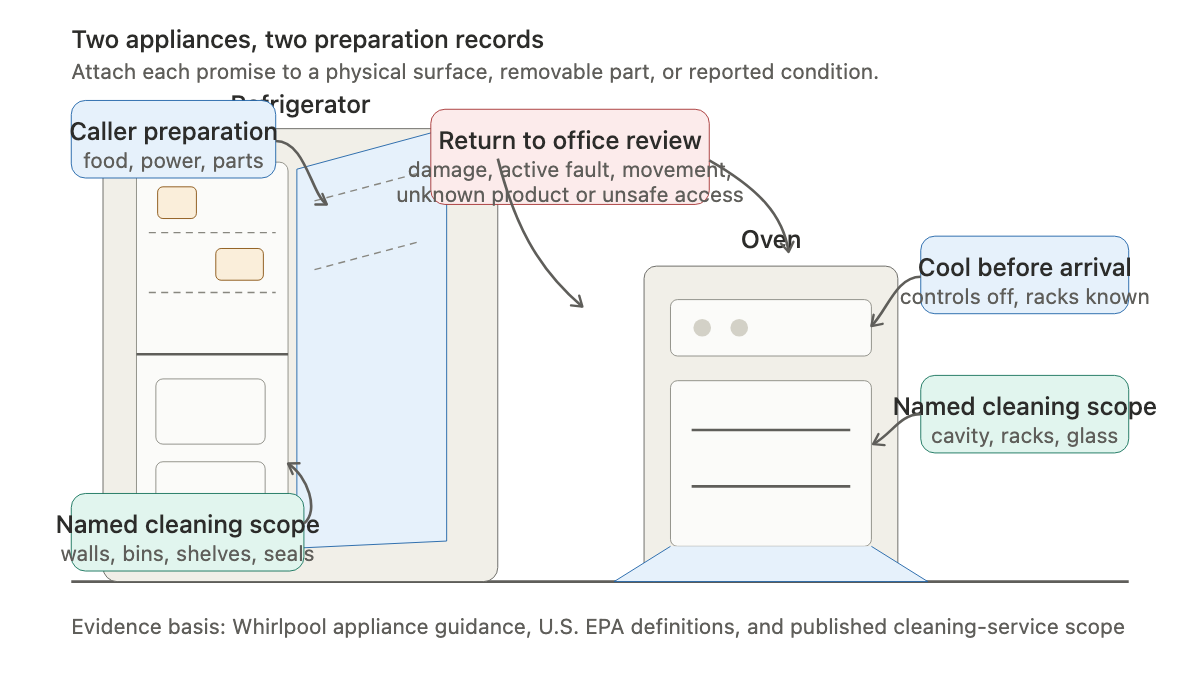
That request needs a short scope conversation before anyone adds time to the visit. Put the oven and refrigerator on separate lines. For each one, name the surfaces, decide who handles food and removable parts, confirm the appliance will be cool and accessible, record existing damage or active problems, and state what the crew will not move, disconnect, dismantle, or repair.
Put each appliance on its own line
“Kitchen appliances” is too broad for a work order. Start with the appliance type and location. A main-kitchen refrigerator, garage freezer, freestanding range, wall oven, and countertop microwave are different jobs. If the customer says “fridge,” ask whether that includes the freezer compartment, ice bin, water-dispenser recess, shelves, drawers, gaskets, top, sides, or only the exterior doors.
Do the same for the oven. Clarify interior cavity, door glass that is reachable without disassembly, racks, rack supports, broiler pan, storage drawer, cooktop, knobs, control panel, backsplash, hood, and exterior sides. Use the company’s approved service list. The caller may use “oven” to mean the whole range.
Merry Maids publishes oven and refrigerator cleaning as specialized appliance options that can be added to a customized plan, subject to local availability. That is a useful model for intake: an appliance interior should be an explicit inclusion, not an assumption attached to “deep clean.”
Keep this page distinct from a whole-home first-time deep-cleaning quote. That appointment needs room condition and household priorities. This call needs appliance-by-appliance preparation and scope.
Make the refrigerator ready before the crew arrives
Ask whether the refrigerator and freezer will be empty when the crew arrives. If food remains, who will remove it, where will it be held, and when will that happen? The cleaning company should not decide what food is discarded. Expired dates, unlabeled containers, leaking packages, and freezer buildup all need the customer’s instruction under a written policy.
Power belongs in the booking note. Whirlpool’s refrigerator cleaning guide tells owners to turn off power at the panel or unplug the appliance for a deep interior cleaning, remove the food, and place it in coolers. A cleaning office should follow its own policy and the model’s manual. Do not promise that a crew will unplug a unit, reach behind cabinetry, handle a water line, or move a loaded refrigerator unless that work is specifically approved.
Ask about shelves, drawers, bins, glass panels, and loose inserts. Will the customer remove them, or does the service include removal and replacement when the manual permits it? Whirlpool advises washing removable refrigerator parts and drying them completely before they go back. Record cracked shelves, chipped glass, stuck drawers, broken rails, torn gaskets, or missing pieces before the visit. A cleaner should not inherit blame for a crack that was already there.
Odor, spilled food, sticky residue, and ordinary soil fit a cleaning conversation. An appliance that is warm, leaking, sparking, making a new electrical smell, or showing an active fault belongs with appliance service or the company’s safety route. Keep the observation plain: “water reported under left front corner” is useful; “clogged defrost drain” is a diagnosis.
Book the oven only after it can be cool and identified
The oven needs its own preparation window. Ask when it was last used and confirm that it will be off and cool before the cleaner arrives. Whirlpool’s oven-rack guidance says controls should be off, the oven should be cool, and racks should be removed before cleaning. The exact method still depends on the model and manual.
Identify the appliance as closely as the customer can. Is it gas or electric, freestanding or built in, single or double, conventional or self-cleaning? Ask for a model-label photo when company policy calls for one. Do not tell a customer to start a self-clean cycle as appointment preparation. The cleaner needs a cool, stable work area, not a hot cavity finishing a cycle when the team reaches the door.
Record the condition. Heavy baked-on residue, grease pooling, foil fused to a surface, melted plastic, broken glass, a loose handle, damaged gasket, nonworking controls, exposed wiring, gas odor, smoke during normal use, or an error code may change the route. Cleaning staff can remove approved soil from approved surfaces. They should not test, diagnose, repair, or dismantle the appliance.
Prior products matter too. Ask whether the customer recently used oven cleaner, degreaser, bleach, an abrasive pad, a homemade mixture, or another product. Get the label or a photo when possible. Never improvise a chemical combination over the phone. The appliance manual, product label, surface material, ventilation, and company procedure should control what happens next.
Use precise cleaning claims
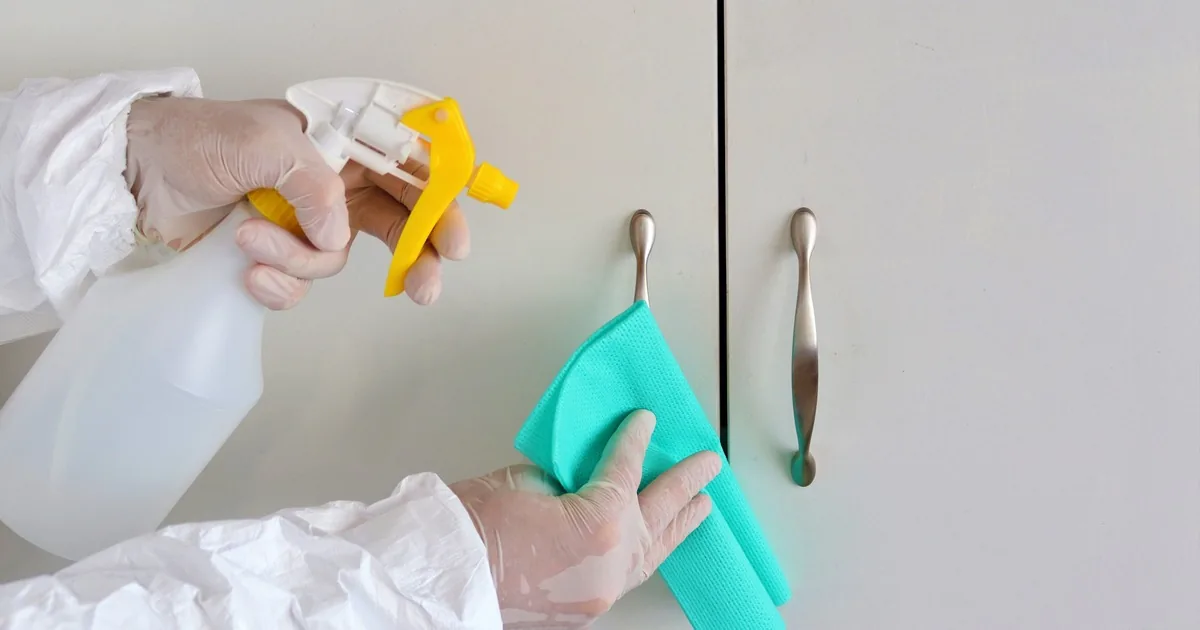
Customers may ask for an appliance to be “sanitized” or “disinfected” when they mean that they want crumbs, grease, spills, and odor removed. Ask what result they expect. Then describe only the service the company is equipped and authorized to provide.
EPA explains that cleaning, sanitizing, and disinfecting are different actions. Cleaning removes dirt and organic matter with soap or detergent. Sanitizers and disinfectants make regulated antimicrobial claims, and EPA tells users to follow the product label, including the required contact time.
That distinction matters inside a refrigerator because shelves and bins may touch food. It matters in an oven because coatings, heating elements, gaskets, glass, and catalytic or self-clean surfaces can have different restrictions. Avoid universal product promises. “We follow the appliance instructions, product label, and our approved process” is safer and more accurate than naming one chemical for every kitchen.
If illness, pests, sewage, fire residue, extensive mold-like growth, sharps, chemicals, or decomposed food changes the condition, pause the ordinary add-on. Route the facts through company policy. A house cleaner should not discover at the door that the requested “fridge wipe” is a specialty cleanup.
Set movement and access boundaries
Ask whether the requested surfaces are reachable with the appliance in place. Does the customer expect cleaning on top, along the visible sides, underneath, or behind it? Will a refrigerator need to cross finished flooring? Is a range anchored by an anti-tip device or connected to gas? Is a wall oven built into cabinetry?
Do not let “behind the appliance” slip into the ticket without an owner. Many cleaning companies will not move heavy or connected appliances. Others will work behind a unit only after the customer or another qualified party has moved it safely. Write the boundary in the booking note and say who restores the appliance position.
Access around the appliance counts too. Record a narrow galley, island clearance, floor protection, pets, children, mobility equipment, parking, elevator rules, and other workers scheduled in the kitchen. If the refrigerator food will sit in coolers, ask where those coolers can go without blocking the crew.
For a vacant property, use the move-out cleaning intake guide to coordinate keys, utilities, empty rooms, and final handoff. Appliance scope still needs its own line even when the rest of the home is empty.
Read back a crew-ready appliance ticket
A useful readback sounds like this:
“Friday’s recurring visit adds the interior of the main-kitchen refrigerator and the single electric oven. Customer will remove all refrigerated and frozen food before arrival and place it in two coolers outside the kitchen work path. Refrigerator scope includes interior walls, door bins, two drawers, four shelves, gaskets, and exterior doors. Customer reports a cracked lower drawer and will leave it in place. Crew does not move or unplug the refrigerator.
“Oven will be off and cool before arrival. Scope includes the interior cavity, two removable racks, reachable interior door glass, cooktop, knobs, and exterior front. Customer used a labeled oven product on Tuesday and sent a photo. No disassembly, self-clean cycle, repair, gas work, or movement of the range is included. Customer reports no active leak, electrical smell, gas odor, broken glass, or error code.”
That note gives the crew a picture before they enter the kitchen. It also gives the customer a chance to correct the scope while the calendar can still absorb the change.
For recurring service, keep the add-on attached to the date rather than silently changing the standing checklist. The recurring cleaning frequency guide explains why cadence and scope should stay separate in the account record.
An AI receptionist can collect the same fields after hours, but the script should preserve the company’s preparation, product, movement, and stop-condition rules. The final work order should say exactly which doors open, which parts come out, where the food goes, how cool the oven must be, and what condition sends the job back to the office.