A recurring customer calls Thursday afternoon about Friday’s cleaning. “I need to cancel,” she says. Thirty seconds later, the office learns that she wants the same crew on Monday, the keypad code has changed, and nobody has told the cleaners.
That call contains a reschedule and an access update. Treating it as a generic cancellation creates two avoidable problems: the office may quote the wrong rule, and the crew may still arrive with an old code.
A useful answer starts by naming what happened to the appointment. Then check the notice timestamp against the company’s current written policy, state the rule in plain language, and record any new access instructions in the approved secure system. Fees and notice windows vary between businesses. Receptionists should never invent an “industry standard” on the phone.
Separate four events that callers mix together
“Cancel” can mean several things in ordinary conversation. The booking record needs a narrower label.
- Cancellation: The scheduled visit is removed and no replacement date has been confirmed.
- Reschedule: The visit moves to a specific open date and time that both sides accept.
- Skipped recurring visit: One occurrence is omitted while the recurring relationship remains active.
- Lockout: The crew reaches the property but cannot gain access under the agreed plan.
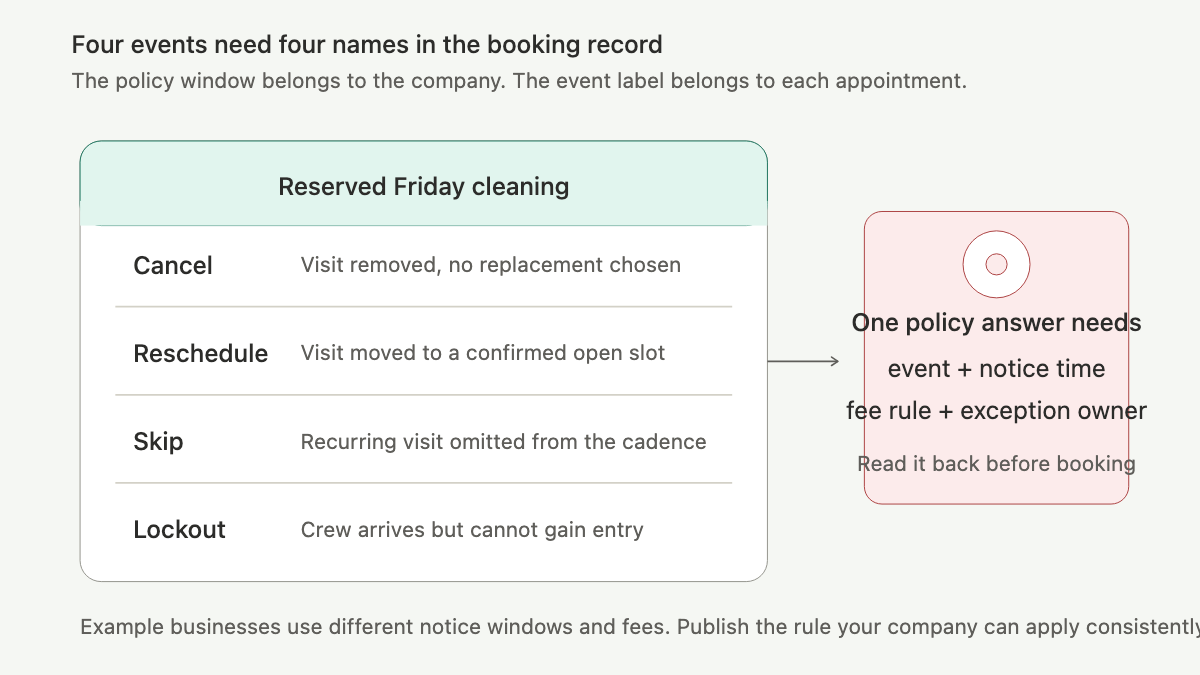
Those distinctions matter because a company may treat each event differently. For example, Boardwalk Cleaning’s published FAQ distinguishes timely rescheduling, late changes, skipped recurring visits, and lockouts. Dust and Mop’s customer terms use their own notice and access rules. These are real examples, not universal terms.
Ask one direct question: “Do you want to remove this visit, or should I look for another available date?” If the caller wants another date, do not call it rescheduled until an open slot is confirmed. A preference for Monday is still a pending request.
For recurring service, ask whether only this visit is changing or whether the cadence should change too. A customer who keeps skipping every other weekly appointment may need a biweekly plan. The recurring cleaning frequency guide covers that separate conversation.
Use the appointment record, not memory
Once the event is clear, pull up the exact appointment. Verify the service address, scheduled date, arrival window, service type, quoted or recurring price, and the timestamp of the customer’s message. If the business measures notice in business hours, weekends and office closures may affect the calculation. Follow the wording your company has published.
Do not round a Thursday 3:40 p.m. message into “about two days.” Record the actual timestamp. The policy should tell staff which clock matters and which channel counts as notice, such as a phone call, voicemail, customer portal, text, or email.
Cleaning-industry guidance from ZenMaid recommends giving customers the terms at signup, keeping them visible, naming a contact method, and stating exact notice periods and fees. That is sound operational advice. The fee amount itself belongs to the company’s policy and service agreement.
A clear phone explanation can be short:
“Your cleaning is booked for Friday in the morning arrival window. We received your change request Thursday at 3:40 p.m. Our current policy treats that as a late reschedule. The applicable fee is shown in the terms you received at booking. I can check Monday availability now, but I cannot move the appointment until a slot is open.”
If the caller disputes the rule, read the relevant sentence. Do not argue about whether the policy is fair, promise a waiver, or improvise a discount. Explain who can review an exception and when the customer will hear back.
Make exceptions traceable
Life happens. A good policy can still allow judgment, but the receptionist needs a defined approval path. Decide in advance who may waive a fee, which facts that person needs, and whether any categories receive special treatment. Staff should not have to guess based on how upset a caller sounds.
When an exception is approved, keep the original event in the record. Add the approver, reason, date, and outcome. Changing “late cancellation” to “timely cancellation” hides what occurred and makes future conversations harder. A waiver changes the charge. It does not change the timeline.
Avoid promises such as “We always waive the first one” unless that sentence appears in the current policy. Published guidance may suggest a one-time courtesy, but your business still needs a rule that staff can apply evenly.
Treat a lockout as an access failure
A lockout starts when the crew arrives and the agreed access method fails. The door is locked, the key is missing, a keypad code no longer works, a gate will not open, or the person assigned to meet the team is absent.
Before labeling the event, confirm the crew is at the correct address and within the promised arrival window. Check whether the access instructions were current, whether the crew followed them, and whether the designated contact was called through the approved channel. If the business has a wait-and-escalate procedure, record each attempt and time.
Never ask a cleaner to search for an unrecorded hidden key or try nearby doors. Never place a gate code, alarm code, lockbox combination, or key location in a broad dispatch chat. Access credentials belong in the system your company has approved for restricted information.
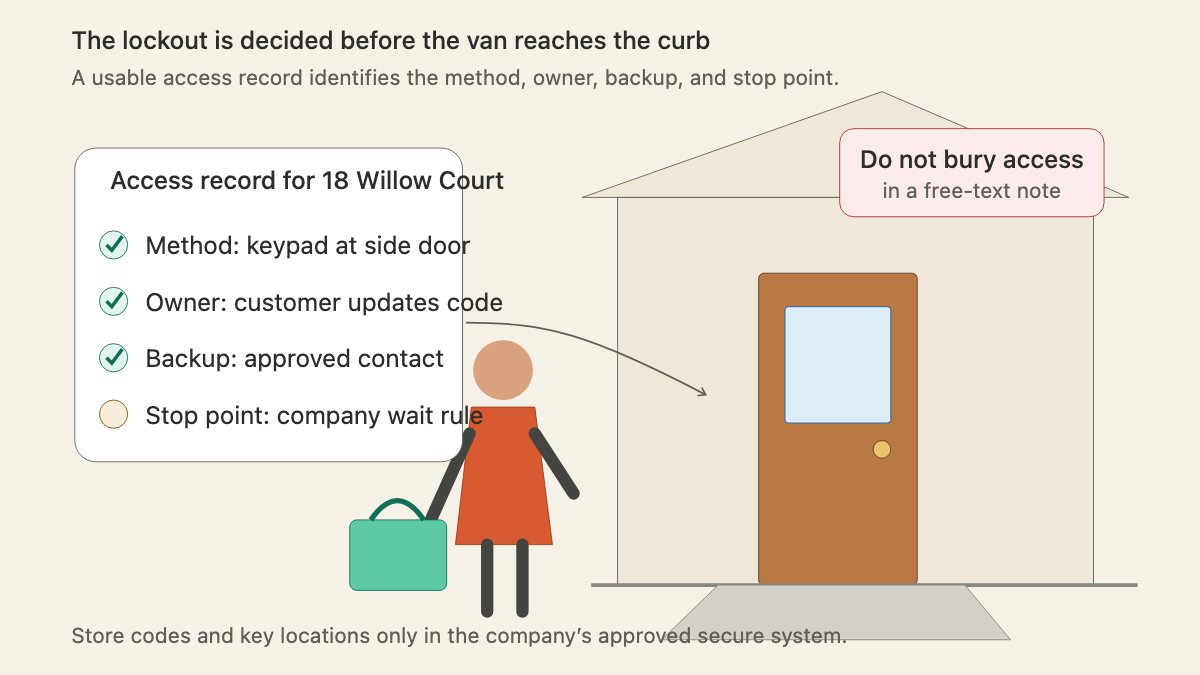
The access record needs four fields:
- Method: customer present, staffed desk, keypad, lockbox, approved key, or another permitted method.
- Owner: the person responsible for making that method work before arrival.
- Backup: the approved contact or alternate method if the first one fails.
- Stop point: the company’s wait, contact, and rerouting rule.
The customer’s access duties should be stated when the appointment is booked and repeated in the reminder. Published terms from Dust and Mop and Boardwalk both do this, though their exact lockout consequences differ. That difference is the point. Quote your rule.
For an empty property, confirm utilities, parking, building access, and who secures the home afterward. The move-in cleaning booking guide provides a fuller intake for vacant homes.
Answer the policy questions customers actually ask
When a caller asks, “Will I be charged?” the honest answer depends on four facts: which event occurred, when notice arrived, which version of the policy governs the booking, and whether an authorized exception was approved. Pull those facts before giving a yes or no.
When asked, “Can I move it to next week?” check the schedule first. Say, “I can look for an open visit next week.” Do not imply that rescheduling erases a fee unless the written terms say so.
When asked, “Why is there a lockout fee if nobody cleaned?” explain the reserved crew and failed access in neutral language: “The team traveled to the confirmed address for the reserved visit but could not enter using the access plan on file. Our lockout rule is in the service terms. I can document what failed and send it for review if you believe our record is wrong.”
When asked, “What if your company cancels?” use the company-side cancellation procedure. It should explain how customers are contacted and what scheduling remedy the business offers. Do not answer a company cancellation with the customer penalty language.
End every call with a readback
The final readback should name the appointment state, any charge or pending review, the next confirmed date if one exists, and every access change. Keep it factual.
“Friday’s visit is canceled. Your fee review is pending with the office manager, and I have not promised an outcome. Monday is only a requested date until scheduling confirms it. Your old keypad code has been removed from the active access record. Please update the new code through the secure customer link before another visit is confirmed.”
Send the same facts through the normal confirmation channel. If an AI receptionist takes these calls after hours, it can classify the event, capture the timestamp, and route an exception request. A manager still owns waivers and disputed charges.
The cleanest policy call ends with one appointment state and one access plan. Friday is canceled. Monday is either confirmed or still pending. The crew should never discover the difference while standing on the porch.