A recurring customer calls before Monday’s clean and says, “The spare key is under the blue planter. The alarm code is 4471.” The receptionist now holds two sensitive details, but still lacks the information the cleaner needs. Which door has the planter? Is the system armed in Away or Stay mode? Who answers if the code fails? Where should the key go after the visit?
A useful cleaning-service access note covers six things: the approved entry point, credential type, person responsible for it, alarm sequence, failed-access contact, and required departure state. Keep the actual key, address mapping, and codes in restricted systems. Give the cleaner the smallest amount of access needed for that visit.
That last rule is the most important. A cleaner needs a reliable way through one door during a defined service window. The cleaner rarely needs a household master code, unrestricted smart-home permissions, or a key tagged with the customer’s street address.
Choose the smallest access method that works
Start by asking whether anyone will be home. Client-present entry removes the need to store a key or door code, though the office still needs the resident’s name, arrival window, doorbell instructions, and a backup number. If nobody will be there, identify the exact method: retained key, customer-controlled lockbox, smart-lock guest code, garage keypad, building fob, doorman, property manager, or another arrangement your company accepts.
The NIST definition of least privilege says access should be limited to the minimum necessary for the assigned task. It is an information-security principle, not a cleaning regulation, but it gives an office a sound test. Does the arrangement open only the required entrance? Can access be limited to the people and time involved? Can it be returned or revoked when service ends?
Ask these questions on the call:
- Which entrance should the cleaner use, and how is it identified from the street or building corridor?
- Is the credential a physical key, lockbox combination, fob, door code, app invitation, or concierge instruction?
- Will the customer provide a guest credential, or does the proposed method expose a master code?
- Does the credential also control a gate, elevator, garage, alarm, or interior door?
- When does access begin and end, and who removes it after a one-time job?
- Who can solve an entry problem while the cleaner is still outside?
Some smart locks support individual passcodes, schedules, activity history, and current lock status. Google documents those controls for compatible locks in Google Home, but capability varies by model and setup. Ask the customer what their device supports. Do not promise a scheduled code or activity log before someone checks the actual lock.
A hidden key is easy to describe and hard to control. If company policy allows one, record the precise location and the return step in the restricted access record. Do not repeat that location in a crew-wide group message. If the caller says the door will be left unlocked, explain your policy plainly and offer an accepted alternative when possible.
Keep the credential separate from the address
A metal key carries no natural audit trail. The office has to create one.
When a company retains customer keys, attach an internal identifier such as K-214, not a name, phone number, or street address. Store the address-to-tag mapping in a restricted customer record. Keep the tagged key in a locked cabinet, record who issued it for a visit, and require its return. One cleaning company, Touch of Freedom, publishes a key and alarm policy that describes number-coded keys without identifying information and in-person return when service ends. That is one company’s procedure, but the underlying separation is useful.
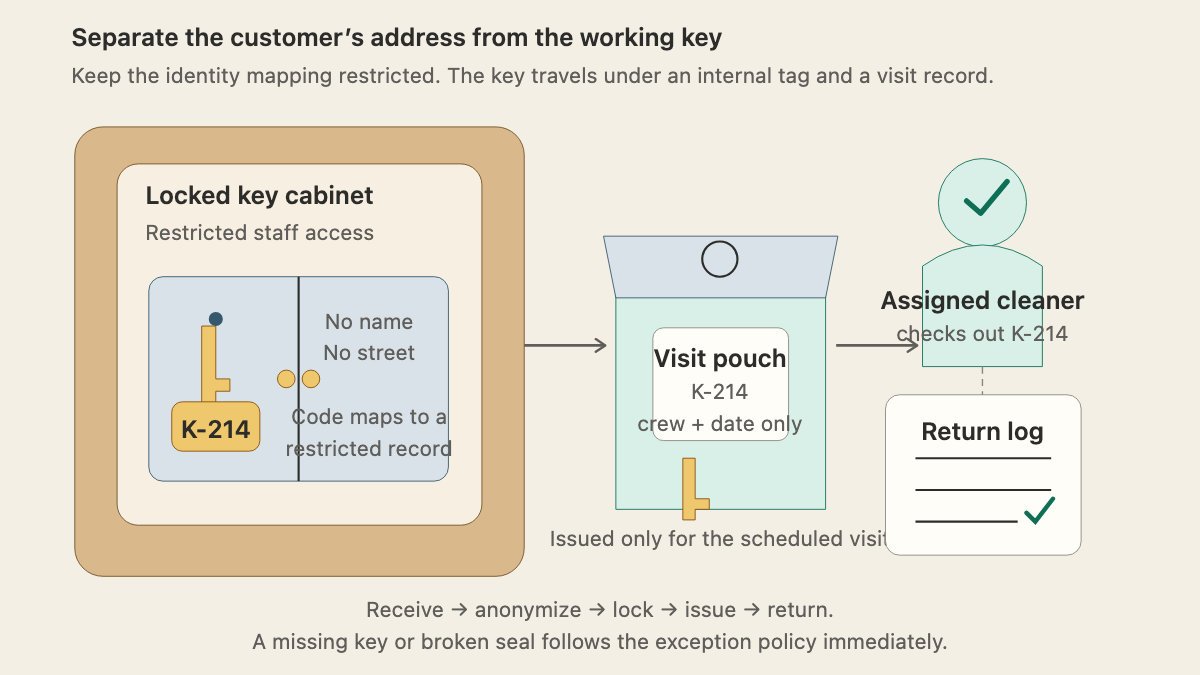
A practical custody record names the customer account, internal key ID, storage location, date received, employee who accepted it, authorized users, checkout and return events, and final disposition. If the key is lost, damaged, copied without approval, or not returned at shift end, staff should follow the company’s incident procedure immediately. The receptionist should never improvise a quiet replacement.
Digital credentials need the same ownership. Store them only in a system approved for sensitive access data. Restrict who can reveal them. Remove former employees promptly. When the device permits individual users, assign a cleaner or team credential that can be disabled without changing the customer’s main household code.
House-cleaning industry guidance describes several custody models, including retained keys, lockboxes, smart-lock credentials, building fobs, and client-present entry. The right choice depends on what the customer owns and what the cleaning company can control consistently. A clever method with a vague handoff is weaker than a simple method with clear custody.
Turn alarm instructions into a testable sequence
“Alarm code in notes” is incomplete. Record what the cleaner should see and do.
Ask the customer to identify the alarm brand or panel type, the normal arrival state, the approved user code or method, the action required to disarm, any entry delay, and the departure step. Confirm whether the same credential controls a connected lock. Ask what message, light, or sound indicates success. Then name the person to call if the panel shows something else.
Ring, for example, documents unique access codes for shared and guest alarm users. Those users can arm and disarm through the keypad, and the owner can reset a code. Other systems use different roles and commands. The office should follow the customer’s device instructions and its own written policy.
Never ask a customer to place a duress code, master code, emergency word, or monitoring-account password in an ordinary dispatch note. Never train a receptionist to guess around a panel error. If an alarm sounds or the screen differs from the recorded state, the cleaner should step back, call the named contact, and follow the company’s incident procedure. Emergency conditions go to the appropriate emergency service.
The access plan should also cover other people. May a contractor, relative, dog walker, or delivery person enter while the cleaner is inside? A published cleaning-company policy may prohibit staff from admitting unknown visitors, and that is a sensible boundary to settle before the visit. The cleaner should not become the customer’s temporary doorman by accident.
Verify arrival and departure as separate events
A successful entry proves only that the cleaner got in. It says nothing about the door and alarm after the work is done.
At arrival, the cleaner should confirm the property, entrance, and expected state before using the credential. If the house number, unit, lockbox, key tag, or panel state does not match the work order, stop. Calling from outside is cheaper than opening the wrong door.
At departure, the cleaner follows the recorded sequence: gather equipment, check agreed windows or secondary doors, return the key to its required place, close and test the entry door, arm the system when instructed, and record completion. If the lock does not latch or the alarm will not arm, the visit remains open until the exception is handed to the named person under company policy.
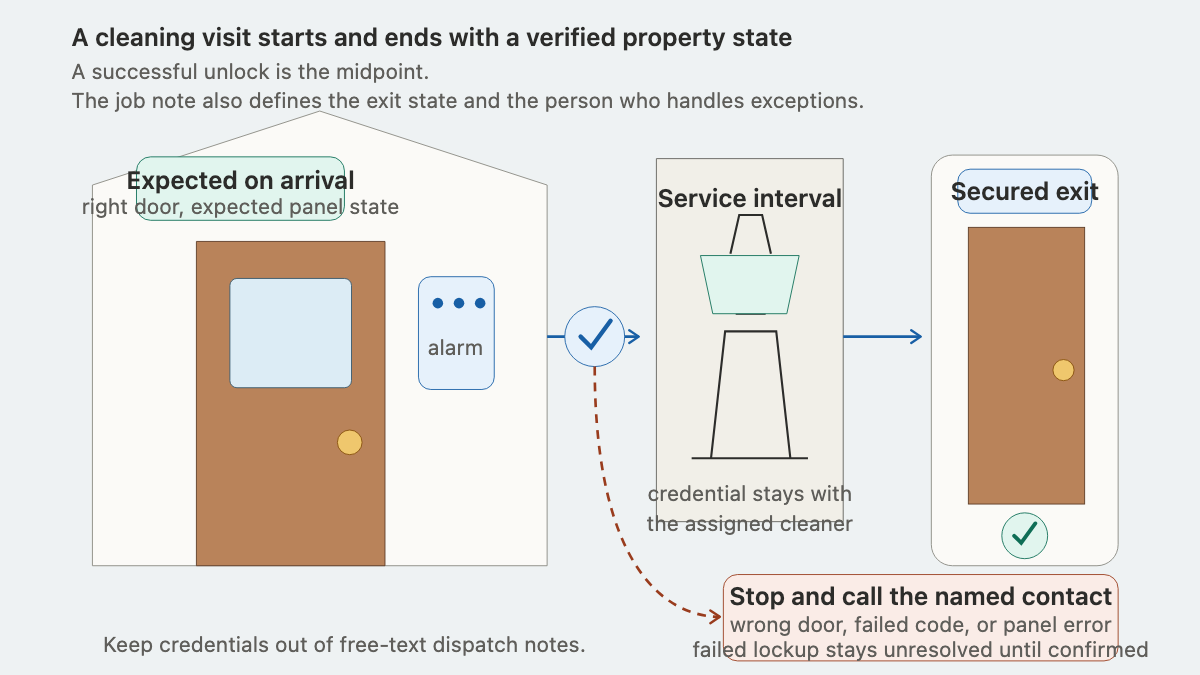
Record events without copying secrets into the event log. “K-214 checked out to Team B at 8:42” is useful. “Customer alarm code is 4471” does not belong in a routine status feed. The access system can hold the secret while the operations log records who used the approved method and when.
For an empty property, access is only one part of readiness. The move-in cleaning call guide covers utilities, contractor handoff, surfaces, and final access. For repeat service, connect this record to the cadence and scope in the recurring house-cleaning call guide.
Read back one dispatchable access note
Before ending the call, read the plan back in operational order. A complete note could say:
“Cleaner uses the east lobby entrance and checks in with the concierge under the company name. Concierge releases building fob F-18 for unit access. Customer has created a cleaner-specific alarm user. The credential is stored in the restricted access field and is available only to the assigned crew. Expected panel state on arrival is Armed Away. Cleaner disarms under the manufacturer’s normal steps, completes the visit, closes and tests the unit door, arms Away, returns F-18 to the concierge, and records completion. If the concierge has no fob, the panel differs from the note, or the door will not secure, cleaner remains outside or at the threshold and calls Morgan at the approved number. Staff do not admit other visitors.”
That note identifies the physical route, credential owner, expected states, failure contact, and exit proof. It avoids putting a real code in general dispatch text.
Set a review date for recurring customers. Entry methods change. Building staff turn over, fobs are replaced, alarm users are removed, and a customer who once worked from home may now expect unattended entry. Confirm the access plan after any lock, alarm, household, staffing, or schedule change. When service ends, return physical credentials and revoke digital access under the company’s documented process.
An AI receptionist can collect the non-secret fields after hours, identify missing ownership, and route sensitive credential handling to the approved system. The standard stays the same for every caller: one known entrance, one accountable credential path, one exception contact, and a door that is confirmed secure before the visit closes.