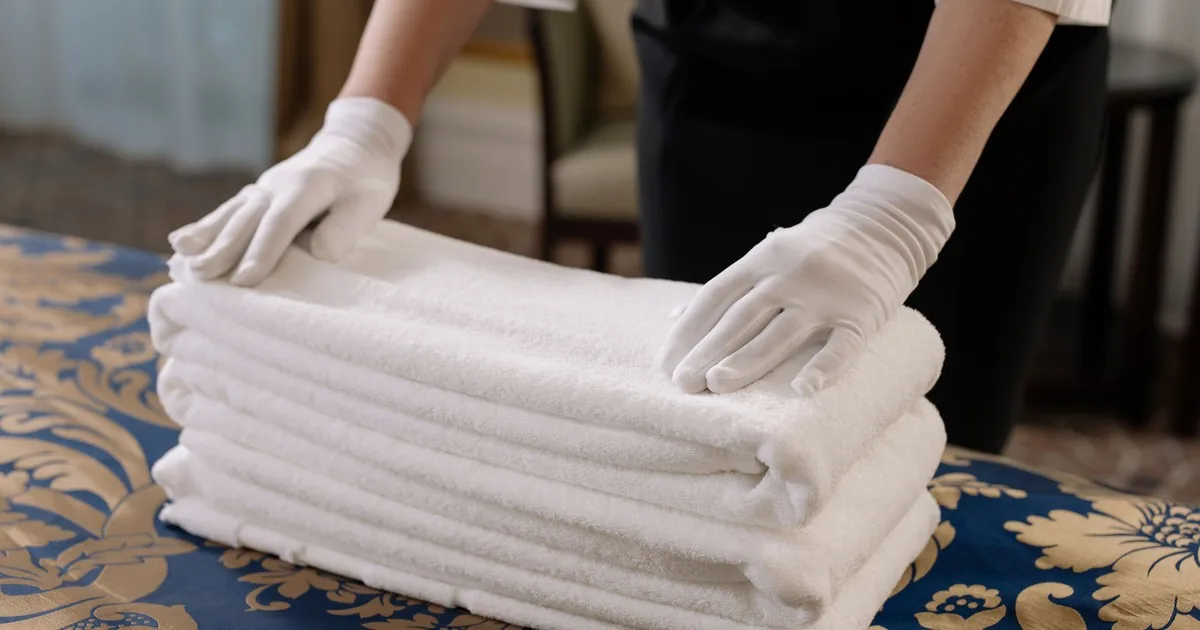
A recurring customer calls on Tuesday and says, “Could the cleaner do two loads and change the beds on Thursday?” One basket holds bath towels, kitchen cloths, a waterproof mattress protector, and a red cotton blanket. The fitted sheets are still on three beds. One dryer cycle may run beyond the cleaning appointment.
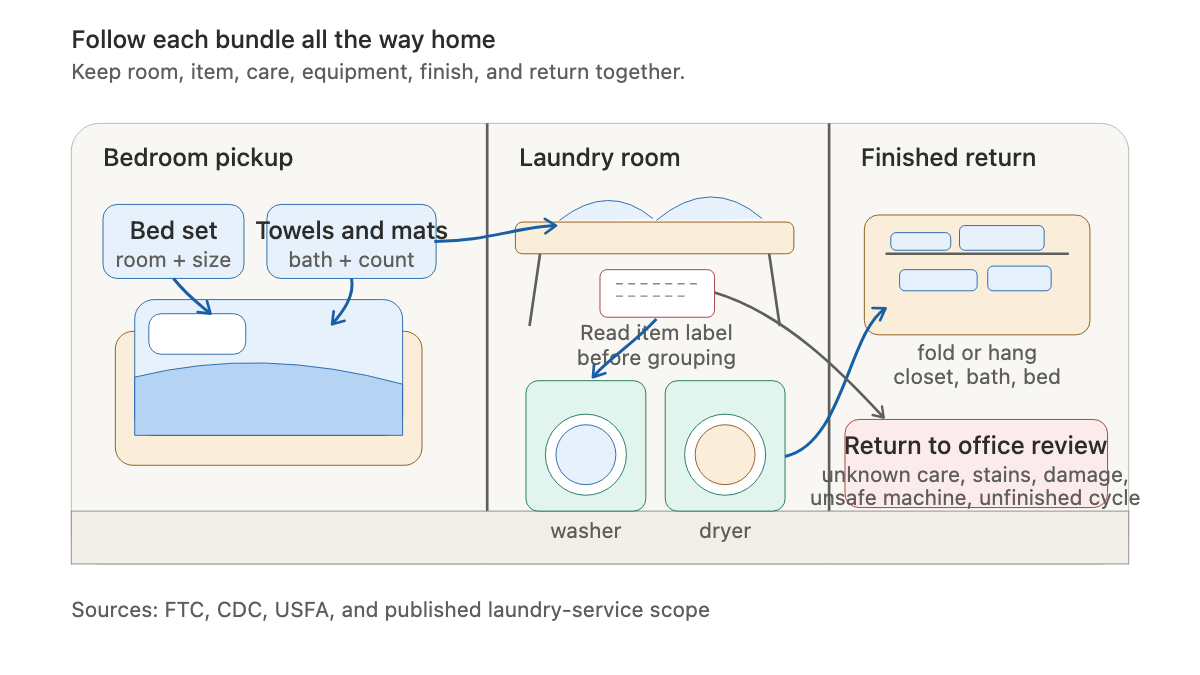
The office needs more than a basket count. Name every bundle, connect it to a room or person, check its care instructions, identify the machines and products, decide who owns unfinished cycles, and state exactly where clean items go. Bed-making, folding, hanging, stain treatment, ironing, and putting clothes away are separate promises.
Count bundles and beds before promising a slot
Start with the service address and ask whether the request covers household linens, personal clothing, or both. “Linens” can mean sheets, pillowcases, duvet covers, blankets, mattress protectors, bath towels, hand towels, washcloths, bath mats, kitchen towels, tablecloths, or cleaning cloths. Record each group. A single pile may contain items that cannot follow the same care path.
Ask how the caller estimated the work. A hamper, bag, bed, or armful is not a machine load. Request a photo when your company uses photos for quoting, then mark quantities as estimates until the crew sees them. The useful question is, “Which items are included, and where are they now?” A workable answer sounds like “queen sheets on the guest bed, six white bath towels in the hall hamper, and two kitchen towels by the washer.”
Beds need their own count. For each bed, capture the room name, mattress size, whether the crew strips it, where the used set goes, where the clean set is stored, and what “make the bed” includes. Ask about duvets, decorative pillows, protectors, adjustable bases, bunk beds, crib bedding, wall-side access, and heavy mattresses. Do not assume a clean replacement set exists.
Personal clothing opens a larger scope. Separate adult clothing, children’s clothing, uniforms, athletic wear, delicate items, and anything the customer wants kept apart. Ask who checks pockets and removes belts, pins, tissues, earbuds, keys, cosmetics, and other loose objects. Put that owner in the work order.
Keep this intake distinct from a whole-home first-time deep-cleaning quote. The cleaning quote describes rooms and surfaces. The laundry add-on follows specific textiles through a complete handoff.
Treat every care label as an instruction
The customer may say, “Everything goes on normal.” That statement does not replace the item label. The Federal Trade Commission’s care-label guidance explains that covered labels communicate washing, bleaching, drying, ironing, and warning instructions. Those instructions can differ even when two items look similar.
Ask whether every included item has a readable label. A missing, cut, faded, or contradictory label needs a company-approved decision before the visit. So does an item marked hand wash, dry flat, line dry, no bleach, or dry clean. The receptionist should record the words or request a clear photo. It should not translate an unfamiliar symbol from memory or choose a substitute method.
Sort decisions belong to the approved laundry process and the customer’s instructions. Capture color, fabric, soil level, pet hair, lint shedding, dye concerns, and anything already known to transfer color. A white towel load and a dark blanket may be simple to separate. A beaded coverlet, wool throw, rubber-backed bath mat, or item contaminated with oil needs review before anyone puts it in a customer’s machine.
Stains deserve exact language. Ask where the stain is, what the customer believes caused it, how old it is, and what products or heat have already been used. Promise the approved treatment, not a result. “Crew will photograph and apply the company’s standard pre-treatment if the care label permits” is a scope. “We will get it out” is a guarantee the office cannot support.
Identify the machines, products, and cycle owner
Record whose washer and dryer will be used. If they belong to the customer, ask where they are, whether the crew has clear access, and whether the customer reports any current problem. Capture the machine type and basic controls only when they affect the approved process. A front-loading washer behind a closet door, a stacked pair in a narrow hallway, and shared machines in a condominium laundry room create different access and scheduling conditions.
Ask about detergent, bleach, fabric softener, scent beads, dryer sheets, stain products, and wool dryer balls. Who supplies each one? Where is it stored? Does the customer require an unscented product or want certain products excluded? Link allergy or sensitivity requests to the company’s product and scope intake. Never promise that a product is hypoallergenic or safe for every person and textile.
The Centers for Disease Control and Prevention says household laundry should use detergent and the recommended water temperature, followed by complete drying. In a work order, “recommended” points back to the item instructions, machine guidance, product label, and company process. It is not a universal hot-water rule.
Ask who handles the lint filter under company policy. The U.S. Fire Administration’s dryer safety guidance calls for a clean lint filter and sound venting, and it tells users to have dryers installed and serviced by professionals. Reception should route reports of smoke, a burning smell, sparking, abnormal heat, a damaged cord, or a crushed or disconnected vent. Do not book ordinary machine use over a reported safety problem.
Time ownership is just as important. Ask whether the expected wash and dry cycles fit inside the appointment, using the customer’s machine and item settings as the reference. If a cycle remains active when the cleaning work ends, who stays, returns, transfers the load, or finishes it? Never leave that answer buried in a general note. A wet load locked in the washer is not a completed add-on.
Define the finish and return location
“Wash and fold” still leaves choices. Ask whether shirts go on hangers, towels use a particular fold, fitted sheets stay as sets, and personal clothes return by person or room. Name the destination: hall linen closet, primary bathroom shelf, guest-room dresser, laundry-room counter, or labeled basket. “Put away” is too broad unless the customer has approved the exact drawers and closets the crew may open.
A published short-term-rental laundry checklist shows the range of possible finishing work: washing, drying, folding, ironing, making beds, placing towels, managing supplies, and reporting worn or damaged linens. A residential cleaning company may offer fewer tasks. The point is to separate them on the ticket so a folded sheet on the laundry counter is not mistaken for a remade guest bed.
Ask how the crew should handle existing tears, frayed edges, missing buttons, bleach spots, permanent stains, and worn elastic. Photos at pickup and finish may fit company policy for rental or property-management accounts. Record who receives a replacement alert and whether the crew may choose another set from storage. Do not discard a damaged textile without authorization.
For a recurring customer, decide whether laundry is a standing task or a date-specific add-on. If it recurs, record the normal bundle, products, machines, bed assignments, storage locations, and exception route. Keep that scope alongside the recurring cleaning frequency record. “Do the usual laundry” becomes dangerous when a guest adds a blanket or a child leaves a uniform in the same basket.
Separate ordinary laundry from special conditions
Ask whether any included item is wet from sewage or floodwater, contaminated with chemicals or fuel, affected by pests, soiled with sharps, or involved in a fire. Route those facts through company policy before accepting the add-on. Ordinary household laundry staff should not discover a specialty cleanup after opening a tied bag.
Illness requests also need precise words. CDC distinguishes cleaning, sanitizing, and disinfecting. If a caller asks to “sanitize all bedding,” find out what outcome they expect and whether the company has an approved textile process that supports that claim. Reception should not invent a bleach concentration, temperature, or cycle.
Pets and household access matter too. Ask whether animals sleep on the included bedding, whether pet hair is heavy, and whether pets will be secured away from the laundry area. Record locked closets, shared laundry-room hours, parking limits, stairs, elevator reservations, and building rules that affect moving bundles between rooms.
Read back a laundry ticket the crew can finish
A useful readback sounds like this:
“Thursday’s recurring clean adds guest-room linens and bathroom towels. Customer will strip the queen guest bed and place that sheet set in the blue basket. Six white bath towels and two white hand towels will be in the hall hamper. The red blanket, bath mat, personal clothing, and primary-bedroom linens are excluded.
“Crew will use the customer’s washer, dryer, unscented detergent, and labeled dryer sheets in the first-floor laundry room. Customer reports that both machines operate normally. Crew will follow item labels, check pockets, clean the lint filter under company procedure, and return unknown-care or damaged items to the blue basket for office review. No bleach, stain-removal guarantee, ironing, repair, or specialty cleanup is included.
“Finished towels go on the hall linen-closet shelf. The dry queen set goes back on the guest bed with the fitted sheet, flat sheet, duvet cover, and two pillowcases. If the dryer cycle cannot finish within the appointment, the crew contacts the office before leaving. The customer has not authorized an unattended running dryer or a wet load left in the washer.”
That record tells the crew what leaves each room and what must come back. It protects the customer’s labels and preferences, and it gives the office a clear stop point when the pile, machine, or timing differs from the call.
An AI receptionist can collect these fields after hours if the script mirrors company policy. The final ticket should let a cleaner identify every bundle, follow its approved care path, finish the promised work, and return each item to the exact bed, shelf, hanger, or basket named on the call.