A recurring customer calls after her first visit and says, “I liked Maya. Can she be my cleaner every Wednesday?” The office can hear two requests inside that sentence. The customer prefers a familiar person, and she wants each new visit to continue the service without a fresh start.
Answer both. Ask whether the customer cares most about the same individual, the same lead cleaner, or a familiar team. Explain the company’s actual assignment policy. Then agree on what should happen when that person is unavailable: send an approved substitute, offer another day, or contact the customer before changing the assignment.
Write the home’s instructions into the shared work order. A preferred cleaner can remember that the upstairs office stays closed and the limestone vanity needs an approved product. The business still needs those details where the next authorized cleaner can use them.
Clarify what “the same cleaner” means
Customers often use “cleaner” to describe several staffing arrangements. One company sends a solo cleaner. Another sends a two-person crew with the same lead and a changing partner. A larger service may keep a small route team familiar with the same homes. Those models create different promises.
Ask one plain question: “Would you like the same individual, the same lead, or a familiar team whenever scheduling allows?” The answer belongs beside the recurring slot. Do not translate “I liked the team” into a named-person guarantee.
The request may have a specific reason. Some customers value familiarity because they work from home, have an anxious pet, need help around a sleeping infant, use a mobility aid, or feel uncomfortable repeating private household instructions. Others simply liked the quality of the first clean. Capture the operational detail without asking the caller to defend the preference.
A useful note might say, “Customer prefers Maya as lead because Maya already knows the office is restricted and the dog stays behind the kitchen gate.” That is more useful than “VIP wants Maya.” It records what must remain true even if the schedule changes.
The company should also distinguish a preference from a complaint. If the customer refuses a previous cleaner because of missed work, damage, conduct, or a safety concern, route the issue through the company’s quality or incident process. A scheduling tag should not bury a service problem.
Say exactly what the company can promise
Continuity language should match the real staffing model. “We usually assign the same lead to your recurring slot” is a normal-practice statement. “We will note Maya as your preferred cleaner and contact you if the assignment changes” adds a communication commitment. “Maya will be there every Wednesday” is a guarantee.
Most offices should be cautious with the last version unless they have a policy and schedule that support it. People take leave, get sick, change routes, train coworkers, and leave jobs. A customer may also move a visit to a day when the preferred cleaner is already booked.
Clean Bees describes its own model in its client guide: the company keeps the same cleaning team assigned to a home to the best of its ability, uses an alternate when needed, and relies on a detailed work order for the home’s focus areas and preferences. That is one provider’s policy, not a rule for every cleaning business. It shows the wording discipline an office needs. The normal assignment, the exception, and the backup system are separate facts.
Do not improve the policy while speaking. If the company has never decided whether customers receive notice about a substitute, the call taker should not invent a notice promise. Record the request for staff review and give a real callback time.
Decide the fallback before anyone calls out sick
A same-cleaner request is incomplete until the office knows what to do when continuity breaks. Ask the customer to choose among the options the company actually offers.
- Send an approved substitute and keep the appointment.
- Contact the customer first, then send a substitute if accepted.
- Offer another available visit with the preferred cleaner.
- Skip the visit under the normal cancellation and frequency policy.
The customer may choose differently based on notice. She might accept a familiar substitute when told the day before but reschedule if an unfamiliar person would arrive without warning. Record the preferred contact channel and who can approve the change.
Avoid promises about exact notice time unless the company controls it. A morning illness may leave only a short window. The honest policy could be, “We contact you as soon as the office knows the assignment must change.” If the company offers a defined notice period, use that exact language.
A customer-requested schedule change can affect the assignment too. Connect the continuity note to the recurring house-cleaning frequency guide: the standing weekday, arrival window, frequency, route, and crew capacity all shape who can return. Ask which priority wins when the customer moves an appointment. Some will keep the date with another cleaner. Others will move the date to keep the preferred person.
Keep home knowledge with the booking
Familiarity is useful because a cleaner learns the house. The business becomes fragile when that knowledge exists only in one person’s memory.
A shared home profile should hold stable instructions such as the approved entry method, alarm procedure, parking restriction, pet boundary, rooms in scope, rooms never entered, fragile or specialty surfaces, company-approved product limits, equipment stored on site, and the customer’s communication preference. Visit notes should hold temporary changes: clean the guest room this week, skip the nursery during nap time, use the side door during driveway work, or focus on the downstairs bathroom.
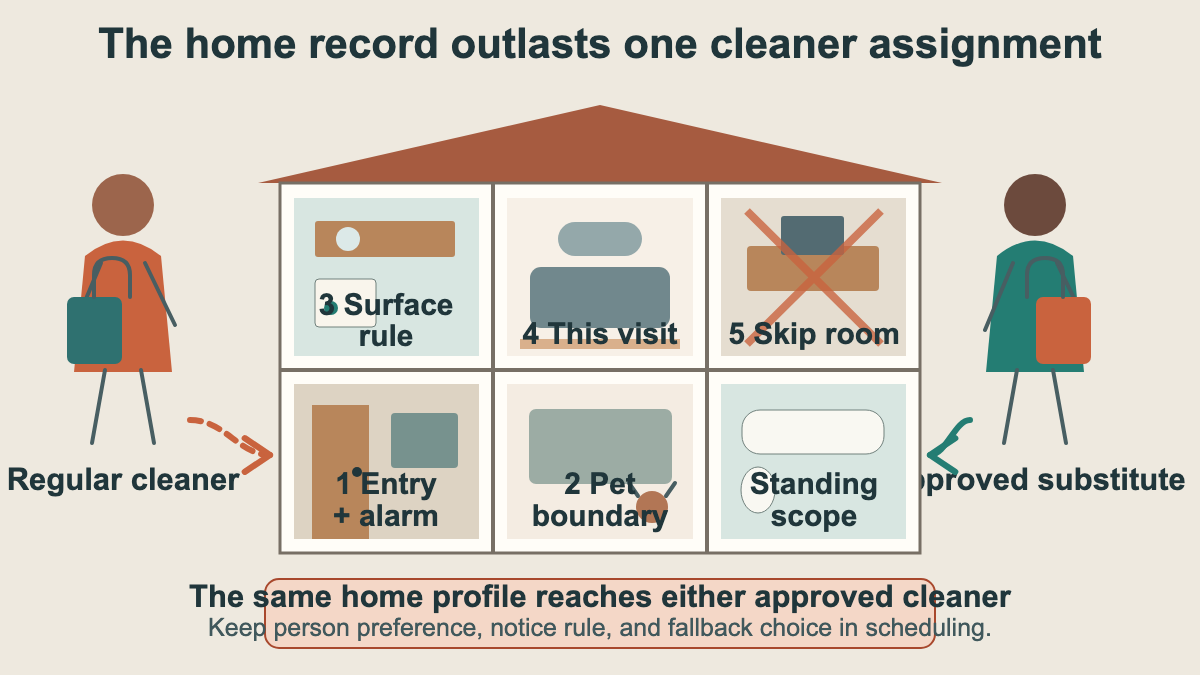
Sensitive access details need the company’s approved storage method. Do not copy a door code or alarm credential into an unsecured group text to make a substitution easier. The key and alarm access guide covers the secure intake boundary. The continuity record can say that authorized access instructions exist without exposing them in every dispatch message.
Product notes need the same precision. “Use green products” does not name a product, surface, or restriction. The EPA’s Safer Choice program helps consumers and businesses identify products whose ingredients meet the program’s criteria. It does not make every labeled product suitable for every person, pet, finish, or task.
The American Cleaning Institute’s product-safety guidance tells users to follow label directions, retain labeled containers, and avoid mixing products. For continuity, the office should record the approved rule in operational language: “Use company-approved fragrance-free product on sealed bathroom tile. Do not use the customer’s countertop spray. Marble vanity requires the approved stone procedure.” Route allergy claims and unusual product requests through the company’s review process.
Pet instructions can change each visit, even at a familiar home. The house-cleaning calls with pets guide explains how to name the animal’s location, physical boundary, handler, and failure contact. “Maya knows the dog” is not a pet plan for the substitute.
Give the scheduler and cleaner different parts of the answer
The scheduler needs the staffing preference, strength of the promise, preferred recurring slot, approved backup pool, customer notice rule, fallback choice, and who may approve a change. The cleaner needs the service scope and the current home instructions.
Keep those records connected, but do not collapse them into one vague note. “Same cleaner requested” tells the cleaner nothing about the home. “Office closed, dog gated, unscented products” tells the scheduler nothing about whether a substitution is allowed.
Read the agreement back to the customer. Here is a complete example:
“Rina is your preferred lead for the Wednesday recurring slot. We will keep that assignment when scheduling allows. If Rina is unavailable, text Alex before assigning an approved substitute. Alex may keep the appointment with that substitute or move to Rina’s next available opening. The shared home profile contains the front-door access procedure, downstairs-only scope, cat boundary, stone-surface rule, and office restriction. Confirm temporary room priorities before each visit.”
That note avoids an attendance guarantee. It also prevents the replacement cleaner from arriving empty-handed and asking the customer to explain the house again.
Review continuity after a schedule change
Revisit the record when the customer changes frequency, weekday, address, access, household members, pets, or service scope. A preferred cleaner who fits a weekly Tuesday route may not fit a monthly Saturday request. Say that before the calendar is changed.
Update the home profile after useful feedback. “Please dust the top of the bedroom frames” belongs in the service record if it remains part of the agreed scope. A one-time request for the guest bath belongs in the next visit note. Staff should be able to tell which instruction expires.
An AI receptionist can collect the continuity preference, notice rule, fallback choice, and changed home details after hours. The cleaning company still decides who is approved, what can be promised, and where sensitive access information is stored.
The best continuity call ends with two clear records. Scheduling knows who the customer prefers and what to do when that person is unavailable. The next authorized cleaner opens the work order and sees the house as it is today: side-door access, dog behind the kitchen gate, office closed, limestone vanity flagged, downstairs bathroom first.