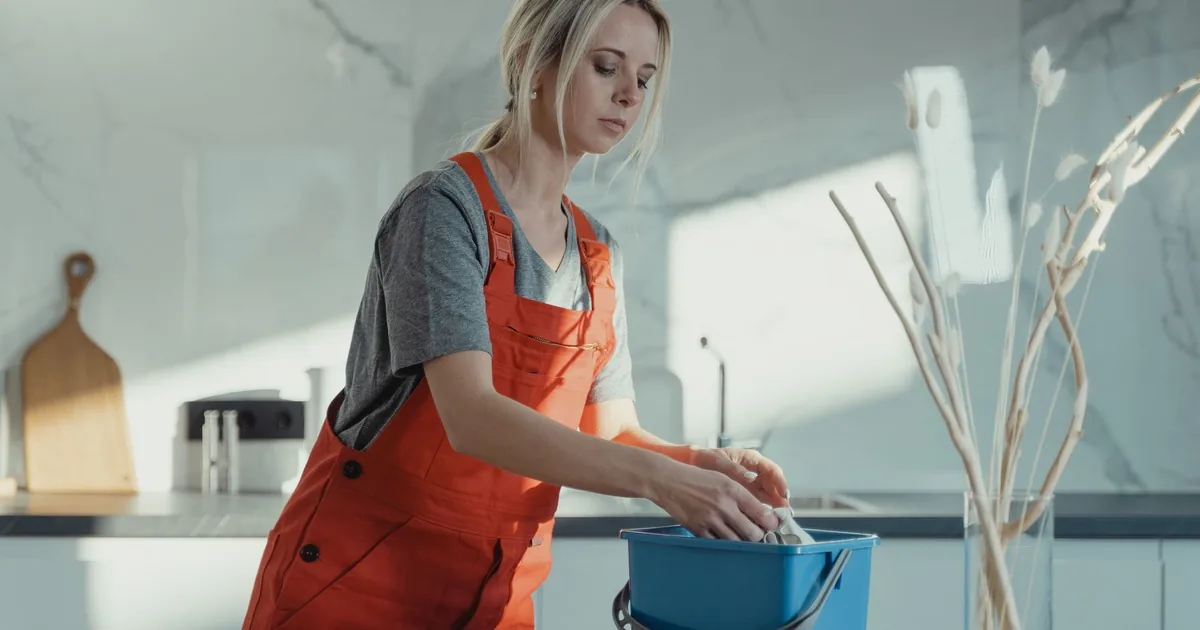
A caller says the flu went through the house and asks for “a deep clean and disinfection.” One child is still resting upstairs. The customer wants the kitchen, two bathrooms, bedding, toys, phones, and every doorknob handled tomorrow morning. She also mentions that someone already sprayed bleach in the guest bath.
That request is not ready for the calendar. The office first needs to establish who is still sick, which rooms were used, what visible material is present, which surfaces are in scope, and whether the company has an approved process for the requested disinfection. Any unknown chemical, bodily fluid, sharp object, or unsupported product claim goes to review.
The safest intake rule is simple: define the condition before naming the service.
Start with the people who will be in the home
Ask whether anyone is currently sick, recovering, isolating, or expected to remain in the property during the appointment. The receptionist does not need a diagnosis or a medical history. The useful facts are practical: occupied rooms, shared bathrooms, entry route, ventilation limits, vulnerable occupants, pets, and the earliest time the company may enter under its policy.
A good opening sounds like this: “Is anyone still having symptoms or using the rooms you want cleaned, and will anyone be home during service?” If the answer is yes, record which person will be where. Do not tell the caller when an illness is no longer contagious. That is medical guidance, and different illnesses have different public-health recommendations.
The CDC’s household guidance says routine cleaning is usually sufficient in ordinary conditions, while disinfection has a clearer role when someone is sick or at higher risk. That distinction affects the booking. It does not authorize a receptionist to decide that a particular home is medically safe.
Ask who can approve changes on service day. If the crew arrives and finds an occupied sickroom, a product already wet on a surface, or a condition missing from the call notes, they need one named contact and a hold rule.
Make the caller choose surfaces, not a slogan
“Disinfect everything” has no usable boundary. Walk through the house by room and ask what the customer expects in each one. In a bathroom, that may mean the toilet handle, faucet, counter, light switch, door hardware, and floor. In a bedroom, the request may include bedside tables, drawer pulls, electronics, bedding, a fabric headboard, and carpet. Those materials do not share one method.
Keep three terms separate. CDC defines cleaning as removing germs, dirt, and impurities with water, soap, and scrubbing. Sanitizing reduces germs to levels set by public-health codes or regulations. Disinfecting uses chemicals to kill most germs on surfaces and objects. CDC also says surfaces should be cleaned before they are disinfected because dirt can interfere with the chemical reaching the surface.
Record the customer’s requested outcome in plain language, then translate it into the services the company actually offers. If the company provides routine cleaning with selected high-touch disinfection, say which rooms and hard surfaces receive each step. If it does not disinfect soft furniture, electronics, toys, food-contact areas, or unfinished wood, put those exclusions in the confirmation.
This is the same discipline used on last-minute cleaning calls, where urgency cannot erase scope. A recent illness makes precise language more important.
Screen for material outside routine residential cleaning
Ask directly whether the home contains vomit, feces, blood, used needles, medical waste, sewage, pest waste, or another biological material. Use neutral words. Reception should record what the caller reports, the room, the surface, the approximate area, whether the material is still present, and whether anyone has attempted cleanup.
Do not quietly convert that report into a standard deep clean. Disease-specific cleanup can require a particular product, protective equipment, handling method, or trained provider. The company’s written boundary decides whether the request is accepted, reviewed, or referred.
Unknown chemicals need the same caution. Ask what products have already been applied, where, when, and whether residue or odor remains. Get the product name and a label photo when possible. CDC warns against mixing cleaning and disinfection products. A note that says “customer sprayed something strong in bathroom” is not enough for the crew to proceed.
The boundary should be firm without alarming the caller: “I can record the condition, but I cannot add that area to a routine cleaning until our supervisor confirms the process and product.”
Match every disinfection claim to the label
A bottle called “disinfectant” does not support every germ claim, surface, or application method. The EPA’s registered-disinfectant guidance says the EPA registration number is the reliable identifier because the same formulation may be sold under different brand names. The label lists the microorganisms addressed, where the product may be used, how it is applied, and how long the surface must remain visibly wet.
The office should never invent those details during a call. Product selection belongs to the company’s approved process. Once the process is known, the booking record should preserve five facts: exact product, supported claim, approved surface or use site, label contact time, and safety directions.
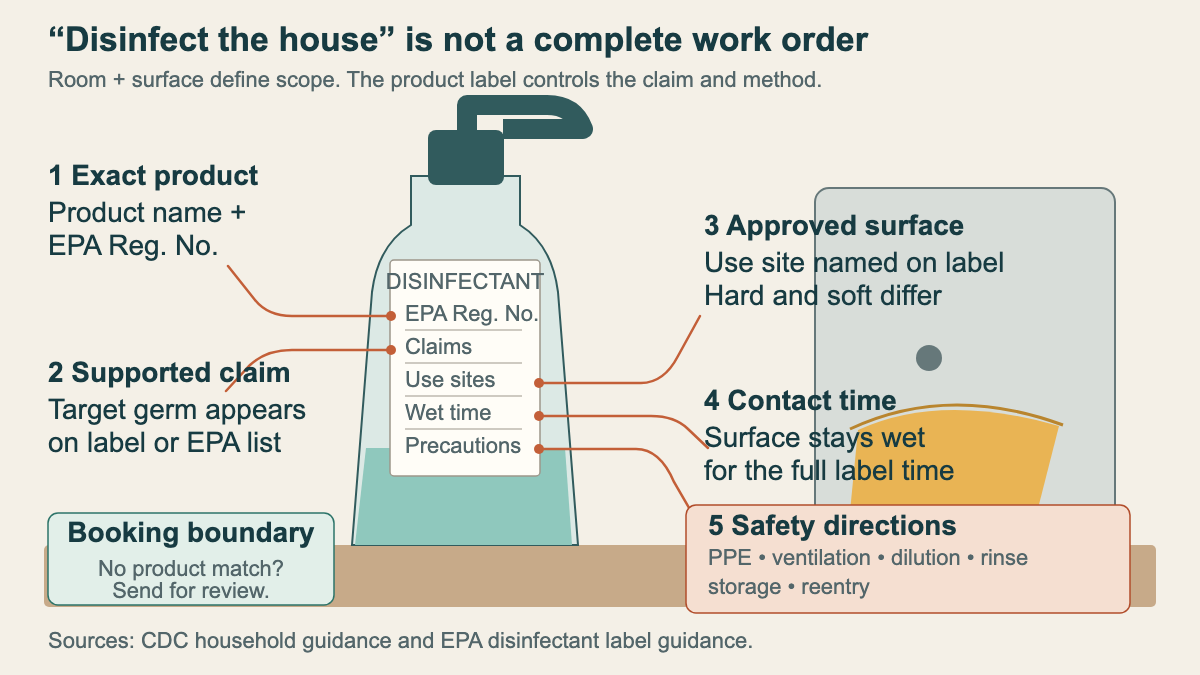
Contact time matters because wiping a product away immediately may not follow the directions. So do dilution, ventilation, personal protective equipment, rinsing, storage, and reentry instructions. The OSHA and NIOSH cleaning-chemical materials point employers to labels, safety data sheets, worker training, ventilation, and protective equipment. The customer’s preferred shortcut cannot replace those controls.
Avoid unsupported language in confirmations. “Crew will disinfect the listed sealed hard surfaces using Product A according to its label” is bounded. “Crew will eliminate all viruses from the house” is not.
Treat soft goods, electronics, and food areas as separate scope
Laundry deserves its own line item. Ask which sheets, towels, clothing, washable toys, and hamper liners are included, who will strip beds, and whether care labels are available. CDC advises laundering with detergent at the recommended water temperature and drying items completely. It also says dirty laundry from a sick person can be washed with other people’s items. The cleaning company still needs a service policy for handling, machine access, folding, and excluded contamination.
Electronics require manufacturer instructions. Record phones, tablets, keyboards, remote controls, game controllers, and touch screens separately. A product suitable for a sealed counter may damage a screen or enter an opening.
Food-contact surfaces need a named procedure too. The booking note should state which counters, tables, highchair trays, refrigerator handles, or sink areas are included and whether the approved label requires a rinse. Do not promise a treatment before checking the intended use site.
Soft furnishings create a common misunderstanding. A customer may point to a couch, rug, mattress, curtain, and fabric toy as one group. Ask what outcome they expect and whether the company offers cleaning or label-supported disinfection for each material. If the answer is uncertain, hold those items for review.
Product restrictions may overlap with illness concerns. Use the same intake discipline described in allergy-sensitive cleaning requests: exact product, exact surface, stated restriction, substitution rule, and one person who may approve a change.
Write the handoff room by room
The final work order should be readable without replaying the call. Start with occupancy and timing. Then list ordinary cleaning, requested disinfection, laundry, exclusions, prior products, access, ventilation, pets, and unresolved conditions by room.
A usable note might say:
- Customer reports household illness; one adult recovering off-site before service. Kitchen and hall bath requested. Routine cleaning throughout both rooms, with label-supported disinfection on listed sealed hard high-touch surfaces. Laundry and electronics excluded.
- Guest bath has unknown bleach product applied near sink at 8 a.m. Area remains on hold until supervisor reviews product photo and ventilation status. No visible bodily fluid reported. Cat secured in closed office, which is excluded.
The pet intake guide explains why “pet-friendly” is too vague. Post-illness work needs the same precision about animal location, treated rooms, drying or reentry instructions, and label restrictions.
Read the scope back to the customer. State what the company will do, what remains excluded, and what still requires approval. Never turn a review into a soft promise such as “the crew can probably handle it.”
An AI receptionist can collect these fields after hours and route exceptions to staff. The company still controls its products, worker protections, specialty-cleanup boundary, and schedule.
The best booking record ends with a concrete release condition: “Supervisor approves the guest bath after reviewing the product label, or that room stays closed.” The crew gets a safe boundary. The customer knows exactly what has been accepted before anyone opens the door.