At 10:15 a caller asks whether someone can clean a three-bedroom house before guests arrive at 4:00. The schedule shows one crew finishing nearby around noon, but the caller has not mentioned the dog, the oven, the cluttered playroom, or the forty-minute drive across town.
The receptionist should not answer with a quick yes.
A last-minute cleaning call needs five facts before a slot is offered: the fixed finish time, service address, live crew and travel capacity, rooms that must be ready, and conditions that could change the work. The office can then offer a smaller confirmed scope, place the request on a callback hold while dispatch checks it, or decline the deadline. Urgency should narrow the promise.
Start with the finish time and address
Ask, “What time does the cleaning need to be complete?” A guest arrival at 4:00 means the crew must be packed and out before then. A key handoff at 5:00 may have a little flexibility. “As soon as possible” has no scheduling value until the caller names the event or cutoff.
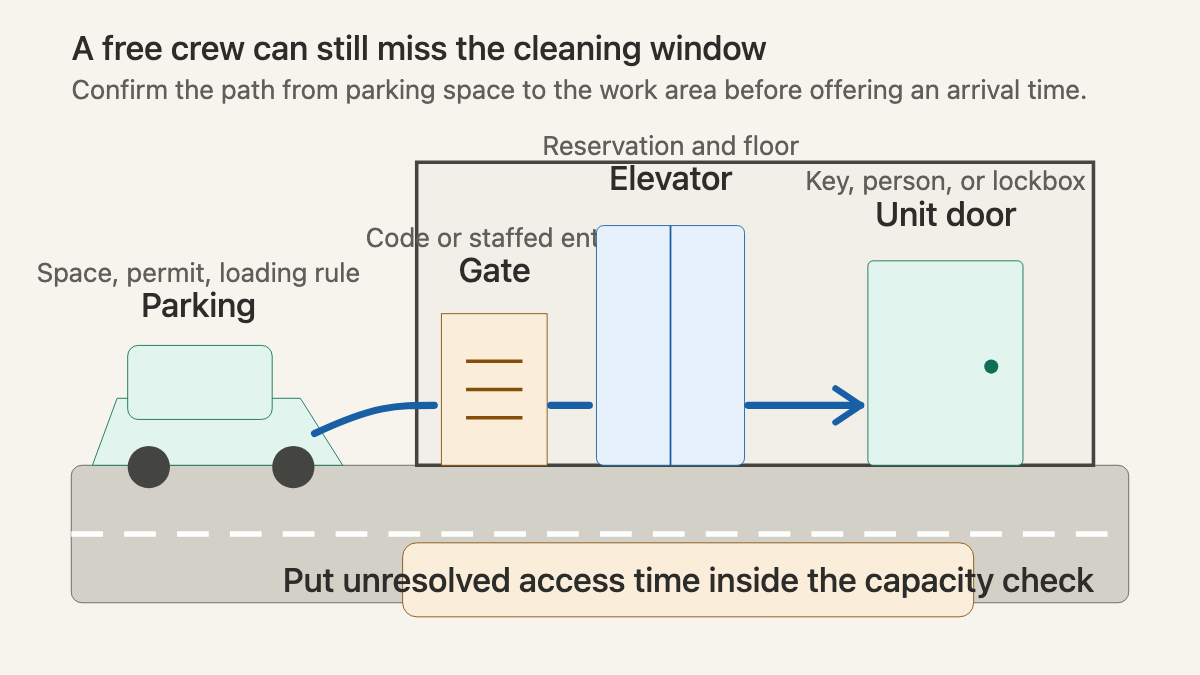
Get the full service address next, including unit number, gate instructions, parking limits, and elevator or loading rules. Travel belongs inside the capacity check. A crew that becomes free at noon is not available for the next house at noon if it still has to unload, drive across town, find parking, and reach a high-rise unit.
Do not quote an arrival until dispatch has checked the live board. The office needs the crew’s current job status, expected travel, required equipment, and the buffer used by the business. Weather, traffic, building access, and an earlier job that ran long can erase a promising window.
Use conditional language during that check: “I can gather the scope now. I will confirm the time after dispatch verifies the crew and travel window.” That sentence protects the schedule without brushing off the caller.
Sort the home into three scope levels
A rushed caller often describes the whole home first. Bring the conversation back to the deadline: “Which rooms must be ready before your guests arrive?”
Create three buckets:
- Must be ready: the rooms tied to the event, handoff, showing, or inspection.
- If time remains: useful additions that the crew may handle only after the confirmed rooms are complete.
- Outside this visit: work that needs another appointment, different equipment, or a separate quote.
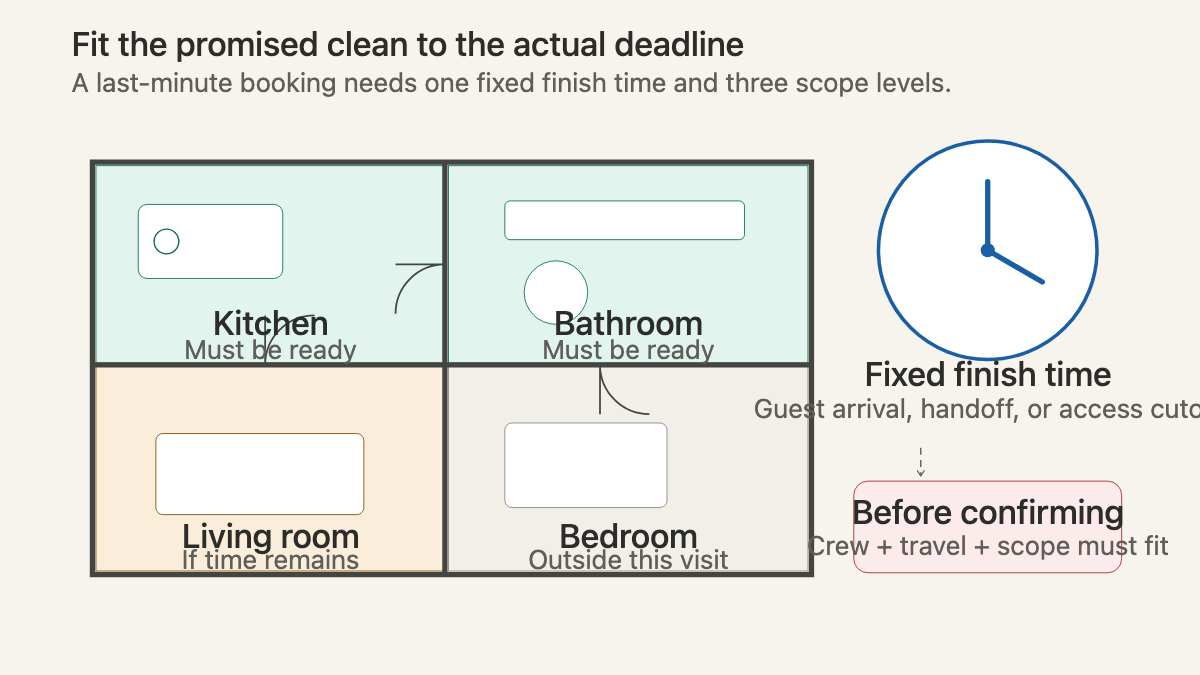
For a dinner that evening, the kitchen, guest bathroom, entry, and dining area may matter most. An upstairs bedroom may be irrelevant. For a rental handoff, the priorities could reverse. The office should let the caller define the outcome, then translate it into rooms and tasks.
Avoid vague scope labels such as “regular clean” unless your company has a written definition the caller receives. Say what is included: vacuum open floor areas, mop hard floors, wipe reachable counters, clean the toilet and sink, empty ordinary waste, and remove fingerprints from the entry glass. Your list will differ. The point is that both sides hear the same promise.
Ask what condition the crew will walk into
Room count says little about effort. Ask for a plain description of the current condition and request photos when your policy allows them. Useful prompts include:
- Is this routine household soil, or has the home gone without cleaning for an extended period?
- Are counters and floors clear enough to clean, or will the crew need to move belongings?
- Are dishes, laundry, food waste, or party debris part of the request?
- Is there grease buildup, heavy soap residue, pet hair, smoke residue, or construction dust?
- Does the caller expect inside appliances, cabinets, windows, wall washing, or stain removal?
- Is any sewage, bodily fluid, pest waste, sharp material, visible mold-like growth, or other hazardous condition present?
The final question is a routing screen. It does not diagnose the material. It tells the office when ordinary house-cleaning staff should stop and send the request for specialist or manager review.
If photos show a larger job than the available window can support, cut scope before changing the finish time. “We can confirm the kitchen and downstairs bathroom before 4:00. The living room is conditional, and the bedrooms would need another visit” is a usable offer. “We will do our best on the whole house” is not.
For a first visit where condition drives the quote, use the first-time deep-cleaning intake guide. It covers photos, buildup, room priorities, and expectation setting in more detail.
Screen access, occupancy, pets, and utilities
Short notice leaves little time to repair access problems. Confirm who will let the crew in, whether that person will stay, and how the property will be secured afterward. Never place lockbox codes, alarm details, or hidden-key locations in casual notes or text threads outside the company’s approved system.
Ask about pets by species, location, and containment plan. “Friendly dog” does not tell a cleaner whether the animal will be loose at the door while equipment comes in. Record who secures the pet before arrival and which rooms remain off limits.
Confirm working water and electricity. Ask whether air conditioning or heat is operating when the weather makes the interior unsafe. For a vacant property, verify that the crew can use the restroom if company policy requires it. A move-in or empty-home request may need the access and utility checks in the move-in cleaning booking guide.
Occupancy changes the plan too. A work-from-home customer may need a quiet room left untouched until a meeting ends. Children may be napping. Movers, decorators, or maintenance workers can block floors and re-soil finished areas. Ask who else will be present and whether another trade controls any room.
Separate cleaning from disinfecting
Callers sometimes add “and disinfect everything” near the end. Treat that as a scope change, not a free synonym for cleaning.
The CDC’s household guidance distinguishes cleaning, sanitizing, and disinfecting. It says routine cleaning with soap or detergent removes dirt and most germs, while disinfection is generally more relevant when someone is sick or at higher risk. A booking agent should ask what the caller means, which surfaces are involved, and whether the requested work fits company policy.
Do not improvise chemical promises to save the booking. CDC says to follow product labels, maintain the required contact time for disinfectants, use recommended protective equipment, provide ventilation where appropriate, and never mix products. EPA also advises label compliance and ventilation during and after cleaning when feasible. OSHA’s cleaning chemical resources cover labels, safety data sheets, training, and worker protection.
Ask whether anyone has already applied a product, especially bleach, ammonia, disinfectant, oven cleaner, or drain chemical. Record the product name, surface, and time of use. If the answer is unclear, put that area on hold for supervisor review. The same rule applies when a customer asks the crew to use an unlabeled bottle.
Confirm the booking as a bounded promise
The final readback should sound like a work order, not a hopeful summary. Include the address, arrival window, hard finish time, confirmed rooms, conditional rooms, exclusions, access, occupants, pets, products, payment terms, and the person authorized to approve changes.
Here is a useful version:
“Dispatch has confirmed a two-person crew for the Oak Street address between 12:30 and 1:00, with work ending by 3:40. The confirmed scope is the kitchen, dining area, entry, and downstairs bathroom. The living room is handled only if those areas are complete. Bedrooms, inside the oven, laundry, and exterior windows are outside today’s visit. The dog will be secured upstairs before arrival. You will provide entry and approve any change by phone. The crew will use the company’s standard products under label directions.”
Send that record through the normal confirmation channel. If dispatch has not approved the slot, send a callback time instead of a booking confirmation. If the caller adds rooms afterward, reopen the capacity check.
An AI receptionist can collect the deadline, rooms, access details, and hold conditions after hours. Dispatch still owns the promise. On a rushed job, the best booking is the one the crew can finish exactly as confirmed before the caller opens the door to their guests.