A host calls at 11:17 a.m. The prior guests were meant to leave at 10. The next group expects the keypad to work at 4, two beds need fresh sets, towels are still in the washer, and the cleaner has found a red stain on the sofa. The host asks, “Can you still turn it?”
The office cannot answer from bedroom count alone.
A vacation-rental turnover call should lock down six things before the job is accepted: the real checkout and check-in window, access, the property scope, the linen route, the restock standard, and the person who can approve exceptions. One named person should own the final inspection and ready message. If the time window or linen capacity is uncertain, route the call for review before promising check-in readiness.
Protect the actual turnover window
Record reservation times as separate events. Ask when the previous guest must leave, when the cleaner may enter, when all work must stop, and when the next guest receives access. Those times can differ. A posted 10 a.m. checkout does not prove the house will be empty at 10:01, and a 4 p.m. check-in may require the property manager to inspect at 3:15.
Then ask who controls each handoff. The host might own guest messages while a local manager handles the lock, a linen service drops clean sets, and the cleaner reports completion through an app. Put names and phone numbers beside the handoffs. “Call the owner if there is a problem” is too vague when the owner is on a flight.
Access deserves its own line in the record: keypad or lockbox, current code, parking limits, gate instructions, alarm procedure, trash route, supply-closet key, and any area the cleaner may not enter. Airbnb's checkout-instruction options include key return, locking doors and windows, turning items off, trash, and used towels. Treat those as property-specific inputs. Never assume the departing guest completed them.
Ask about early arrivals and late departures before they happen. The cleaning company should know who may change the schedule, how that change reaches the crew, and what happens if the usable window becomes shorter than the accepted scope.
Count the property before pricing the work
“Three-bedroom cabin” leaves too much unsaid. One bedroom may have a king bed, another two bunks, and the third a sleeper sofa that becomes a bed only for larger reservations. A hot tub, grill, game room, pet setup, locked owner closet, porch, or detached guesthouse can alter the turnover even when the listing's bedroom count stays the same.
Capture a stable property profile:
- Every sleeping surface that may need stripping and remaking, including sofa beds and bunks.
- Bathrooms, kitchens, exterior guest areas, laundry location, stairs, and detached rooms.
- Amenities the cleaner must inspect, reset, or report, plus explicit exclusions.
- Trash and recycling locations, pickup limits, and the route from the house.
- Owner closets, supply shelves, locked cabinets, and the person authorized to open them.
- Pets allowed, known sensitivities, and any product restrictions supplied by the host.
- Required completion photos and the exact person who reviews them.
Separate routine turnover from exceptions. Routine work might cover beds, towels, dishes, floors, bathrooms, trash, surfaces, and a written restock. A broken lamp, bodily fluid, pest evidence, heavy party debris, smoke odor, an unsafe appliance, or missing property belongs in an exception route. The receptionist records what the caller or cleaner can observe. A manager decides the response, added scope, and guest communication.
Airbnb's host ground rules say listings should be cleaned between stays and name laundry, trash removal, vacuuming or sweeping, and surface wiping. That is a platform baseline, not a complete scope for every home. The cleaning company still needs a property record.
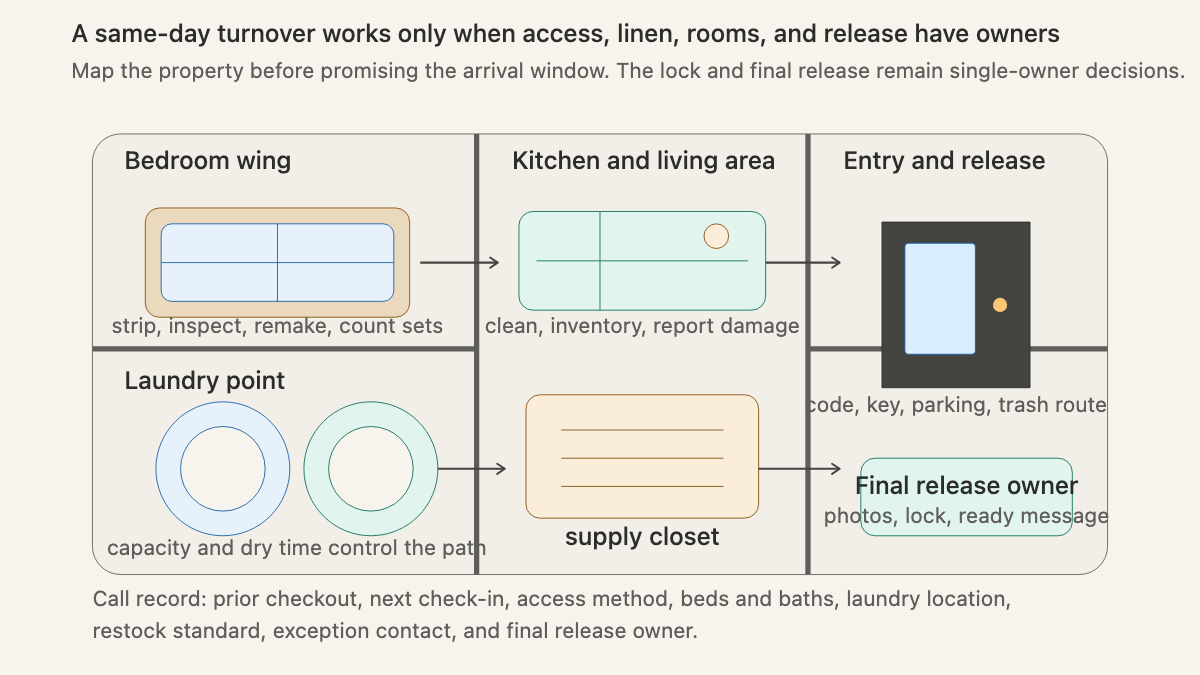
The floor plan makes a scheduling point that a room checklist misses. Beds, kitchen work, inventory, and entry reset may proceed in parallel, but the property cannot be released until the assigned inspector confirms the whole house, secures access, and reports readiness.
Test the linen route before promising the slot
Laundry often controls the finish time because washing, drying, folding, and remaking beds form a chain. Ask how many complete bed and bath sets the property requires at full occupancy. Then ask how many clean sets are already staged, where used linen goes, whether machines are on site, and who owns off-site laundry.
Do not invent a universal cycle time. Machine size, textiles, label instructions, load size, soil, utility performance, and drying method vary. Count capacity in complete sets. If the property needs three bed sets and twelve bath towels but starts with one clean set, the office needs a feasible route for the rest before it accepts the release time.
CDC's home cleaning guidance advises laundering with detergent at the recommended water temperature and drying items completely. It also directs readers to manufacturer instructions for washable soft surfaces. Those details belong in the property's linen standard. The booking agent should not improvise hotter settings, chemical mixtures, or fabric treatments over the phone.
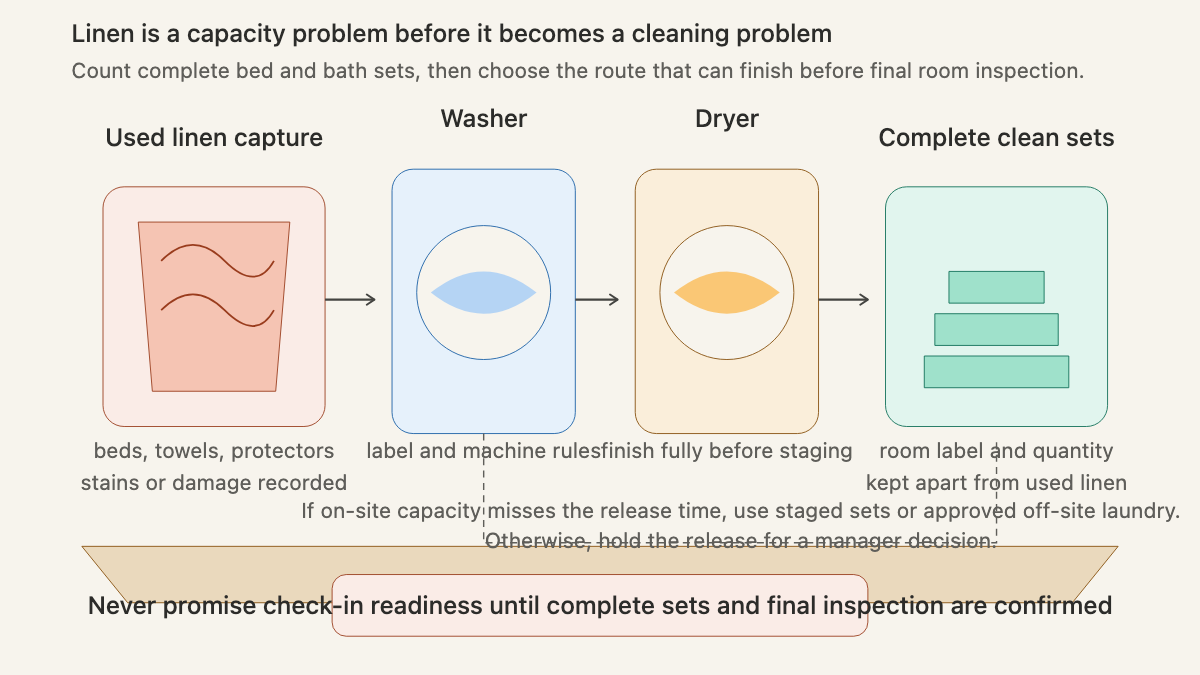
Keep used and clean linen physically distinct. Record stains or damage before processing when the company's policy requires it. Label staged sets by room when bed sizes differ. A clean fitted sheet for the wrong mattress does not complete the room.
The office also needs a failure path. If the dryer stops, a load is still damp, or clean stock is short, who may authorize a linen service, open backup storage, delay release, or contact the host? Put that name in the job before the crew starts.
Turn restocking into a written standard
“Restock the basics” creates arguments. Ask the host for the item, approved brand or specification when it matters, quantity, storage location, reorder point, and person who approves substitutions. Toilet paper, paper towels, coffee, dish supplies, trash liners, toiletries, firewood, propane, and pet items should not be treated as one generic supply category.
Clarify ownership. Some cleaners count and place host-owned stock. Others purchase approved items. A property manager may replenish a locked closet. The job record should say who buys, who pays, who receives delivery, and what the cleaner does when stock is below the standard.
Avoid silent substitutions. If the listed coffee, crib sheet, detergent, or amenity is missing, the cleaner should report it through the agreed channel. The host or manager decides whether a substitute is acceptable. This also protects the cleaning crew from making promises about listing amenities.
Photographs can close the loop when they are specific: supply shelf before restocking, shelf after restocking, damaged item in context, locked entry, and final wide room views. Set a retention and privacy policy. Completion photos should not capture passports, medication labels, payment cards, private messages, or other guest information.
Keep cleaning, sanitizing, and disinfecting distinct
A caller may use these words as if they mean the same service. CDC defines cleaning as removing germs, dirt, and impurities with soap, water, and scrubbing. Sanitizing reduces germs to levels set by public-health codes or regulations. Disinfecting uses chemicals to kill most germs on surfaces and objects. CDC advises cleaning before sanitizing or disinfecting.
The office should capture the requested outcome and the surfaces involved, then follow the company's approved products, labels, training, and local requirements. Never promise a special health outcome from a generic turnover clean. CDC also warns against mixing products and says users should follow label directions, including contact time and protective-equipment guidance.
Worker safety remains part of the scope. OSHA's cleaning-industry hazard resources cover cleaning chemicals, electricity, ergonomics, falls, and other hazards. Route needles, unknown chemicals, exposed wiring, unstable stairs, active leaks, pest hazards, or unsafe appliances to the responsible manager. The next reservation does not erase the hazard.
Assign one person to release the property
The final inspector should compare the house with the written property standard, not memory. Confirm beds and towels, bathrooms, kitchen, floors, trash, supplies, guest-access areas, required amenities, thermostat or equipment settings assigned to the cleaner, doors and windows, damage notes, and completion photos. Then lock the property and send the ready message through the approved channel.
This role can belong to a lead cleaner, inspector, or property manager. It should not belong to “whoever finishes last.” One person needs authority to hold the release when linen is incomplete, damage is unresolved, access fails, or a safety issue remains.
For an empty property that is changing occupants on a longer timetable, use the move-in cleaning intake guide. For routine residential service where the central decision is weekly, biweekly, or monthly cadence, use the recurring cleaning frequency guide.
Read the turnover record back before ending the call: “Prior checkout is 10 a.m. Cleaner access begins after the manager confirms vacancy. Final inspection is due at 3:15 for a 4 p.m. guest code. Two queen sets and eight bath sets are required; one complete backup set is staged. The cleaner counts the written supply list but does not buy substitutions without approval. Casey owns guest-left exceptions and sends the ready message after inspection and lock check.”
An AI receptionist can capture this record after hours. The cleaning company still decides whether the window, crew, products, and exception plan are acceptable. When the phone note names the property, linen route, restock rule, and release owner, the crew starts with a real turnover plan instead of a bedroom count and a deadline.