
A renter calls at 4:40 on Thursday. The movers leave Saturday morning, the landlord walks through the apartment Sunday, and the keys are due that afternoon. She asks for “a full move-out clean” but still has food in the refrigerator, a sofa in the living room, and no idea whether the lease requires the oven interior.
Do not book that as a standard deep clean.
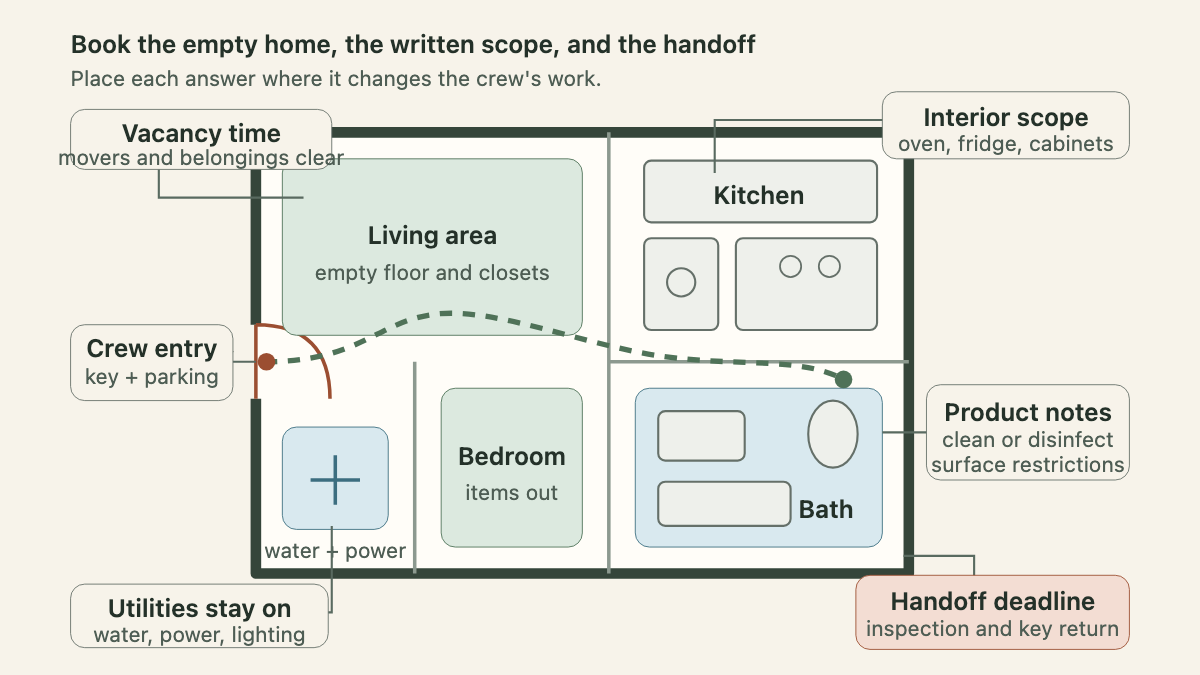
A useful move-out cleaning call confirms when the home will be empty, what the lease or property handoff requires, which appliance and cabinet interiors are included, whether water and electricity will remain on, how the crew will enter, and the exact inspection or key-return deadline. Room count matters. The handoff controls the job.
Start with the handoff, not a generic deep-clean list
Ask who ordered the service and what happens after it. A tenant preparing for an inspection, a homeowner closing a sale, and a property manager turning a unit may use the same phrase while expecting different work.
Record the final event by name: landlord walkthrough, buyer possession, listing photos, property-manager inspection, or key return. Get the date and time. Then ask whether the caller has a lease checklist, management-company scope, sales agreement note, or written cleaning standard. Request a copy before the quote is finalized.
HUD's move-in and move-out inspection form shows why this matters. The form documents condition room by room, including floors, walls, windows, lighting, cabinets, appliances, plumbing fixtures, doors, and locks. It is an inspection record, not a universal cleaning specification. A local lease or property manager may use a different form.
Never promise that cleaning will secure a security-deposit refund. The cleaning company controls its written scope and workmanship. It does not control a landlord's inspection, pre-existing damage, lease terms, or local law.
Establish when the home will actually be empty
“Move-out date” can mean the truck arrives, the last box leaves, the cleaner enters, or the tenant returns the keys. Put each event on the schedule.
Ask when movers finish and whether any furniture, boxes, food, trash, or personal property will remain. A nearly empty room is still blocked if the crew must work around a mattress, decide what belongs in the trash, or wait while movers carry furniture through a wet floor. Confirm who removes leftover items and whether the cleaning company offers hauling. Do not let the crew make disposal decisions at the door.
The American Cleaning Institute moving checklist tells movers to remove trash, clear the refrigerator, cabinets, and closets, and avoid leaving personal furniture or belongings behind. That is sound appointment preparation. It does not mean a cleaner should discard anything without authorization.
Ask about other trades too. Painters, carpet installers, repair technicians, and movers can add dust, block rooms, or undo finished work. If another crew stays on site, define the sequence. Cleaning usually belongs after dusty repairs and before the final inspection, with enough time left for a walkthrough and any agreed touch-up.
Define the room-by-room scope before quoting
Bedroom and bathroom counts give the office a starting point. They do not reveal the work inside an empty kitchen.
Capture the property type, approximate size, number of levels, bedrooms, bathrooms, kitchens, utility rooms, finished basements, garages, balconies, and enclosed porches. Ask whether the property is furnished, partly empty, or fully empty at crew arrival. Then go room by room and name the surfaces that change the estimate.
For the kitchen, confirm the inside and outside of the oven, refrigerator, freezer, microwave, dishwasher, cabinets, drawers, pantry, and range hood. Ask whether the refrigerator will be emptied and whether the freezer needs defrosting. Confirm whether appliances stay with the property. An unplugged refrigerator with a closed door creates a different preparation problem than a working, empty appliance.
For bathrooms, record the number and condition of tubs, showers, glass enclosures, grout, vanities, cabinets, mirrors, and fixtures. In living areas and bedrooms, ask about baseboards, closet interiors, interior windows, blinds, wall marks, ceiling fans, and carpet treatment. “Windows included” needs a boundary: interior glass, tracks, screens, exterior glass, and high windows are separate tasks for many companies.
The ACI checklist includes kitchen surfaces, cabinets, sinks, appliances, bathrooms, floors, handles, switches, closets, and trash. Use it as a prompt, then write the company's actual inclusions and exclusions. Do not imply that every move-out package contains every item on a consumer checklist.
A caller who still occupies the home may need a first-time deep-cleaning estimate. A customer entering an empty property has a different sequence covered in move-in cleaning booking calls. Keep those intents separate in the schedule and on the work order.
Keep cleaning, disinfection, repairs, and hauling separate
Callers often combine several needs into “clean everything.” Split them before assigning a crew.
Routine cleaning removes soil and residue. Disinfection is a separate treatment with product-specific directions and contact times. The ACI guide to levels of cleaning makes that distinction and tells users to follow each product's label. If the caller requests disinfection, ask which surfaces concern them, why they are requesting it, whether anyone has product sensitivities, and whether the service offered by the company fits the request.
EPA's Safer Choice label helps consumers and commercial buyers identify products that meet the program's criteria for ingredients and performance. A preference for Safer Choice products is useful intake information. The label does not replace the directions for the selected product or make it suitable for every surface.
Separate ordinary cleaning from carpet extraction, exterior window work, wall washing, paint repair, junk hauling, pest residue, bodily fluids, sewage, needles, chemicals, mold, asbestos concerns, and heavy construction debris. Some companies offer part of that work under a separate quote. Others should route it to a qualified specialist. The call taker should record what the customer reports and avoid diagnosing an unknown material over the phone.
Confirm utilities, entry, parking, and key return
A crew cannot clean an oven in a dark apartment with the water shut off. Ask whether electricity, water, hot water, lighting, and climate control will operate for the whole appointment. Get the shutoff date if utilities are scheduled for transfer.
The entry plan needs a named person. Record whether the crew will meet the tenant, use a lockbox, collect a key, check in with a leasing office, or receive smart-lock access. Keep codes and key instructions in the company's approved secure system, not loose notes. Ask about alarm procedures, building hours, elevator reservations, loading zones, parking permits, gate access, stairs, and the distance from parking to the unit.
The practical move-out cleaning guide from True Cleaning also calls out belongings, utilities, parking, access, and the inspection or handoff deadline. Those facts belong in the booking record because each can stop the job even when the cleaning scope is clear.
Build a buffer between planned completion and the external deadline. Do not advertise a fixed buffer that ignores the property. A small empty apartment with direct access has a different risk profile than a three-story house where movers leave late and the landlord arrives that evening. The office should see the collision before accepting the slot.
Leave dispatch a record the crew can use
The finished work order should state the service address, property type and size, vacancy time, room counts, condition notes, written checklist received, included interiors, exclusions, product restrictions, remaining belongings, utility status, entry method, parking, on-site contact, completion window, inspection time, key-return time, and who may approve extra work.
A useful note sounds like this:
“Two-bedroom, two-bath apartment on third floor. Movers scheduled out by 10 a.m. Saturday; cleaning entry at noon only after tenant confirms unit is empty. Management checklist attached. Oven, empty refrigerator, cabinet interiors, closets, baseboards, and interior window glass included. Carpet extraction and wall repair excluded. Tenant removes all food, trash, and balcony items. Water, hot water, electricity, and air conditioning confirmed through Sunday. Loading-zone parking requires leasing-office pass; elevator reserved noon to 4 p.m. Key in office envelope under tenant name. Tenant walkthrough requested after crew completion. Landlord inspection Sunday at 11 a.m.; keys due to office by 2 p.m. Any added work requires tenant approval before service.”
Read back the vacancy time, major inclusions, exclusions, entry plan, utilities, and deadline. Send the written scope through the company's normal confirmation channel. If the home is still occupied, photos show a materially different condition, or the movers run late, reopen the schedule instead of forcing the crew to absorb a changed job.
An AI receptionist can collect these fields after hours and flag conflicts for review. The cleaning company still decides whether the scope, condition, access, and deadline fit the slot. That decision should happen before a crew stands outside with a locked door and the inspection clock already running.