A homeowner calls and says, “The yard is covered. Can you clean it up Friday?” The address shows a quarter-acre lot, but that tells the office very little. Three mature maples may be dropping into a fenced backyard, leaves may be packed wet against the house, and the town may collect only loose curb piles on Tuesday.
A useful leaf cleanup booking call confirms the service area, tree cover, current leaf depth, lawns and hard surfaces, beds that should remain undisturbed, access, moisture, the expected finish, and the approved destination for collected material. It also asks whether the customer wants one visit now or a staged cleanup while more leaves are still falling.
Lot size matters. Tree cover and disposal usually matter more.
Describe the property before estimating the leaves
Start with the areas included in the request. Ask whether the customer wants the front, side, and rear yards cleared. Name patios, decks, driveways, walkways, basement stairs, window wells, parking pads, playground surfaces, and fenced runs separately. “Whole property” often means “everything I can see from the street” until the crew discovers a leaf-filled side passage.
Record the lot size when the caller knows it, but do not treat the tax-lot area as the cleanable lawn. The house, driveway, garage, pool, woods, and planted beds may occupy much of that number. Ask for a rough lawn area under company policy or request wide photos from the front and back corners. Aerial imagery can help with layout, though tree canopy may hide gates and surfaces.
Then ask about trees. How many mature trees stand on or next to the property? Are they spread through the yard or concentrated over one section? Do neighboring trees drop across a fence? Has most of the canopy finished dropping, or are branches still full?
A property with one ornamental tree and open turf is a different visit from a shaded backyard beneath oaks and maples. The office does not need a botanical inventory. It needs a picture of where leaves accumulate and whether another heavy drop is likely after the appointment.
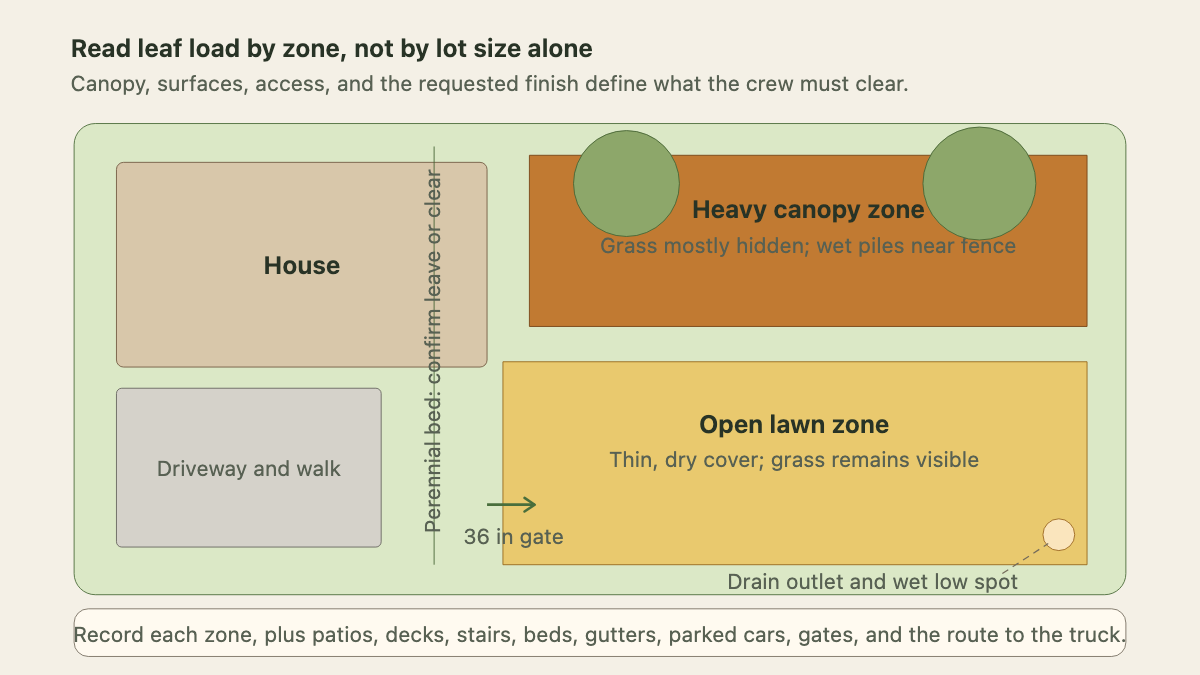
Record leaf load by zone
“Ankle deep” sounds specific until the caller is standing in a drift beside a fence while most of the lawn is nearly clear. Record depth by area and ask what remains visible.
Useful descriptions include “grass visible through a thin dry layer in front,” “grass fully covered below two backyard trees,” “wet pile against the north fence,” and “driveway clear except along the garage.” Ask whether the leaves are dry and loose, damp, or matted. Wet leaves handle differently, add weight, and can conceal edging, drains, branches, toys, or animal waste.
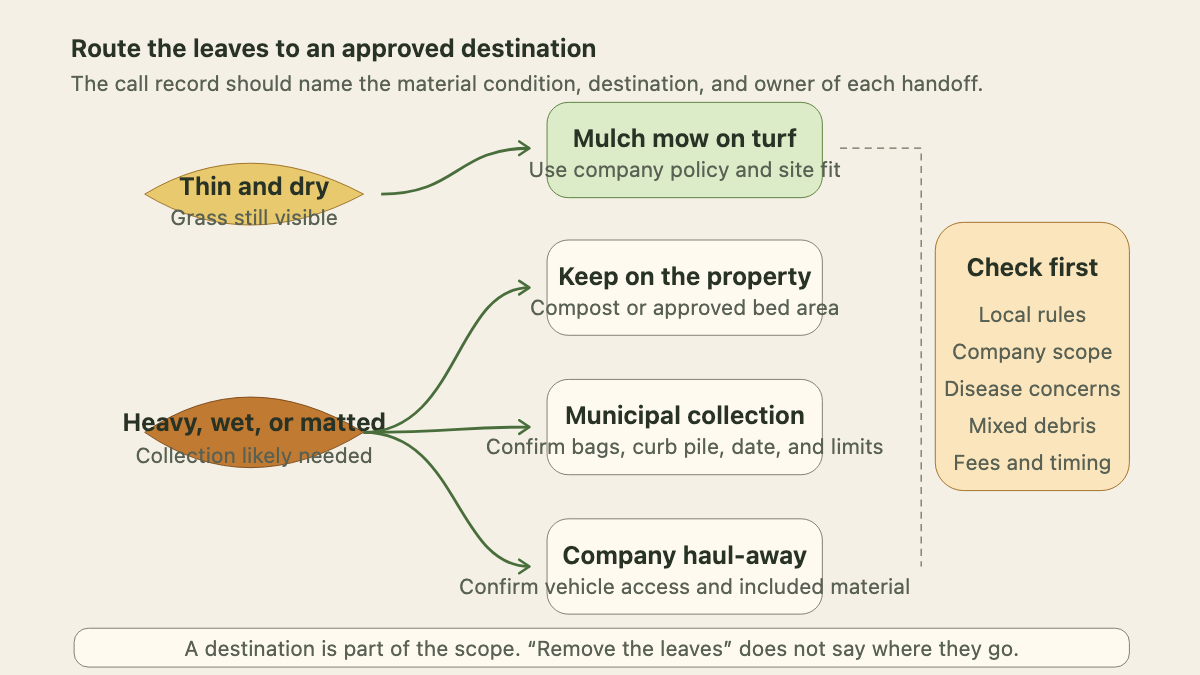
Iowa State University Extension advises managing a layer that leaves little or no grass visible. Its guidance says leaves can be collected, composted, moved to suitable garden areas, or chopped finely with a mower. For mulch mowing, the pieces should settle between grass blades and very little leaf debris should remain visible.
Colorado State University Extension also ties mulch mowing to a manageable layer and notes that dry leaves work better than wet ones. This gives the office a clean boundary: do not promise mulch mowing because a customer requests it. Record the condition and let company policy and the crew determine whether it fits.
Photos should show scale. Ask for one wide image of each service zone, then one image of the heaviest accumulation. A close shot of brown leaves fills the frame but says nothing about acreage, access, or the distance to the truck.
Separate lawns, beds, and hard surfaces
The finish needs to be stated by surface. A caller may want the lawn cleared, leaves removed from gravel, the front walk blown clean, and the perennial beds left alone. Another customer may want every bed cleaned to bare mulch. Those are different scopes.
Iowa State’s guidance explains why blanket cleanup can be a poor instruction. Leaves in perennial and shrub beds can offer winter protection and habitat, while a heavy layer on turf can block light. Diseased or pest-affected plant material may need removal and separate handling. Office staff should record what the caller reports without diagnosing a tree or plant problem.
Ask these questions in plain language:
- Which lawn sections, beds, hard surfaces, drains, stairs, and window wells are included?
- Should healthy leaves remain in any naturalized or planted area?
- Are there fruit, sticks, pinecones, acorns, pet waste, trash, or old yard debris mixed in?
- Has the customer noticed diseased leaves or pest-damaged plant material that needs review?
- Are gutters, roofs, street drains, pools, and pond surfaces excluded or part of a separate service?
- What does “finished” mean: turf visible, hard surfaces blown clean, beds lightly cleared, or a company-defined standard?
Mixed material deserves its own note. A leaf pile containing branches, soil, stones, plastic bags, pumpkins, or household trash may not fit the company’s normal leaf process or the destination’s acceptance rules.
Put gates, slopes, and the travel path in the work order
Leaf cleanup is a material-moving job. Ask how the crew and equipment reach every zone, then follow the debris route back out.
Record gate width, steps, steep slopes, retaining walls, narrow side passages, soft ground, low branches, parked vehicles, and locked access. Note fences that catch large drifts. If bags or tarps must travel through a finished courtyard, across a pool deck, or up exterior stairs, the crew should know before arrival.
Ask where the truck and trailer can park. Municipal parking restrictions, school pickup traffic, one-way streets, long shared drives, and condo loading rules can shape the appointment. For commercial properties, identify the site contact and the hours when entrances or sidewalks must remain open.
Wet conditions can change the route even when the leaves themselves are manageable. A low backyard may be too soft for equipment after rain. A drain buried under leaves may need careful clearing. The call handler should flag the condition and avoid promising that every section can be completed on the scheduled day.
Choose the disposal path before scheduling
“Take it all away” is incomplete. The booking record should say where the leaves are expected to go and which party owns the handoff.
The practical destinations are on-site mulch mowing, an on-site compost or approved bed area, municipal collection, or company haul-away. Each needs a different confirmation. On-site placement needs an agreed location and acceptable material. Municipal collection needs the town’s current rules for bags, loose piles, curb position, dates, and quantity limits. Company haul-away needs vehicle access, accepted material, and any written fee policy.
The U.S. Environmental Protection Agency includes leaves within yard trimmings alongside grass, tree, and brush material. Its national material-flow data does not tell a contractor what a specific city, compost facility, or transfer station accepts. Verify the rule that applies at the service address.
If the request is mainly to haul an existing pile that somebody else created, it may belong under yard-waste haul-away intake. A cleanup visit includes gathering material across the property. A haul-away visit starts with material already staged. Keeping those intents separate prevents a small pickup ticket from hiding hours of raking and blowing.
Set timing around continued leaf drop
Ask why the customer chose this week. They may have a municipal pickup date, a property showing, a holiday gathering, a final mowing, or a safety concern on wet steps. Record the reason because it defines the useful completion date.
Then ask how much canopy remains. A one-time cleanup while half the leaves are still on the trees can look unfinished two days later even when the crew met the written scope. Offer only the scheduling patterns the company actually supports: one early visit plus a final cleanup, recurring seasonal visits, or a single visit after the main drop.
Weather belongs in the confirmation. Wind can move leaves across property lines while the crew works. Rain can mat them against turf and hard surfaces. State who decides whether conditions allow the work, how delays are communicated, and whether the appointment can be split by zone.
Avoid a timeless promise such as “all leaves removed.” A better completion standard names the areas and the moment: lawn turf visible at departure, listed hard surfaces blown clean, designated beds left undisturbed, and collected material placed at the approved destination. New leaves can fall after that.
Read back a crew-ready leaf cleanup note
A strong read-back sounds like this:
“Front and fenced rear yard included. Customer estimates about 7,000 square feet of lawn, with two mature maples over the rear half. Front has a thin dry layer with grass visible. Rear turf is mostly covered, with one wet drift along the north fence. Clear the lawn, driveway, front walk, patio, and basement stairs. Leave the perennial bed beside the garage undisturbed. Access is through a 40-inch side gate with three steps. No gutter work. Company haul-away requested under the written scope; sticks larger than the accepted size and mixed trash are excluded. Customer wants one visit before a Saturday property showing, though leaves remain on both maples.”
Confirm the appointment type, arrival window, parking notes, photo-submission method, weather policy, disposal terms, and any items awaiting review. Link this ticket to the broader landscaping resource library when the request also includes mowing, pruning, drainage, or recurring grounds work.
An AI receptionist can collect the same zones, leaf conditions, access details, timing, and disposal choice after hours if it follows the landscaper’s real service boundaries. On Friday morning, the crew should know which gate opens, which bed stays untouched, where the wet pile sits, and exactly where the last tarp of leaves is supposed to go.